"There is nothing more pleasant than cruising on a boat with the whole family."
Letter from Empress Catherine the Great

Thursday, November 6, 2014

Nov 1 - 5 -- zero miles -- Five More Laydays in Oriental

We end up spending eight nights here. That's the way it is in shipyards. It takes longer and costs more than expected.  Deaton's however, is a very fine yard. Small but bustling with activity, with friendly competent and helpful staff, free electric which we used to warm the boat through our heat exchanger on the cold nights, and a small lounge with a washer dryer $3.50 per load), good shower, TV and a small desk and sofa. We really became friends with the staff who all cheered the news when Witty was found. John Deaton and his wife, Karen have owned and operated the place with service manager and master teacher Greg, their son Steve, Rita, who was the most helpful about Witty and maybe about 20 -30 other folks.  We had business and they let us fax letters and photocopy others -- no charge.
And despite the gloom of Witty's potential demise, or perhaps because of it (and after his return) work on the boat (and life) went on.
Our friends, Bill and Sando,
saw how ratty looking our small jib sheet had become and gave us a new one, from his old Saga, which had been offered for sale in a consignment store. A very valuable gift. I whipped its new ends when I cut it into two pieces to serve as the sheet and as a line to better secure the dink. Bill also taught me a better placement for the shackle at the clew of the sheet and Lene helped me pull the new line through its under the deck channel with a snake.
 I saw that Oriental has a dealer for AB Inflatable dinghys and scored a valve cover for ours and I used electrical tape to enlarge the washer and thereby make a better fit for the air pump nozzle to inflate our dink. I tried to change the zinc in the refrigerator unit but needed the yards help when the old zinc twisted off in its holder (a new brass holder at $7.50 was a lot cheaper than the labor needed to melt the zinc out of the old one). Lene ordered the electronic versions of Waterways Cruising Guides to the Intercoastal by Mark Doyle. I polished and waxed the stainless steel of the bowsprit and bow pulpit and cleaned out the bilge. This in addition to overseeing/assisting the yard's workers who hauled the boat two more times, replaced the lip of the Strong Seal (dripless stuffing box) in an attempt to stop the leak, aligned the prop shaft with the engine by shifting the engine on its mounts, and took ILENE out for a test drive which shows that we have good alignment --but we still have a leak, The cause this time is believed to be a distorted plastic disc bolted with four bolts to the transmission and four more to the shaft. It is plastic so it will shatter to prevent harm to the transmission if we hit something. Our choices were to get a replacement disc, or one of steel to take up the space, or get a new longer propeller shaft so no such spacer would be needed. We chose option A, and it is being sent to friends in Florida for me to try to install there.

But it was not all boat work and Witty worry. We had a tour of Bill and Sando's big new 45 foot dual engine DeFever trawler, named Lucille, like her predecessor, their Saga.
.
Bill loves that it has easy access at dock level from the stern, does not have an open fly bridge (which he would not use), and has wide, safe, covered, exterior passageways. He is a perfectionist about his boats, keeping them pristine and making many improvements for comfort, safety and convenience. A minor example of these is the port side rear view mirror shown in the first photograph. M/V Lucille was in Maine this past summer and we hope to join Bill and Sando there in the summer of  '16. I continue to very much admire Bill's gentle, intelligent advice over the years and Lene says he has the best sense of humor.  He prefers to make longer off-shore passages to get to the desired cruising grounds more quickly, a very useful philosophy as we head south trying to get where it is warm before it gets too cold up here after a delay of a week.
Then, we had drinks and snacks at their lovely spacious modern home, raised about five feet above their lawn, which reaches to to the seawall,
which in turn is five feet more above sea level, with a commanding view of the Neuse River and all the boats that necessarily traverse it on the ICW. All told we enjoyed three dinners out with them, at half the local eateries, "M and Ms," "The Silos" which is built in two connected silos and "Toucan", and two breakfasts with them aboard ILENE.

And I played with the blog and determined that on the ten separate days that we made passages in October since we left Annapolis on October 12, we totaled 351 miles -- compared to the 268 we made in less than 48 hours from the Harlem to Annapolis on October 8-10. We went shopping for groceries several times and took Witty to the vet. Lene has a cold and visited a local emergency medical place and the Walmart's pharmacy. I try to not patronize Walmart whose owners get rich by paying their staff so little that we taxpayers subsidize them through food stamps etc.  But here we shopped at their store which was one of the places that put up a the lost kitty poster.

People in Orient are friendly and honest. The Yard leaves the keys to two of its old vehicles with a signup sheet for use by residents. I put some gas in the tank. I asked the man in the chandlery if I could return the valve cover if it didn't fit. He said: "Don't pay me now: come back and pay me if it fits". When I took our propane tank for a refill, the hardware store man said it was a flat service fee for filling, that the tank seemed 3/4 full and he couldn't charge me $12 for only $3 worth of gas. While walking around on the afternoon after the big storm, I saw folks gathering pecans that had fallen off of trees during the storm. Later I stooped to pick one up and Lee gave me a bag of them from her tree and invited me into her house to meet her husband Billy and their family, who were eating their dinner. They relocated here about a month ago from Orange County, NY. See, it doesn't take long here for the friendliness habit to set in.

I visited the Oriental Historical Museum and took most of one of their walking tours, past the town's historic houses. Oriental was a poor town founded in the late 1870s by hard working fishermen and farmers. This house, with its metal roof, like many of them, was the home of a prominent citizen in its day and is still very well maintained.
Mr. Midyette was the founder. When the post office was established here in the 1870s a name was needed. Mrs. Midyette thought of the steamer "Oriental," which had been wrecked (without loss of life) while carrying people and property for the US government during the Civil War in 1862. This wreck was on the outer banks, about 30 miles from here but Mrs. Midyette suggested the name and it has been so ever since. The name gives rise to the Asian theme including dragons. Here is a view from the middle of Broad Street, also known as Route 55, the main drag, looking west.
 I took a shot looking the other way, which was equally devoid of activity. You can get the idea that traffic jams are the not a big problem in this town. I did not get the full picture when I asked about population. The lovely, dedicated and knowledgeable volunteer at the museum told me it was 750. The Census Bureau reported 900 in 2010. But I'm thinking both omitted the people who live in newer larger homes outside, but have Oriental mailing addresses, such as our friends, Bill and Sando. The town still has fishing but its farming gave way to lumber mills which were located where the public dock is now and from which I took this picture of the 1970's era bridge, which replaced the very much narrower wooden bridge of the depression era.
There are several  marinas on this side, the upstream side of the bridge, but not for us, because the bridge height is 55 feet.
 After the mills were shuttered the town was rescued by the boating community. 2700 boats is a lot of boats for what is still a very small town. I believe that much of the money in town nowadays comes from folks who retire here to live with their boats in a moderately warm place.
We plan to stop here again on our return trip back home.

Tuesday, November 4, 2014

Breaking News: Witty the Kitty Is BAACK!!

Approximately four days after his sudden disappearance, Lene was walking the 150 yards to the shipyard's shower/head/lounge when she heard a cat sound. Not the loud yowl Witty is capable of, nor the weak mewl either -- but a cat sound. I got our strong flashlight and we saw what seemed like an orange cat running along a low "catwalk" at the near side of the big building that houses the yard's repair shops and parts department. This is 200 feet from us by the docks or 100 as the crow flies.
From bow of ILENE you turn left, right and then right before getting to the right corner of the big building.
I had walked this catwalk


and my had leg crashed through the plywood decking when I put my foot on a spot that was not directly over one of the horizontal 2 x 4s that  support it.
This had been a few days before, during one of my many expeditions shaking Witty's plastic box of treats. Lene ran back to get the treat box and we made our way to the back of the big beehive of bustling activity, now quiet for the night.
Fifteen feet behind it, hidden in woods that have encroached it, is a decaying one room structure (seen at the left in the photo above) under which Witty had apparently found shelter.

He was skittish or fearful and of two minds whether he wanted to be brought back into domesticity/captivity. But eventually his desire for food won out and he approached Lene and after giving him a hand full of food she grabbed him and I carried him back to the boat where we could see him better in the light.
He really looked none the worse for wear, his coat clean and not infested with brambles, though in need of a brushing. No apparent wounds or loss of weight. Alfie, normally diffident toward him as well as toward us, licked him lovingly. We gave him a big portion of food, though not too much because he regurgitates when he wolfs down too much.
Lene is elated!
 The gloom of mourning that had settled over our expedition is vanished.  We are both so happy to have him back,  though he seems to be eyeing the companionway as if he enjoyed his four days of freedom.
We have been notifying all the folks who gave advice and support that the search is successfully concluded. How many of his nine lives are left?

Saturday, November 1, 2014

October 28 - 31 -- 35.3 Miles -- Slade Creek to Deaton Yacht Service in Whittaker Creek, Oriental and Three Laydays There, So Far And a Possible Tragedy

The passage to Oriental was on the fourth or fifth consecutive virtually windless day, a day power boaters love because of flat seas. We did put up the genoa today, and got a couple of knots from it, but for only about six miles. Then, entering the wide Neuse River, we tacked and were preparing to put the sail out on the starboard side but the wind died again.
We were originally headed for River Dunes Marina, lovely with good restaurant and clubhouse and inexpensive ($1.50/foot) especially at half that rate with the two nights for the price of one special that they gave us at the boat show. We were there with our friends, former Saga 43 owners Bill and Sando, who we met in Maine in '07, in the Caribbean in '10 and at River Dunes in '12. They live in Oriental.

But it appears that the damage I did to the wind instrument in the Dismal Swamp Canal was greater than I had thought -- I broke the instrument at the top of the mast. Also, while investigating the reverse gear problem (we do have reverse gear but it rattles loudly, especially until it comes up in speed) I discovered a small leak in the Strong Seal dripless stuffing box.  The manual says this is harmless but ....?  So we asked Bill, who recommended  Deaton's Shipyard on Whittaker Creek. They said they could do our work and that dockage at their dock while they do it would be free and save us the cost of their technicians' travel time from Whittaker Creek to River Dunes. So River Dunes can be on the return trip. Entry to this creek was tricky due to shallow water; our depth meter, set to warn us if it gets shallower than 7.1 feet, was beeping. We were advised to follow the buoys -- not the chart -- and to favor the right side of the channel. Lene brought us in without incident.

We dined aboard our first night and Bill and Sando came over for a mango pancake breakfast next morning, after this sunrise.
They sold their Saga and now have a 45' foot DeFever trawler , which we hope to see before we leave.


The mechanic used a cherry picker to remove the old broken wind measuring device, protruding forward at the top of the mast.


Here is the shiny new unit above the old broken one.
We were moved twice to different docks during the first full day while the Yard was estimating the
labor costs of the propeller and seal repairs. The propeller, a very good Max Prop, sounds bad and our choices include sending it off to California to be repaired, which means staying here for three weeks or getting something to replace it and having it sent back to us in Florida after refurbishment and using it as a spare until the next time we are hauled out and it can be reinstalled. And the choices for a potential spare/replacement include solid bronze, feathering bronze or a very hard feathering plastic, at prices that vary from hundreds to thousands of dollars, for the propeller alone. It is making our heads spin with all the choices and the pros and cons of each.
Dinner at one of the local restaurants (Shrimp and Grits) with Bill and Sando after a day in which Lene used the yard's truck to get beauty treatments and we did the laundry.

The next day we had a "short haul" to permit an actual look at the prop. Such good news! The propeller is fine; it is the Spurs brand line cutter that was making the noise. It sits around the prop shaft forward of the prop and includes rotating blades attached to the shaft and a fixed blade that does not rotate. These act as scissors to cut lines.  But in our snagging and cutting crab pot lines, the Spurs unit had been pulled aft along the shaft so that the fixed part was no longer held fixed but spinning and knocking, especially when reverse gear pushed water against it.The shiny bronze band in the picture below is the forward end of the propeller (sadly with the bottom paint not adhering well). Just to the left of it in the picture is the Spurs unit, which should be about half an inch away from the propeller so that its forward end is held in place;  shown here with the rotating blades on top and bottom.
A very quick and easy repair including re-lubrication of the prop and installation of three new zincs to replace ones I had installed in the spring, which were rather corroded away.


The engine purred like certain other critters aboard when I drove the boat back to a slip. What a relief!
But later that evening, between eight and nine, a possible tragedy struck. Alfie came home from one of her exploratory jaunts but Whitty did not.

We searched far and wide for him that night and the next morning, shaking a plastic jar of his treats and calling his name.  There is no tidal current and there was very little wind that evening so if he fell in he could have swam to shore and would not have been washed out to sea. The people at Deaton's and the surrounding neighborhood have been extremely helpful. We called the sheriff's office and both of the local vets. They posted a message on the town net and made up color posters that they told us to post in the three most highly trafficked shops in town. When we wander about calling Whity's name, folks come out of their homes to tell us that they are looking for him and praying for us. Due to repairs to the stuffing tube, we will be here until Wednesday and will rent a car and come back if he is found after we leave.  The worrisome part is that several people have told us that they lost pets to a certain fox who makes his home here. We have not given up hope and Lene cries occasionally but she's hanging tough. I'm not a crier; maybe I'd be better off if I could. Whity's sister, Alfie, seems unusually cuddly and needy. She wants to be close to Lene and is not eating well. We have done everything we can think of since he did not come home and now have to trust in his and our higher power.
It is sort of analogous, in a lesser way, to being the loved ones of a MIA. We can't mourn because he may be alive but as time passes, hopes fray. He may have been taken in by someone who will turn him in later. Here is the coffee mug I use every day, which Lene bought in Martinique in 2011. We always feared, though we adopted a sort of fatalistic attitude, the possibility of loss to the sea. I never considered loss of our cats on terra firma.

Monday, October 27, 2014

October 26 and 27 -- Elizabeth City to Deep Point to Slade Creek -- 43.5 and 33 NM, Respectively

From Eliz. City we got a late, 11 A.M. start, due to marketing.  It was mostly motoring but we put up the genoa three times for about half of the passage, once even turning off the motor. We arrived at the anchorage after the sun had set, but before it got dark. Our route was to continue down the Pasquotank River, traverse Albemarle Sound and go south (up) the Alligator River to a place off Deep Point which is deep enough to anchor, moderately protected from potential winds, outside the ICW channel and reachable before dark. The little white space to the left of the word "River" in the upper right quadrant of this chart segment hit the spot. It is 2/3 of a mile long and about 700 feet wide at its widest spot.
There are about 8 boats here. We are in 11 feet of water with 60 feet of chain out. We have a potential problem because when we tried to use reverse gear to set the anchor, we heard only strange sounds. So we laid out sixty feet of chain, which, with the weight of the anchor, held us in place all night in very gentle air. If we had dragged, there was a lot of room behind us toward the channel in which the anchor, hopefully would have caught. No internet access here. Dinner, card games (Lene almost always wins), reading and in the morning we emptied the aft compartment so I could take a look at the "no reverse gear" problem. I saw how, by disconnecting the end of the cable from the shift lever at the helm, one could manually shift the boat at the engine itself. And while we had access, I added distilled water to those of the cells of the batteries that looked like they could use a few sips.
Among the boats here were "Whisper," who we met in Elizabeth City, and their buddy boat "Piper."
In fact, two of the three adorable kids who played with Witty belong to Piper, not Whisper. We accompanied them most of the next day, toward Slade Creek through the Alligator-Pungo Canal and somewhat down the Pungo River, but they had elected to go elsewhere the second day.
The AP canal is quite a bit wider and almost twice as deep as the Great Dismal Swamp Canal.
Our only scary moment was crossing under the Wilkerson Bridge, near its southern end; unlike all the other fixed bridges over the ICW, which are 65 feet high, this one got short changed and is only 64 feet high -- and we are 63.5 feet high!
Slade Creek is wide and over a mile long. We got here first, at about 2:30 after a totally motoring day, and anchored in the first bend after entry, where the wind protection was good, in eight feet of water and were later joined by two other boats. There is lots of room here.

Then chores: I dove into the brownish, tannin dyed water and cut several lengths of line from around our propeller, but the boat still makes a chattering noise in reverse. We will get this checked out in Oriental, our next stop. (Also the harvesting of leaves in the Great Dismal Swamp Canal whacked our wind speed and direction instruments making them even more in need of calibration.)  I went up the mast to reattach the halyard for the Harlem Yacht Club burgee because the halyard had worn through in the strong winds in Yorktown, completed the wiring of our two million candlepower flashlight for finding buoys at night, hung a picture, fixed a cabinet and organized our cabinets. This last in the course of looking for the two white LED interior lights that we replaced with red ones to preserve night vision. Lene does not like living in a red light district. But we have not found the white ones yet.
The problem here is flies, lots of them. Lene killed about a hundred that had invaded ILENE. She is fully screened but they got in while we were underway and the companionway was open.
Also Alphie gave Lene a scare. She was missing, Lene was crying. I looked in both the aft end and the forward end of the stack pack tube that holds our mainsail when it is not in use. No Alphie. Finally I unzipped the top of the tube to raise this sail and there she was, in the middle, perturbed that her nap disturbed.

Sunday, October 26, 2014

October 25 -- Portsmouth VA to Elizabeth City NC -- 43.8 Nautical Miles

Today we traversed the Great Dismal Swamp, one of three inland routes between Norfolk and North Carolina. This is the westernmost route and most of it is a very straight and narrow (about 50 feetwide) canal
that is not very deep (about eight to ten feet).A new route to a new port.
One thing about it is easier. Normally I piece together many legs of a day's journey, measure the length of each lag and add them together. But in the ditch, the charts show the mileposts from mile zero in Norfolk to over a thousand miles later in Florida. But these are in statute (land) miles and so one must take only 85 percent of them to get the nautical miles. Today we started half mile north of mile zero and Elizabeth City is at mile 51, leading to 43.8 nautical miles. And describing "legs" would have been difficult after we exited the canal proper into the Pasquatank River, which is nothing if not sinuous. Oops, upside down. Eliz. City is the black boxes (streets) toward the upper right, the old down town.

But this path is more challenging because there is no sailing allowed, and the road is so narrow, requiring constant attention as when driving a car. Also there are hazards above and below. Below are "deadheads" -- water soaked tree stumps that lay on the bottom and give us a thump when we hit them. We know they are there and that we will take a few hits (four today) but unlike coral heads in the Bahamas, they do not sink your boat. The peril above is tree branches that overhang the canal and get whacked by our mast (about three times today).


Here is some of the flora we harvested with our mast and shrouds, showing also the straightness of the canal, the diagonal to the lower left corner.


It was a long day, but warm at last and sunny, and windless. Normally we don't like windless days but no sailing is possible in the canals so no big loss. We got underway at seven in morning mist, and headed up the Elizabeth River to make it to the first lock, at the northern end of the swamp, at its 8:30 scheduled opening.


Here we are, all five boats, locked up together.
The lock business and the associated bridge took an hour and we timed the next 22 miles at five knots to arrive at the second and last lock for its 1:30 opening, and arrived in Elizabeth City at about 5 pm. A long, slow, ten hour day.
Yesterday we crossed paths with a mammoth container ship; today a more modest craft.
Eliz. City calls itself "The Harbor of Hospitality" and this billboard
is 50 feet from our slip. It proves this true by providing seventeen free guest docks, and we took one. In the morning, a man and his daughter offered us a ride, three miles, to the supermarket and Judy and Rich, who work for the Coast Guard, gave us a lift back. Yep, a friendly town. We are bow in. On the way in we looped our starboard stern line over a piling and  then ran forward to hand a bow line to one of the friendly volunteers who secured it to a piling near land on the port side. Easy, in the absence of wind. The other two lines loop around pilings off the other two corners and I added a spring line to keep us from crashing into the street ahead of us if there was a surge (but no surge tonight) and we were totally secure. Black line is starboard aft line and white is spring line.
The last step was loosening the starboard forward tether and tightening the port one to bring our bow above the short stubby dock so that we could climb down from the bowsprit onto it.


On arrival we took free shoreside showers
and had dinner ashore before returning for the evening. There was a very easy camraderie among the crews of the boats here, all enthusiastic about their similar but individual adventures. Next to us, separated only by our biggest fender, is a beautiful Shannon, "Whisper", whose three very young, very blond children came aboard to play with our crew. Witty was not really a happy camper in this, but he played along well enough. I missed the photo op.

Friday, October 24, 2014

October 24 -- Yorktown to Portsmouth - 43 Miles

We were underway from 9:15 to 4 pm, and under sail except for the first ten minutes and the last hour after the wind died. This was quite a contrast from when we made the reciprocal passage in late may or early June 2012 when we had no wind at all. We went from a deep broad starboard reach to a more beamy port reach after the jibe, out in the Bay.
But first we were approached, fast, by an orange machine gun toting RIB. The Coasties aboard told us, politely,  that we must keep 500 yards distant from a vessel they were escorting. We barely saw it at first,  but it came up on our starboard beam with another orange dinghy escort.
Other VHF announcements to the world from the Coast Guard said that they would use force, including the possibility of deadly force, on  any vessel that got too close.

It was a clear cold brisk day out on the Bay. Lene resorted to MANY layers; me, a few less of them. we crossed a lot of water on banks that had depth in the teens before entering the deep water of Hampton Roads and later, the Elizabeth River, which divides Portsmouth from Norfolk. The Roads was the site of the battle of the Monitor and the Merrimac.  This big guy passed us,
going slowly out. We were properly outside the channel, but not far enough outside to make Lene happy.


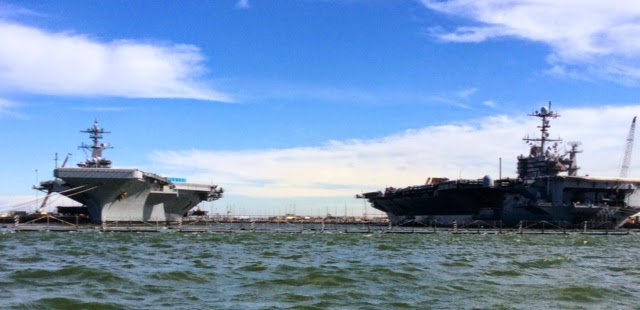
The water is deep here virtually wall to wall. And this area remains a center of Naval activity. We expected to see these guys,
but not the Battleship Wisconsin, which I had thought had been retired long ago. Note the nine huge 16 " diameter guns, each capable of hurling a one ton projectile 20 miles.

Once out of the Bay -- yes we are now south of Chesapeake Bay -- despite shaking out the reef and switching to the Genoa, we did not have enough wind and hence resorted to motoring.  We took the free dock by the Renaissance Hotel. No water, no electricity, no hands to help us with our lines -- you just get what it says, a free dock for the night - the same spot in which we spent two nights in 2012. It is across a little basin from the ferry that will run you over to Norfolk for $4 round trip. Luckily that noise and the resulting wakes stop at night.

Lene made a perfect landing and I rigged up the fender board to keep us off the pilings. We took a short stroll through town on Lene's successful search for coffee and met up with folks from four boats that are traveling together, and, since the canal is narrow here, with fixed times for lock openings they will be with us as well.  Back to our boat for a good home cooked meal. Here is Norfolk, across the river from our boat.


October 21-23 Cape Henry to Yorktown and Two Laydays There - 23 miles

The crossing was done by motor, all the way, without raising any sails, less than five hours. The wind was in our face but only five knots true, not enough to raise any waves. The only obstacle was this guy,
last seen in the sunset on the horizon from Cape Charles, who lay on anchor right on our course across the Bay. I caused another problem by accidentally turning off autopilot while trying to turn on the cockpit radio, which gave Lene a scare. The York River is wide and deep almost to its shores. We entered against the tide slowing us somewhat.

Yorktown County government runs the modern efficient Riverwalk Landing Marina here, which we visited in 2006 and 2012. We asked about staying on the outward side of the marina's floating dock (so easy to get on and off) but the friendly dock master said: "No way am I putting you there!" He was right. Both days we were here the wind howled, the river was filled with large whitecaps and the large excursion schooner, "Alliance", tied up on the opposite side of the dock from us, pitched up and down like crazy.
In fact I had planned to move to our next port on our second day here, and with the strong wind at our back and then at our side, we could have made it. But Lene and the kitties have had enough rough rides for a while and there is much here to amuse us.

The reasons we keep coming back to Yorktown is that our friends, Stan and Carol, live in nearby Williamsburg. I met Stan up at Cornell 52 years ago; he has been teaching at William and Mary for the last 36 years. They are such wonderful hosts and lend us their car, though which we provisioned and visited barbers and the drug store as well. They also shared with us two delicious home cooked meals, we took them to a French restaurant and we had mango-blueberry pancakes aboard with them and also did some sight seeing. Their home is decorated with the Carnival glass that Stan collects and the imaginative quilts that Carol makes.
I visited the Waterman's Museum, located immediately adjacent to the marina, which is at the river side immediately below the cliffs where General Cornwallis surrendered to General George Washington, ending our Revolutionary War. Cornwallis surrendered after the French fleet under DeGrasse defeated the fleet of British ships containing the reinforcements that Cornwallis needed. The museum is housed in a large plantation house that was donated and transported to this site from the other side of the river on a large barge. Watermen are defined as anyone who makes his or her living on the water. As amateurs, Lene and I are not watermen. The battle of the Capes, which led to the end of our revolution is portrayed, as are piracy, fishing and shell fishing and wooden boat manufacture and repair. Here is the museum's model of a fish trap,
also called a pole net. These run for considerable distances in an east-west orientation in the Bay. About half the fish that are brought up against it by the flowing tides will swim toward the trap and can be harvested periodically from the pen at the right. These traps are one reason to not sail in the Chesapeake at night. We came too close to one of them a few days ago, before turning away.  Running into this would likely damage both trap and boat.

I learned that a certain local Pirate, when captured and convicted in England, was fined 1000 pounds by the crown to be used to create a new school in Virginia, William and Mary. Thus unlike Harvard and Yale, which were funded largely on the basis of the profits of the slave trade, William and Mary's founding moneys were the profits of piracy. I had only 90 minutes there and two docents latched onto me. Phil (wearing a "Tin Can Navy" hat) took care of me inside, followed by Bubba who filled my head with knowledge once I proceeded outside to the wooden boat sheds. Clearly, these knowledgeable gentlemen would have talked my ears off for several hours more if I had more time, which I would have enjoyed.

The next day, Carol took me to DeWitt Wallace and Abby Aldrich Rockefeller Museums of Art in Colonial Williamsburg, where I saw a lot of beautiful old quilts and wooden furniture, but found nothing  nautical to report to you.