One of our Harlem members called me to report that while he was trying to moor his boat nearby, it had hit ILENE and damaged a lifeline stanchion which he would pay to replace. He is a friend and a standup guy but I had to report back, after next I sailed. that it was two stanchions, not one. They are the ones that frame the port side gate. The aft of the two damaged ones is not broken off like the forward one, but I knew it was damaged when I tried to grind the winch and its handle would not turn past the inward bent stanchion. He also said that he would pay for the lifelines which were kinked, but I told him that while I would replace them, the kinks had occurred when I had hit a boat's anchor in Hyannisport in 2016.
There are also some mechanical problems related to the stanchions -- drilling holes near the bases of the stanchions where they get screwed into place in their brackets and on the sides of them where diagonal braces are screwed in, plus potential problems removing the lower part of the broken stanchion which seems stuck in its base. But I have asked the member who hit me -- he has good mechanical skills -- to work with me, instead of my hiring someone else to do the work. The good news is my discovery that e the stanchions are intended to hold up lifelines to prevent folks from falling overboard, they have a secondary beneficial effect. They absorbed the impact of the other boat's twelve tons to protect ILENE's hull! The equivalent of a car's bumpers. The other good news: ILENE is sailable without this repair.
Other problems were smaller:
1 One of the allen bolts at the ends of the pin that holds the end of the main sheet to the traveler block fell out. Fortunately I found the pin with the other bolt, making buying a new bolt easy to find. Meanwhile a big knot at that end of the sheet stops it at the first sheave so we can sail.
2 Another allen wrench was taken to the hardware store to size the correct set screw that holds the port side of the tube/frame of the dodger in its deck socket. The tube slipped out of the socket and while reinstalling, I dropped the screw which bounced overboard! But removing the tube from its socket made stretching the dodger to the frame much easier than ever before.
3 I got a new pickup stick due to my failure to communicate with Lene -- we drove over the dead one, not harming the boat but destroying the stick. Temporarily, an empty one gallon water bottle became a float which I picked up with the boat hook.
I also spent a few hours cleaning the interior of mildew on the cabin roof. Yeah, Clorox!
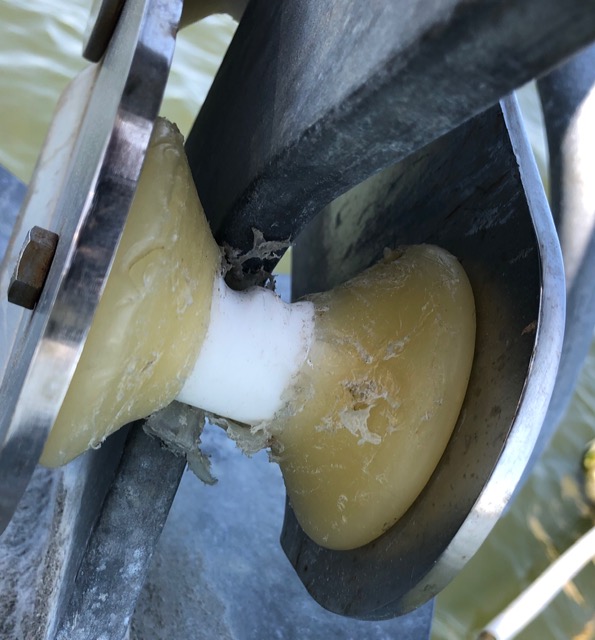
And I remeasured the bow roller for the anchor which is being eaten away by the chain. I checked and the roller rolls freely when the weight of the anchor is removed. Most of the time the chain is snubbed rather that putting the weight of the boat on the roller. I have finally located a vendor who makes such rollers of a more durable plastic..
We had two lovely evenings of dinner and theater with sailing friends (one, actually, without the dinner) and I led a Club cruise planning meeting to which four boats contributed their ideas. If everyone's plans coalesce, ILENE will spend the first seven of an eleven day cruise with three or four other Harlem boats. The group will visit Watch Hill, RI and Three Mile Harbor on the north side of Long Island's south fork. At that point the group will turn back west and ILENE will detach eastbound for the exploration of up to 26 other ports/anchorages in Rhode Island.
And the second half of my two part article about our favorite ports in Maine is out in the current June issue of Points East magazine. Pointseast.com. "Favorites", not "Best," because we have only visited 27 percent of Maine's ports so far, and because "best lists" are so subjective. And the Long Island equivalent of Points East, Wind Check, is interested in an article about our recent catamaran experiment which I will write up when it rains or gets too cold. Windcheck is for New York and Connecticut waters what Points East is for New England.
The Harlem's Wednesday afternoon group, the Old Salts, had their first sail of the 2019 season. Per our tradition, this was after lunch at the Club. I predict that a new salad created by Chef Anne: "Chicken Avocado", will be a big favorite. Creamy, crunchy, spicy, healthy and yummy is how I described it: what's not to like! Seven of us sailed in moderate and light winds. When the wind temporarily failed entirely, we just broke out the "apres sail" libations a bit earlier until it came back.
Lene joined me for two day sails with other friends: first for 5.5 hours with Sheila, who has sailed with us many times, and her friend Babette, who has sailed in the past but never aboard ILENE or on Long Island Sound. The next day was enjoyed for 4.5 hours with Jeff, now a newly minted MSW who was too busy studying to sail with us the past two summers. Each day we headed across Eastchester Bay, jibed onto a port tack and got to or almost to Peningo Neck at Rye before heading for home. The first trip had variable winds, with the strongest in Hart Island Sound. There we were close hauled and I worried that we would need to motor for a minute to get around The Blauses; we got to 6.5 knots in puffs. But we had to use the engine for about an hour after the turn, before the winds came back. We planned to hang and lubricate in the cockpit for a while before going in to dinner, with Lene's brother, Ken, and our nephew, Mendy. They drove out to join us. But the skies were very threatening so we called for the launch and got back into the clubhouse not two minutes before a tropical style deluge that lasted ten minutes.
Next day with Jeff, the wind was stronger and we achieved eight knots on a close reach with the full main and small jib on the way out, slower on the return. One disappointment: outbound we were gaining on a boat, later identified as Laughter, a beautiful metallic green C & C which is smaller and was under reefed main and genoa. But then I was inattentive and the wind changed and she pulled away from us again. I congratulated her owner for winning the "race" when we passed Laughter on her mooring back in the Harlem's mooring field.
"There is nothing more pleasant than cruising on a boat with the whole family."
Letter from Empress Catherine the Great
Sunday, June 2, 2019
Monday, May 20, 2019
May 8 - 19 -- Launch, GIC and ILENE's First Sail of 2019!
And five work days (27 hours) sprinkled in and about the three main events.
Lots of taking off the winter stuff: ladder, hose, electric cord, painting and polishing equipment -- to the car and thence to the locker. I reinstalled the microchip containing all of the charts of the Atlantic coast of the US, Canada and at least some of the Bahamas into the MFD. When out of the MFD the chip is so tiny that it gets stored in the somewhat larger chip. That's my finger to show how small things are.
Also, I hosed down the deck, getting off 99 percent of the debris that accumulates there all winter, purged the fresh water lines of propylyne glycol, filled both of the tanks with seven minutes of hose water, and reattached the salon table.
The launch, assisted by the Huguenot's Orlando and Gus, was as uneventful as conceivable -- on time, with none of the various hitches of prior years involving salt water in the boat.
The Huguenot let me tie up to their dock overnight, because had I driven to the Harlem I would not have arrived until after the last launch at 4 pm. Next morning I bent on the small jib, my favorite sail in case of engine failure in a tight spot. It is so easy to unfurl, regardless of the direction of the wind and its self tacking feature makes it easy to tack out of a tight spot. But this task, sadly, was not uneventful: first I forgot to roll the furling line into the drum. This was corrected by hand furling the sail at the foil, being that it was a light wind day in a well protected spot. But next I realized that I had led that furler line to starboard instead of port! I had planned to mount another sail that day but spent too much time with the small jib. I motored to the Harlem -- very fast on such a clean bottom. Bennett came, we had lunch and he drove me to the Huguenot where his Ohana was launched and my car awaited my drive home. Next day it was my turn to return the favor, to drive Bennett and his friend Ian from the Harlem to the Huguenot. Then we drove Ohana to the Harlem as soon as the tide rose enough to get her keel out of the mud. But instead of mooring there, we made a slow underway transfer of Mendy and his friend, Grace, from to launch to Ohana for a half hour sail before the launch shutdown for the night at 4:00. Well it was more of a drift than a sail, but gave Grace a wee taste of what sailing can be.
Then after two rest days of rain and a severe stiff neck I bent on ILENE's two large sails and eventually put in the reefing lines on my fifth try to get them right. Also mounted the blocks for the dinghy davits (at the cost of the pin of one shackle; they don't float!), the Lifesling, and the MOM-8 man overboard module, which is secure but not on right yet. The rest was interior cleaning which is now mostly done.
The Harlem's 136th Annual Going into Commission came off on a nice warm sunny Saturday afternoon.
I got this good photo by going to the sea wall, as unobtrusively as possible, to get the sun on the faces of our Flag officers backed up by all of our Past Commodores. This ceremonial raising of the flags at the start of the season is a time capsule. It hasn't changed during the 30 years I have been with the Club, and probably not during the 100 years before that either. There are never surprises during this ceremony and I think that's a good thing. In a world where everything seems to be changing rapidly all the time, this timeless ceremony gives a note of serenity. And we have had black, female and gay people in these lines, by the way, though, as I understand it, the Club did not admit females to membership until the 1970's. Bennett and Harriet had planned to attend but something came up so they gave their ticket to Mendy who enjoyed the abundant good food. The company was great - all sailors, and we were seated with, among others, Paul and Amy, who with their eight year old son, sail a Sabre 32 called "Farther". That's a good name for a cruising boat , which is how they want to use it. Thus is only their second season with her. I filled their heads with as much as I could. I was authorized to try to plan a club cruise for this summer by the new Fleet Captain, Matt.
Next day was ILENE's first sail and Rhoda came along. I helped her install her boats batteries and we did not get off the mooring until after four, for a 90 minute romp. The wind had been predicted for the low teens all day but we saw gusts up to 30 knots. We used the full main but no head sail. It was a shakedown cruise and we moved fast, achieving 8.4 knots for about 30 seconds. We were on port tack to near Throggs Neck and then a long starboard beam reach to the eastern side of Manhasset Bay. Rhoda had the helm most of the day. A shakedown and the bowline at the bottom of the blue first reefing line blew out -- I had poorly tied the knot. We picked up the mooring on our first try but I sort of fell from the gunnel of the launch onto its deck when departing. It took the wind out of me for a few minutes but nothing broken and so apparent bruises of excessive pains. Too much wind and the launch operator was straining to hold the launch to the boat's side, but not close enough.
I'm ready for more! The fun has begun!
Lots of taking off the winter stuff: ladder, hose, electric cord, painting and polishing equipment -- to the car and thence to the locker. I reinstalled the microchip containing all of the charts of the Atlantic coast of the US, Canada and at least some of the Bahamas into the MFD. When out of the MFD the chip is so tiny that it gets stored in the somewhat larger chip. That's my finger to show how small things are.
Also, I hosed down the deck, getting off 99 percent of the debris that accumulates there all winter, purged the fresh water lines of propylyne glycol, filled both of the tanks with seven minutes of hose water, and reattached the salon table.
The launch, assisted by the Huguenot's Orlando and Gus, was as uneventful as conceivable -- on time, with none of the various hitches of prior years involving salt water in the boat.
The Huguenot let me tie up to their dock overnight, because had I driven to the Harlem I would not have arrived until after the last launch at 4 pm. Next morning I bent on the small jib, my favorite sail in case of engine failure in a tight spot. It is so easy to unfurl, regardless of the direction of the wind and its self tacking feature makes it easy to tack out of a tight spot. But this task, sadly, was not uneventful: first I forgot to roll the furling line into the drum. This was corrected by hand furling the sail at the foil, being that it was a light wind day in a well protected spot. But next I realized that I had led that furler line to starboard instead of port! I had planned to mount another sail that day but spent too much time with the small jib. I motored to the Harlem -- very fast on such a clean bottom. Bennett came, we had lunch and he drove me to the Huguenot where his Ohana was launched and my car awaited my drive home. Next day it was my turn to return the favor, to drive Bennett and his friend Ian from the Harlem to the Huguenot. Then we drove Ohana to the Harlem as soon as the tide rose enough to get her keel out of the mud. But instead of mooring there, we made a slow underway transfer of Mendy and his friend, Grace, from to launch to Ohana for a half hour sail before the launch shutdown for the night at 4:00. Well it was more of a drift than a sail, but gave Grace a wee taste of what sailing can be.
Then after two rest days of rain and a severe stiff neck I bent on ILENE's two large sails and eventually put in the reefing lines on my fifth try to get them right. Also mounted the blocks for the dinghy davits (at the cost of the pin of one shackle; they don't float!), the Lifesling, and the MOM-8 man overboard module, which is secure but not on right yet. The rest was interior cleaning which is now mostly done.
The Harlem's 136th Annual Going into Commission came off on a nice warm sunny Saturday afternoon.
I got this good photo by going to the sea wall, as unobtrusively as possible, to get the sun on the faces of our Flag officers backed up by all of our Past Commodores. This ceremonial raising of the flags at the start of the season is a time capsule. It hasn't changed during the 30 years I have been with the Club, and probably not during the 100 years before that either. There are never surprises during this ceremony and I think that's a good thing. In a world where everything seems to be changing rapidly all the time, this timeless ceremony gives a note of serenity. And we have had black, female and gay people in these lines, by the way, though, as I understand it, the Club did not admit females to membership until the 1970's. Bennett and Harriet had planned to attend but something came up so they gave their ticket to Mendy who enjoyed the abundant good food. The company was great - all sailors, and we were seated with, among others, Paul and Amy, who with their eight year old son, sail a Sabre 32 called "Farther". That's a good name for a cruising boat , which is how they want to use it. Thus is only their second season with her. I filled their heads with as much as I could. I was authorized to try to plan a club cruise for this summer by the new Fleet Captain, Matt.
Next day was ILENE's first sail and Rhoda came along. I helped her install her boats batteries and we did not get off the mooring until after four, for a 90 minute romp. The wind had been predicted for the low teens all day but we saw gusts up to 30 knots. We used the full main but no head sail. It was a shakedown cruise and we moved fast, achieving 8.4 knots for about 30 seconds. We were on port tack to near Throggs Neck and then a long starboard beam reach to the eastern side of Manhasset Bay. Rhoda had the helm most of the day. A shakedown and the bowline at the bottom of the blue first reefing line blew out -- I had poorly tied the knot. We picked up the mooring on our first try but I sort of fell from the gunnel of the launch onto its deck when departing. It took the wind out of me for a few minutes but nothing broken and so apparent bruises of excessive pains. Too much wind and the launch operator was straining to hold the launch to the boat's side, but not close enough.
I'm ready for more! The fun has begun!
Monday, May 13, 2019
Sailing a Cat In The Grenadines -- Part 2 -- The Adventure
We began and ended at the Blue Lagoon Marina on St. Vincent itself and visited eight other islands, putting in about 110 miles with only one lay day.
The first and last stops were in Admiralty Bay on Bequia, the sailing center of the nation. Both of our stops there, however, were Sundays which meant not much action. Below a pretty Bequian sunset.
The Tobago Cays was my favorite stop. Three islands, almost surrounded by reefs make a nice harbor. So popular that it is a national park with a modest fee. We were led to a mooring in the cut between Petite Rameau to the north and Petite Bateau to the south by a boat boy, Neil, a grown man really. I asked: "Where are the lobsters?" He said "That's me!" We recalled that in 2011 we had enjoyed half a large clawless Caribbean crustacean grilled over charcoal in half a 50 gallon drum, served with large portions of grilled potatoes, rice with peas, plantains and salad, with fresh fruit for desert. Then it was served on the east or windward side of Petite Bateau. This made for an after dinner challenge: launching and getting into the dink in the surf. But now the dinner is cooked on the protected leeward side of the island, closer to our mooring, under the tent like structures as viewed from our boat.
The price is a bargain at $110 EC, about $41 US. Back then they served no beverages at any price but now they do, though you still have to bring your own silverware. It is barefoot dining at picnic tables with other sailors from France, England, Canada, Germany, etc., all reveling in a magical experience. Lobstering season ended the next day, so our timing was lucky, but Neil will continue serving fish and chicken. Incidentally, in 2011 there was only a tarp hung between trees over the cooking station and only a dozen folks were served. Now there are about a half dozen friendly competitors who have the kind of covers used at street fairs and they served about a hundred revelers.
But the heart of the park is the turtle reservation on the SW side of the easternmost island, Baradel. It is marked off by swimming pool lane style floats to keep boats out. We dinked to the tiny beach at the south end of the island, to the right as seen from our boat, snorkeled, and then walked the path to the top of the island, only 70 feet high but providing panoramic views.
My joy is to find and float above "my turtle" for maybe 20 minutes with a clear underwater view thanks to the snorkel mask, watching him assiduously bite off bits of short seagrass. At one point he swam up the eight or so feet, poked his head out of the water, scanned the area and dove back down to continue breakfasting. Sort of like what we later did in climbing to the "summit" of Baradel. We also came to a large section where the bottom had a lot of large starfish, lying apparently dead to the world, about five or six feet apart in an irregular pattern. Bennett and Harriet did more snorkeling than we did and even brought their own gear. Bennett saw a ray as well. The only daytime rain during our cruise was during the snorkeling, while we were already wet. Many nights had brief five minute light showers and one a bit heavier while we were under shelter at a restaurant.
Sailing is always more fun with pretty girls aboard!
Next came the port of Clifton on the NE corner of Union Island. The harbor is created by a large surrounding reef and has another reef in its center called "Go Around Reef". We dinked in to shop and bank, including fruits and vegetables from Eleen's, one of several shops in the market.
Eleen claimed to have remembered Ilene from 2011. Then to Happy Island, a bar built with concrete on a tiny sandbar in the harbor, approachable only by shallow draft dinks, stand up paddleboards or by swimming -- they accept wet money. The island behind the left boat in the picture below. Our only true indoor dinner with shoes was back in town. Bennett said that the Union Island people were the friendliest people of all the friendly folks in the Grenadines.
My original itinerary included Sandy Island next. But we were warned off of that plan in the chart briefing because that uninhabited sandbar is a suburb of Carriacou Island which is a suburb of Grenada, a different nation. So technically this stop would have required four visits to customs and immigration: to check in and back out of both St. Vincent and Grenada. The attraction at Sandy, where we had taken a mooring for the night in 2011, is the schools of larger tropical fish when snorkeling. Our chart briefer suggested Mopion, instead of Sandy, an even smaller sandbar near Petite
St. Vincent. Is only good for day anchoring while snorkeling, to be followed by anchoring at Petite St. Vincent at night. Well it was blowing 25 knots across tiny Mopion so even if we had anchored there, snorkeling would not have been fun. We took a look and went the extra mile to anchor at Petite St. Vincent, thinking we could snorkel Mopion next morning before the winds built up. PSV is a private island operated as an exclusive resort with 22 separate elegant one or two bedroom houses and two dining rooms. The rate in high season for a one bedroom is $1980 US per night plus 21% for taxes and service charges but that includes three gourmet meals per day, except alcohol.
Like I said, exclusive; its for folks who want to get away. But it was off season and they do allow (they can't stop) boats from anchoring off shore (ours was the boat to the left). They did allow us use of a significant part of the lovely beach and to have supper under a grass roofed hut a few feet from the water. Another barefoot fine dining experience. I made the mistake of ordering barracuda steak; too bony, kingfish is better.
In the morning Mopion was scratched because the wind had not died down. But we reverted to the original idea of Sandy Island, figuring that if we took a mooring for only a few hours and snorkeled without setting foot on the sandbar, we would not be violating Grenadian sovereignty. This was the first time we tried to take a mooring without the help of a boat boy and we learned how useful they are for catamarans. After several attempts, we gave up. No pickup sticks, short pennants from the tops of the balls and a great height at the front of our two bows, 24 feet apart, from which the ends of each of the two mooring lines had to be inserted through the eye and then lifted back up on deck. It seemed impossible. In fact Bennett even put on his flippers and tried to do it from in the water. This swimming move was dangerous but no one was hurt. the wind would blow us off before we could accomplish the manouver. This shows our track, the black lines, during the attempts.
We left Sandy without stopping and sailed to Chatham Bay on the leeward side of Union Island and anchored there. Despite being on the leeward side, catabatic winds come whooshing down from the hilltops so it was not really calm. I noticed that the jib furler had wrapped around the foil above the drum rather than in the drum. We found the jib halyard, lowered that sail, tied it down to the deck so it would not blow away and anchored. Then we set to work getting the furler straightened out and raising the jib again. We were struggling in the wind with me at the winch, Bennett trying to feed the luff tape into the foil's groove and trying to keep the women aft so they would not get conked by the flailing block at the clew. The mistake I had made was not straightening out the luff tape before we started feeding it, with a resulting twist. A voice appeared from a dink: "Can I be of help?" The answer was yes and the man tied off his dink, came aboard and provided the third set of hands.Their boat is a 40 foot Hunter named "Ever After" anchored next to us but a good safe distance away. I forgot to mention how huge Chatham Bay is, room for a hundred boats but only seven of us present; so no need to anchor too near anyone else. They live aboard with an orange tabby named cruiser, in Grenada and work aboard as proprietors of a boat canvas shop with two sewing machines. Frank was a Montana rancher and cowboy who became a farrier in the California thoroughbred racing industry where he met Jules, who had spent many years in Arizona and was a lady jockey.
We took them to dinner at Seckie and Vanessa's beachfront shelter. We had dined there in 2011 and reenacted the same routine. Me: "We are friends of Tabou, from St. Vincents, who now lives part of the year in the Berkshires in Massachusetts." He: "Yes, and how is his wife Rona?" They are now assisted by Summer, Vanessa's nephew.
Next day, was a lay day for us, except for me: Frank and Jules needed to go around to the Clifton side of Union island to visit an ATM and we needed provisions. I asked to hitchhike and they accepted me and gave me the helm. They are on vacation from their business until June. I got to know them a bit. Very competent and Frank is a lot like our friend, Dean, of "Autumn Borne": always eager to help strangers. Also, because they live in Grenada, and love animals, and with the Arizona connection, I am going to electronically introduce them to our friend Marty, another Arizona expat who has similar interests. While I was away, Laurenz had fixed the outboard and seeing that the dink was not at our boat, Frank put me ashore where I walked the long beach to the other end which has a four room resort where I hooked up with the rest of Azurro's crew.
After a few hours we retraced our wake past Chatham Bay and on to Saltwhistle Bay in the northwest corner of Mayreau Island. A small harbor, but there was room for us. Bennett wanted ribs but none of the restaurants had any and we settled for chicken. Next to us was a boatload, and I mean load, of twelve physicians from Poland on a large cat; one was not a doctor yet but the daughter, in medical school, of the captain, a dermatologist.
Then, after Bequia, to Young Island Cut,on St. Vincent a mile away from Blue Lagoon, where we snorkeled and had dinner at the resort there. Bennett and Harriet, they are younger, climbed to near the top of the adjacent sugarloaf shaped island where they got this picture with Blue Lagoon center background.
Next morning, at our request, Mike drove over in his dink, came aboard and piloted us back to the charter base in Blue lagoon where we were debriefed.
Lots of photo credits to Bennett.
Sunday, May 12, 2019
Sailing a Cat in The Grenadines-- April 27 - May 7 -- Part I
We cruised for eleven days in St Vincents and the Grenadines with Bennett and Harriet. The cat was the girls' idea -- an experiment. They were enthused about the no-heeling reputation of catamarans. The glasses won't tip over! Everything does not have to be secured in the cabin! These were the attractions of a cat to our women. This post describes the boat and its sailing characteristics; Part II will describe the fun we had. So if you are one of the readers who does not like the sailing aspects, just skip to the next posting, soon.
Ours was a Lagoon 39 of 2016, named "Azurro II" owned by French people with a Vincentian courtesy flag.
It was a generous sized boat for only two couples because it was designed for four. Unlike Long Island Sound, the prevalence of cats in the Vincentian waters was remarkable -- in one port, including us, there were nine cats and only three monohulls. And in looking around, we noticed that Azurro II was one of the smaller cats out there.
We arrived after a long day of travel at nine pm, got settled aboard and slept at the dock of the well sheltered Blue Lagoon Marina in the south coast of St. Vincents, the largest and capital island of the archipelago nation of St. Vincents and the Grenadines. The boat had slightly smaller cabins in the forward part of each of its hulls, which we used for storage, and quite large ones aft. Large enough that we slept, pullman style, athwart ships, what with no material heeling. In each hull the cabins were separated by a passageway inboard and a head with shower and sink. These bedroom sections were six steps down from the central ridging portion of the boat which had a large table, nav desk and galley, forward, and another large table on the outdoor covered patio deck aft. The indoor and outdoor sections of the upper deck were separated by a large sliding door and window and we closed them, and locked them, only when leaving the boat. The interior wood was blond and nice looking, but the cabin sole was a dark plastic type material that has several lighter blotches where prior sailors has apparently used bleach to get up dirt. Up another four steps was the helm station, to starboard, covered by a canvas bimini of its own, with steering and engine controls, a large new B&G Multi 'Function Display and two winches, one electrified, from which all lines for both sails could be handled. The boat was equipped with everything one might need (except dinghy lights). Though young, the boat already showed signs of wear: dents and scrapes that result from use and are characteristic of chartered vessels that are used by many people, not their owners, and some of whom have skill
shortages. In fact, while we did no material harm we had never sailed a cat and experienced a learning curve.
Before we could get underway we had three tasks to accomplish. First the girls took a cab to the market for provisioning. While they were away, Marlin gave us guys a thorough tour of the boat showing us where everything was, e.g. boathook, first aid kit, dinghy anchor, keys, flashlight, tool kit, etc. There is so much storage space that one must remember which large cabinet has each item. The tool kit, with its often used pliers, sat in the kneewell of the interior navigation station. Marlin told us how to turn on and off each switch, and which ones not to touch. He turned on the two engines and the electronics. He lowered the dink from its davits and turned on its outboard. The third task was the chart briefing by Raymond who outlined the favorite destinations and the distances between them, described in hours not nautical miles. Lene and I had been through these waters in 2011, twice: first southbound toward neighboring Grenada in the spring and again northbound in the fall. We had ideas about which ports to visit and the one to avoid (Mustique -- an overpriced exclusive Disneyland style island). In fact, I had laid out our entire draft itinerary months ago and sent it to our companions; I love cruise planning.
Finally about noon, Mike, our pilot, raised the main and piloted us out through the single red and green day marks at the sides of the channel between the reefs that protect Blue Lagoon and then left in the dink he had brought along. Regrettably, none of our coaches knew how to get the data out of the MFD. It provides lots of info to those who know which buttons to push. And there was no manual for its use. We have learned Raytheon's system but not B&G's. We used it, but without finding the "find boat" button or putting in a waypoint and getting course and time or distance to it.
Unbeknownst to us, Mike had put the second reef in the main for our first passage. I believe that he had intended to put in only the first reef but the labels on the clutches for the two reefing lines were reversed! We did have the first reef in most of the days we sailed. I had the helm for most of the time and found that observation of the main sail trim from the helm was quite difficult. I had to put the boat on auto and come down and aft to see that sail's trim. I never found the adjustable outhaul for the main; maybe there is none
.
As for the jib, it was a self tacking one as seen in the photo above, like aboard ILENE, but it has no secondary jib sheets to pull the clew forward and down to obtain a better trim downwind. One day the pin in the shackle that attaches the jibsheet/outhaul to the clew of the jib fell out! These things can happen if the rigging is not frequently and closely observed. Fortunately, the pin was captured by the open shackle and did not dive overboard. We were able to furl the sail and tie a line around it (Azurro II had several spare lines; some chartered boats have not an inch of it!) and made the reattachment once on a sheltered mooring. The only mistake in that regard, which we pointed out to the charter company, was that we reattached it 180 degrees wrong, resulting in a twist in the line. Another time we tightened the furling line too tight on the electric winch and got a wrap. What to do? The only thing I could think of was to cut the knot at the top of the furling drum. This shortened the line by five inches, which was immaterial given its extra length.
All told, the boat seemed slow, given the strong winds we had, though on the return we did see a few minutes of 7.4 knots one day. I will attribute some of the slowness to my lack of familiarity with the fine points of sailing a cat.
The charter company twice sent out its contracted mechanic on Union Island, Laurenz.
First to fix the refrigerator door hinge which had been broken off and check the batteries which he said were OK as long as we ran one of the engines two hours twice per day. But it was Bennett who figured out, when despite the solar panels wed had to turn off the refrigerator at night to keep the "low voltage" alarm from buzzing. Lorenz second trip it was to clean the carburetor of the dinghy engine which was shutting itself down at the most inconvenient times.
The company also "ate" the fuel cost, almost $200 US, for 20 gallons, which the charter broker had not told us about. We can't complain about Dream Charters.
OK; but how did the experiment turn out? Well the Admiral's conclusion was "I'd rather be sailing our boat." I agree and considered that comment to be a successful conclusion of the experiment. Our monohull digs in and heels a bit, but due to its heavy low pendulous keel it then rides through and over the waves rather smoothly. A cat is a big rectangle, 39 feet long and perhaps 24 feet wide. As advertised, even without a keel, a cat does not heel much, due to its huge beam. It can't press its leeward hull down into the water far enough to get much of a heel.
But instead, the waves pick up one corner of the rectangle at a time and then drop that corner to pick up another. So there is considerable irregular random rocking motion, particularly when the wind and waves are abeam. And the helm is much higher than on a sloop; my eyes are maybe 12 feet above the water.
The rocking and rolling is magnified at that height. Another effect of the extra height above sea level of the helmsperson's eyes is to diminish the pleasurable illusion of speed. In not too many other vehicles does going seven knots, about eight miles an hour, feel fast. From the height of the cat it seems less fast at the same speed.
Ours was a Lagoon 39 of 2016, named "Azurro II" owned by French people with a Vincentian courtesy flag.
It was a generous sized boat for only two couples because it was designed for four. Unlike Long Island Sound, the prevalence of cats in the Vincentian waters was remarkable -- in one port, including us, there were nine cats and only three monohulls. And in looking around, we noticed that Azurro II was one of the smaller cats out there.
We arrived after a long day of travel at nine pm, got settled aboard and slept at the dock of the well sheltered Blue Lagoon Marina in the south coast of St. Vincents, the largest and capital island of the archipelago nation of St. Vincents and the Grenadines. The boat had slightly smaller cabins in the forward part of each of its hulls, which we used for storage, and quite large ones aft. Large enough that we slept, pullman style, athwart ships, what with no material heeling. In each hull the cabins were separated by a passageway inboard and a head with shower and sink. These bedroom sections were six steps down from the central ridging portion of the boat which had a large table, nav desk and galley, forward, and another large table on the outdoor covered patio deck aft. The indoor and outdoor sections of the upper deck were separated by a large sliding door and window and we closed them, and locked them, only when leaving the boat. The interior wood was blond and nice looking, but the cabin sole was a dark plastic type material that has several lighter blotches where prior sailors has apparently used bleach to get up dirt. Up another four steps was the helm station, to starboard, covered by a canvas bimini of its own, with steering and engine controls, a large new B&G Multi 'Function Display and two winches, one electrified, from which all lines for both sails could be handled. The boat was equipped with everything one might need (except dinghy lights). Though young, the boat already showed signs of wear: dents and scrapes that result from use and are characteristic of chartered vessels that are used by many people, not their owners, and some of whom have skill
shortages. In fact, while we did no material harm we had never sailed a cat and experienced a learning curve.
Before we could get underway we had three tasks to accomplish. First the girls took a cab to the market for provisioning. While they were away, Marlin gave us guys a thorough tour of the boat showing us where everything was, e.g. boathook, first aid kit, dinghy anchor, keys, flashlight, tool kit, etc. There is so much storage space that one must remember which large cabinet has each item. The tool kit, with its often used pliers, sat in the kneewell of the interior navigation station. Marlin told us how to turn on and off each switch, and which ones not to touch. He turned on the two engines and the electronics. He lowered the dink from its davits and turned on its outboard. The third task was the chart briefing by Raymond who outlined the favorite destinations and the distances between them, described in hours not nautical miles. Lene and I had been through these waters in 2011, twice: first southbound toward neighboring Grenada in the spring and again northbound in the fall. We had ideas about which ports to visit and the one to avoid (Mustique -- an overpriced exclusive Disneyland style island). In fact, I had laid out our entire draft itinerary months ago and sent it to our companions; I love cruise planning.
Finally about noon, Mike, our pilot, raised the main and piloted us out through the single red and green day marks at the sides of the channel between the reefs that protect Blue Lagoon and then left in the dink he had brought along. Regrettably, none of our coaches knew how to get the data out of the MFD. It provides lots of info to those who know which buttons to push. And there was no manual for its use. We have learned Raytheon's system but not B&G's. We used it, but without finding the "find boat" button or putting in a waypoint and getting course and time or distance to it.
Unbeknownst to us, Mike had put the second reef in the main for our first passage. I believe that he had intended to put in only the first reef but the labels on the clutches for the two reefing lines were reversed! We did have the first reef in most of the days we sailed. I had the helm for most of the time and found that observation of the main sail trim from the helm was quite difficult. I had to put the boat on auto and come down and aft to see that sail's trim. I never found the adjustable outhaul for the main; maybe there is none
.
The reefing lines were fitted with sleeves of the outer layer of braided line, probably to prevent excess tightening. The effect was that the second reef line hung loose when the sail was furled, in a big loop at the aft end of the boom. And the boom runs quite a bit aft of the hard dodger/patio roof
high above that deck. The loop snagged the flagpole once, but worse, it got wrapped around the boom. That prevented raising the main to its full first-reefed height. I used the boat hook in one hand, holding onto the boat with the other while Lene held onto me for safety while I groped with the boat hook and unhooked the tangle while bouncing in the seas. Also, because the aft end of the boom extends so far aft of the boat, instead of a back stay there are two strong rubber covered stays running from the mast head, one to each quarter. Off the wind, one of these stays was pressed against the main, creasing its belly
The final problem with the main was that we were never able to close its stack pack. We were able to mash the sail into the stack pack somewhat but not to close it. This was not a problem for us, but it permitted the intense Caribbean sun to gradually destroy the owner's sail. We could never reach the zipper atop the aft end of the boom.high above that deck. The loop snagged the flagpole once, but worse, it got wrapped around the boom. That prevented raising the main to its full first-reefed height. I used the boat hook in one hand, holding onto the boat with the other while Lene held onto me for safety while I groped with the boat hook and unhooked the tangle while bouncing in the seas. Also, because the aft end of the boom extends so far aft of the boat, instead of a back stay there are two strong rubber covered stays running from the mast head, one to each quarter. Off the wind, one of these stays was pressed against the main, creasing its belly
As for the jib, it was a self tacking one as seen in the photo above, like aboard ILENE, but it has no secondary jib sheets to pull the clew forward and down to obtain a better trim downwind. One day the pin in the shackle that attaches the jibsheet/outhaul to the clew of the jib fell out! These things can happen if the rigging is not frequently and closely observed. Fortunately, the pin was captured by the open shackle and did not dive overboard. We were able to furl the sail and tie a line around it (Azurro II had several spare lines; some chartered boats have not an inch of it!) and made the reattachment once on a sheltered mooring. The only mistake in that regard, which we pointed out to the charter company, was that we reattached it 180 degrees wrong, resulting in a twist in the line. Another time we tightened the furling line too tight on the electric winch and got a wrap. What to do? The only thing I could think of was to cut the knot at the top of the furling drum. This shortened the line by five inches, which was immaterial given its extra length.
All told, the boat seemed slow, given the strong winds we had, though on the return we did see a few minutes of 7.4 knots one day. I will attribute some of the slowness to my lack of familiarity with the fine points of sailing a cat.
The charter company twice sent out its contracted mechanic on Union Island, Laurenz.
First to fix the refrigerator door hinge which had been broken off and check the batteries which he said were OK as long as we ran one of the engines two hours twice per day. But it was Bennett who figured out, when despite the solar panels wed had to turn off the refrigerator at night to keep the "low voltage" alarm from buzzing. Lorenz second trip it was to clean the carburetor of the dinghy engine which was shutting itself down at the most inconvenient times.
The company also "ate" the fuel cost, almost $200 US, for 20 gallons, which the charter broker had not told us about. We can't complain about Dream Charters.
OK; but how did the experiment turn out? Well the Admiral's conclusion was "I'd rather be sailing our boat." I agree and considered that comment to be a successful conclusion of the experiment. Our monohull digs in and heels a bit, but due to its heavy low pendulous keel it then rides through and over the waves rather smoothly. A cat is a big rectangle, 39 feet long and perhaps 24 feet wide. As advertised, even without a keel, a cat does not heel much, due to its huge beam. It can't press its leeward hull down into the water far enough to get much of a heel.
The rocking and rolling is magnified at that height. Another effect of the extra height above sea level of the helmsperson's eyes is to diminish the pleasurable illusion of speed. In not too many other vehicles does going seven knots, about eight miles an hour, feel fast. From the height of the cat it seems less fast at the same speed.
Friday, April 26, 2019
April 9-26 -- A Lot of Work Days And Some More Work Days For The Club
We did spend one day visiting our friend, Fran, in Kent CT. Before lunch, we took a hike on a short piece of the Appalachian Trail, just below Bulls Bridge, on the Housatonic, which runs into Long Island Sound at Stratford CT. The river was running high.
After lunch I checked out Fran's canoe, at the side of her lake, Clifford Pond, which had been rebuilt and made water tight again.
The rest of the activity was work, of three types. The first was two days (ten hours) for a work party led by Dan, the Marine Chairman of the Harlem Yacht Club. I was the sixth member of the team and the least skilled. The tasks related to the marine railway by which the boats stored at the Club are launched in the spring and hauled out in the fall. It was preventative maintenance and
very heavy work. One project Involved lifting the platform on which the boats sit to let the railroad wheels and axles set in boxes beneath the platform fall out so we could detach the axles and wheels, clean them and re-grease them before reinserting them. Heavy truck jacks were used to lift the platform. This task was accomplished on the first day. The second task was to replace the "sleeves" that hold up the columns at the sides of the platform. Slings are strung between pairs of these columns which hold the boats it place, in the air, during hauling. The sleeves fit into pits at the base of the platform and are inserted and held in place by "pins" so the columns can be rocked back or forth to accommodate boats of different widths. The sleeves were rusty, very rusty, and to get each of them out we used the fork lift. First, one of its tines would push them to one side and then a heavy chain connecting the column and the fork lift pulled them back the other way.

After several repeats of this manoeuver, the rust's hold had broken free and the fork lift was used, with a long heavy crowbar through the top of the column and across the tynes of the lift to lift them out. Tony was the driver and it was a game of inches to line things up and keep the tires of the lift on boards on the platform so that its weight did not break through its grate. Very careful driving and all of the men contributed imaginative ideas. I was quite impressed by the skills as well as the dedication of this well oiled team. But the replacement sleeves, were perhaps 1/16 of an inch too wide to fit into the columns! And the holes for the pins did not match up precisely. What to do? Someone pointed out that 1/16th inch of steel will be 1/2 inch
thick or more when it rusts up. So the team ended up grinding off the rust, observing that there was plenty of good solid steel left and taking the sleeves to Newark to be re-galvanized. The second work party was to reinstall the system so the Club will be able to launch boats this spring. I was the outsider but they accepted me and I tried to be useful, getting tools and blocks of wood and making a small contribution. Without members with skills and willingness to volunteer their time, we could never afford to pay contractors to do such jobs. Because we will be away on the date of the Club's annual spring work party, I was pleased to have this opportunity to serve the Club.
All new-shiny and back together again, with two new pins:
I also did several non-manual tasks. I contacted Jamie, who we connected with in Maine last summer. Jamie and Laurie have been to Newfoundland many times and he spent almost a full hour filling my head with information, about how to get to Newfoundland with another hour needed after i absorb this, to find where to go in Newfoundland. There are three routes from Nova Scotia to Newfoundland, West, Mid or East of Cape Breton Island. Because visiting Newfoundland will require both going there and coming back, we will have the opportunity to use two of these routes. And several alternative first stops north of Nova Scotia were also outlined including Prince Edward Island and two small islands that are part of France. Lots of time ahead to think about how we want to spend our three months on cruise this summer. The Central route is through the Bras D'or Lakes that we visited in 2017.
I also spent some time getting the tiny microchip that contains the charts of the waters we sail out of the MFD and back to my home laptop where the free updating was installed. Next year it will be $100 for another updating or a replacement chip.
I had to return the barrell zinc to be placed on the propeller shaft -- wrong size and material.
Jeff Lazar, the rigger, came by and noted, that in addition to the general examination of the rigging that I asked him to do (so the mast won't fall down) the VHF antenna atop the mast is rusty and needs replacement. I also had the pleasure of reading the first of my two part article in Points East Magazine (pointseast.com) "Our Favorite Maine Anchorages". The editor did a good job of dividing up and reorganizing my text and adding charts to illustrate the first part of the route, but the on-line version omits most of the photos.
But eleven days during this period, 54 hours (plus 3.5 by Ed Spallina and eight by our nephew, Mendy) were devoted to getting ILENE ready to splash. A total of 65 hours of labor and a few more are needed, by Mendy, to wax the port freeboard.
The bulk of this work was on the hull, scrubbing it, taping and painting below the waterline, removing yellow stains with FSR and applying six different paints: 1) a green primer on the propeller and its shaft, 2) four coats of white paint on this underwater metal, 3) blue bottom paint, several coats in some places with moving of the jack stands and chains to get the spots they cover, 4) some varnish in the interior of the cabin, 5) white rustoleum primer on the steering compass stand and at fifteen foot intervals to mark the anchor chain and 6) white enamel Brightsides paint over the Rustoleum.
Then came washing the freeboard with soap and water and a brush (and Scotchbrite on the dirty spots) compounding it and finally the paste wax. Mendy also helped me lift the three heavy sails from ground level to ILENE's deck so they are now staged to be bent onto their roller furlers and spars. I always like to have at least one sail available for the short first voyage from ILENE's winter home back to the Harlem in case of engine trouble.
Lene and I, with Bennett and Harriet of s/v "Ohana," will be enjoying a bareboat charter of a 39 foot catamaran from April 27 to May 7 in St. Vincent and the Grenadines. My first sail of 2019. The next post to this blog will report on that cruise.
After lunch I checked out Fran's canoe, at the side of her lake, Clifford Pond, which had been rebuilt and made water tight again.
The rest of the activity was work, of three types. The first was two days (ten hours) for a work party led by Dan, the Marine Chairman of the Harlem Yacht Club. I was the sixth member of the team and the least skilled. The tasks related to the marine railway by which the boats stored at the Club are launched in the spring and hauled out in the fall. It was preventative maintenance and
very heavy work. One project Involved lifting the platform on which the boats sit to let the railroad wheels and axles set in boxes beneath the platform fall out so we could detach the axles and wheels, clean them and re-grease them before reinserting them. Heavy truck jacks were used to lift the platform. This task was accomplished on the first day. The second task was to replace the "sleeves" that hold up the columns at the sides of the platform. Slings are strung between pairs of these columns which hold the boats it place, in the air, during hauling. The sleeves fit into pits at the base of the platform and are inserted and held in place by "pins" so the columns can be rocked back or forth to accommodate boats of different widths. The sleeves were rusty, very rusty, and to get each of them out we used the fork lift. First, one of its tines would push them to one side and then a heavy chain connecting the column and the fork lift pulled them back the other way.

After several repeats of this manoeuver, the rust's hold had broken free and the fork lift was used, with a long heavy crowbar through the top of the column and across the tynes of the lift to lift them out. Tony was the driver and it was a game of inches to line things up and keep the tires of the lift on boards on the platform so that its weight did not break through its grate. Very careful driving and all of the men contributed imaginative ideas. I was quite impressed by the skills as well as the dedication of this well oiled team. But the replacement sleeves, were perhaps 1/16 of an inch too wide to fit into the columns! And the holes for the pins did not match up precisely. What to do? Someone pointed out that 1/16th inch of steel will be 1/2 inch
thick or more when it rusts up. So the team ended up grinding off the rust, observing that there was plenty of good solid steel left and taking the sleeves to Newark to be re-galvanized. The second work party was to reinstall the system so the Club will be able to launch boats this spring. I was the outsider but they accepted me and I tried to be useful, getting tools and blocks of wood and making a small contribution. Without members with skills and willingness to volunteer their time, we could never afford to pay contractors to do such jobs. Because we will be away on the date of the Club's annual spring work party, I was pleased to have this opportunity to serve the Club.
All new-shiny and back together again, with two new pins:
I also did several non-manual tasks. I contacted Jamie, who we connected with in Maine last summer. Jamie and Laurie have been to Newfoundland many times and he spent almost a full hour filling my head with information, about how to get to Newfoundland with another hour needed after i absorb this, to find where to go in Newfoundland. There are three routes from Nova Scotia to Newfoundland, West, Mid or East of Cape Breton Island. Because visiting Newfoundland will require both going there and coming back, we will have the opportunity to use two of these routes. And several alternative first stops north of Nova Scotia were also outlined including Prince Edward Island and two small islands that are part of France. Lots of time ahead to think about how we want to spend our three months on cruise this summer. The Central route is through the Bras D'or Lakes that we visited in 2017.
I also spent some time getting the tiny microchip that contains the charts of the waters we sail out of the MFD and back to my home laptop where the free updating was installed. Next year it will be $100 for another updating or a replacement chip.
I had to return the barrell zinc to be placed on the propeller shaft -- wrong size and material.
Jeff Lazar, the rigger, came by and noted, that in addition to the general examination of the rigging that I asked him to do (so the mast won't fall down) the VHF antenna atop the mast is rusty and needs replacement. I also had the pleasure of reading the first of my two part article in Points East Magazine (pointseast.com) "Our Favorite Maine Anchorages". The editor did a good job of dividing up and reorganizing my text and adding charts to illustrate the first part of the route, but the on-line version omits most of the photos.
But eleven days during this period, 54 hours (plus 3.5 by Ed Spallina and eight by our nephew, Mendy) were devoted to getting ILENE ready to splash. A total of 65 hours of labor and a few more are needed, by Mendy, to wax the port freeboard.
The bulk of this work was on the hull, scrubbing it, taping and painting below the waterline, removing yellow stains with FSR and applying six different paints: 1) a green primer on the propeller and its shaft, 2) four coats of white paint on this underwater metal, 3) blue bottom paint, several coats in some places with moving of the jack stands and chains to get the spots they cover, 4) some varnish in the interior of the cabin, 5) white rustoleum primer on the steering compass stand and at fifteen foot intervals to mark the anchor chain and 6) white enamel Brightsides paint over the Rustoleum.
Then came washing the freeboard with soap and water and a brush (and Scotchbrite on the dirty spots) compounding it and finally the paste wax. Mendy also helped me lift the three heavy sails from ground level to ILENE's deck so they are now staged to be bent onto their roller furlers and spars. I always like to have at least one sail available for the short first voyage from ILENE's winter home back to the Harlem in case of engine trouble.
Lene and I, with Bennett and Harriet of s/v "Ohana," will be enjoying a bareboat charter of a 39 foot catamaran from April 27 to May 7 in St. Vincent and the Grenadines. My first sail of 2019. The next post to this blog will report on that cruise.
Tuesday, April 9, 2019
March 31 -- April 8 -- The Explorers Club, The Salmagundi Club and A Social Event With Sailing Friends Plus 4.5 Work Days
Pleasurable business before pure pleasure. Why 4.5 work days? Because one of them lasted only 2.5 hours due to 36 degree temperature in light rain, no fun out there. But all told I worked 26 hours and also derived the benefit of three and a half hours of help from Ed Spallina. Ed mixed up a batch of Epoxy to 1) repair the two small broken pieces of cabin sole that surround the mast, 2) the holes for the lowest hinge of the aft head door and 3) filled a notch in the fiddle at the galley sink. We also reinserted the ball bearings in the car of the mainsheet traveler.
We disassembled the gooseneck fittings and discovered the cause of the rattle. I had previously been pleased with the phone advice given promptly by Charleston Spars, the manufacturer of the unit, from its location in South Carolina. But that company was acquired by the very fine French marine devices company, Wichard, and it being in the rush season, the gentleman there did not return my calls. The casting riveted to the back of the mast has two vertical holes through which a pin is bolted. The pin also goes through two vertical holes in a casting at the forward end of the boom.

There was a bearing in the top of the two holes of the mast fitting. It was loose but I cut a strip of plastic from an old retired yellow cutting board. That piece, wrapped around the outside of the top bearing, filled the gap rather neatly. The bottom was more problematic. A bearing was supposed to be in there but was not. Hence the offensive rattle. Ed measured for it and ordered one from Carr McMaster ($4.50 plus shipping). During our next time together, the problem should be solved. Meanwhile the boom is suspended from the main halyard at its forward end and its topping lift
aft, and tied off to both sides so it cannot swing.
I asked Ed to help me install a replacement diaphragm in the Whale brand manual bilge pump located under the cabin sole in the galley. He said it is aluminum and corroded and should be replaced with one of reinforced plastic. We took it out and I searched for the replacement on line and from catalogs. It uses another name but is also made by Whale. Here are the similarities and differences: The plastic one pumps the same volume as the aluminum (good) but is lighter in weight and slightly smaller in its dimensions (good). And in addition the new plastic one is half the price! I ordered via the internet from a place in Florida, at a price considerably lower than Defender's, and it arrived next day and is ready to install when next I meet up with Ed.
I spent almost four hours sanding the sides of the repaired cabin sole boards, which had expanded a bit with the epoxy. They now fit again, and I polyurethaned them. I got the prop and shaft and its fittings down to bare metal for their coating with four coats of specialized bottom primer and paint and replaced all three zincs. Well. not so fast: The barrel zinc for the shaft that I had bought at Defenders (I got two to have a spare) were aluminum, not zinc, and 1 1/4" rather than 1 1/2" inch so I had to return them and get the right ones. And the tiny zinc for the Spurs line cutter cracked so two more are on order from Florida (the cracked one replaced at no cost, no questions asked). I also lubed the prop. It reminded me of the first time that I tried to do this in the spring of 2006 in Annapolis, and did not even know what a zerc fitting was, much less how to use it to get the grease into the prop. It was the evening of the last day before the launch and I knew the task had to be done before launch. Finally I asked a truck driver who was parked nearby, who showed me how to do it.
Then I rigged up the new hose and sprayed the dust and particulates off the top and did a "proof of concept" trial on using FSR (fiberglass stain remover - blue non-toxic goo in a jar) to erase the organic stains caused by leaves, before using that same product all the way around the water line, to get the gelcoat in that area from tan back to white. And I used a maroon Scotchbrite pad and water to lightly scrub the bottom. I was not nearly as thorough as usual but I got it ready to tape and paint. And I have decided that I will not compound the entire freeboard, about 450 square feet of white gelcoat above the waterline, this year, but will only do the bad spots, before waxing it. At least two days of work shedded, and with my shoulders being as they are, I will live with a boat that is imperfectly clean.
Lene and I enjoyed a brunch and matinee with our sailing friends, Harriett and Bennett.
The Salmagundi Club was created by artists for their own pleasure about ten years before the Harlem. On Fifth Avenue at 12th Street, it is about a seven minute walk from my house. They had a show of maritime art so I alerted the members of the Harlem who might enjoy it. The work was beautiful and expensive, e.g., up to $30K, but it was a small show -- only fifteen pieces, six of them seascapes without boats.
The Explorers Club was founded 20 years after the Harlem and has a lovely clubhouse on East 70th Street. It promotes and celebrates exploing by land. sea and air, on the earth's surface, in space and underwater and in caves. Their program was an all day series of excellent, well illustrated lectures by name brand circumnavigators. It included breakfast, lunch, snacks during breaks and a cocktail hour with enough food that it sufficed as dinner. The sister of the chairman of the event was very pleased that three of us Harlemites were present, and asked me to thank our Commodore for publicising the event, which is how I learned of it. Hoch, who has a Pearson 36, drove up from suburban Philly and Matt, who is a social member (does not own a boat -- yet!) were my clubmates in attendance. Matt is scheduled to crew on a passage from Hawaii to Seattle next month and offered to crew on passages with ILENE in the future.
The best part was the speakers.
Halsey Herreshoff was there to introduce one of the speakers. I got to speak with John Rousmaniere about his recent article in Cruising World announcing that his age, the same as mine, had compelled him to decide that he was not alert enough to do blue water sailing anymore. He admitted to me that he would do overnights, such as Nantucket to Nova Scotia, but not longer than one night out at a time. He spoke about the Americas Cup (mentioning that like me, while recognizing the advances of technology that that race has inspired, he is not really a fan of the new planing craft). He also described the Fastnet tragedy, which is the subject of one of his many books.
Dave Rearick went around solo on a modern Open 40 racing hull, "Bodacious Dream" with corporate sponsors. He told us his technique of sleeping with a kitchen timer in his pocket, set to wake him up every fifteen minutes. I asked why, given the infrequency of meeting other boat once far off shore and his radar alarm, he needed this, but he likes doing it his way. He took 8.5 months to get around and asked himself "Was it worth it?" And he answered that it seemed like a self indulgent activity, until he thought that by writing about it he thereby was helping others so indeed it was worth it. And while I have never and will never circumnavigate, I like to think that this blog is intended to help others too.
Frank Blair circumnavigated on a 63', gaff rigged wooden schooner, Maggie B, with 30 of its 70 tons being its lead keel. he praised the schooner form as fastest and easiest at sea. He took 26 months to get around (38,400 NM) but noted that despite long passages between continents he spent two out of every three days in port. Hmmm! -- the same ratio as on ILENE's cruises. He had about three crew at all times, but 27 individuals comprised those three. He said: I can teach a neophyte to sail but I can't teach a jerk to not be a jerk. He told us many lessons he had learned:
Every new noise is a bad noise, a sign of trouble.
Save all manuals and label all chargers.
Night watches are the most pleasant past of the day.
Customs is crazy; in Australia they confiscate ALL of your food.
Always get propane as soon as you clear customs because it can take a long time.
Use meteorological forecasts to place your boat where the best winds are.
He agreed with Dave Rearick that autopilot is more accurate after an hour that a human helmsperson.
He put his boat in the yard in Lunenberg Nova Scotia, where it had been built, after his return for some refurbishing and lost it when the yard completely burned down. But he got a new boat with the insurance money and plans to cruise Newfoundland this summer. Perhaps we can connect there; I'll be looking for him.
The last two speakers were women. One lost her fiancee overboard from a 46 foot delivery from the south seas to San Diego in a dismasting/rolling/pitchpole and spent the next 41 days jury rigged to Hawaii using celestial navigation. She wrote a book that was made into the movie "Afrift" released in 2016. The other circumnavigated on a 28 foot boat "Inspired Insanity" with a severe budget and many system failures, but made it.
Lots happening already this young spring.
We disassembled the gooseneck fittings and discovered the cause of the rattle. I had previously been pleased with the phone advice given promptly by Charleston Spars, the manufacturer of the unit, from its location in South Carolina. But that company was acquired by the very fine French marine devices company, Wichard, and it being in the rush season, the gentleman there did not return my calls. The casting riveted to the back of the mast has two vertical holes through which a pin is bolted. The pin also goes through two vertical holes in a casting at the forward end of the boom.

There was a bearing in the top of the two holes of the mast fitting. It was loose but I cut a strip of plastic from an old retired yellow cutting board. That piece, wrapped around the outside of the top bearing, filled the gap rather neatly. The bottom was more problematic. A bearing was supposed to be in there but was not. Hence the offensive rattle. Ed measured for it and ordered one from Carr McMaster ($4.50 plus shipping). During our next time together, the problem should be solved. Meanwhile the boom is suspended from the main halyard at its forward end and its topping lift
aft, and tied off to both sides so it cannot swing.
I asked Ed to help me install a replacement diaphragm in the Whale brand manual bilge pump located under the cabin sole in the galley. He said it is aluminum and corroded and should be replaced with one of reinforced plastic. We took it out and I searched for the replacement on line and from catalogs. It uses another name but is also made by Whale. Here are the similarities and differences: The plastic one pumps the same volume as the aluminum (good) but is lighter in weight and slightly smaller in its dimensions (good). And in addition the new plastic one is half the price! I ordered via the internet from a place in Florida, at a price considerably lower than Defender's, and it arrived next day and is ready to install when next I meet up with Ed.
I spent almost four hours sanding the sides of the repaired cabin sole boards, which had expanded a bit with the epoxy. They now fit again, and I polyurethaned them. I got the prop and shaft and its fittings down to bare metal for their coating with four coats of specialized bottom primer and paint and replaced all three zincs. Well. not so fast: The barrel zinc for the shaft that I had bought at Defenders (I got two to have a spare) were aluminum, not zinc, and 1 1/4" rather than 1 1/2" inch so I had to return them and get the right ones. And the tiny zinc for the Spurs line cutter cracked so two more are on order from Florida (the cracked one replaced at no cost, no questions asked). I also lubed the prop. It reminded me of the first time that I tried to do this in the spring of 2006 in Annapolis, and did not even know what a zerc fitting was, much less how to use it to get the grease into the prop. It was the evening of the last day before the launch and I knew the task had to be done before launch. Finally I asked a truck driver who was parked nearby, who showed me how to do it.
Then I rigged up the new hose and sprayed the dust and particulates off the top and did a "proof of concept" trial on using FSR (fiberglass stain remover - blue non-toxic goo in a jar) to erase the organic stains caused by leaves, before using that same product all the way around the water line, to get the gelcoat in that area from tan back to white. And I used a maroon Scotchbrite pad and water to lightly scrub the bottom. I was not nearly as thorough as usual but I got it ready to tape and paint. And I have decided that I will not compound the entire freeboard, about 450 square feet of white gelcoat above the waterline, this year, but will only do the bad spots, before waxing it. At least two days of work shedded, and with my shoulders being as they are, I will live with a boat that is imperfectly clean.
Lene and I enjoyed a brunch and matinee with our sailing friends, Harriett and Bennett.
The Salmagundi Club was created by artists for their own pleasure about ten years before the Harlem. On Fifth Avenue at 12th Street, it is about a seven minute walk from my house. They had a show of maritime art so I alerted the members of the Harlem who might enjoy it. The work was beautiful and expensive, e.g., up to $30K, but it was a small show -- only fifteen pieces, six of them seascapes without boats.
The Explorers Club was founded 20 years after the Harlem and has a lovely clubhouse on East 70th Street. It promotes and celebrates exploing by land. sea and air, on the earth's surface, in space and underwater and in caves. Their program was an all day series of excellent, well illustrated lectures by name brand circumnavigators. It included breakfast, lunch, snacks during breaks and a cocktail hour with enough food that it sufficed as dinner. The sister of the chairman of the event was very pleased that three of us Harlemites were present, and asked me to thank our Commodore for publicising the event, which is how I learned of it. Hoch, who has a Pearson 36, drove up from suburban Philly and Matt, who is a social member (does not own a boat -- yet!) were my clubmates in attendance. Matt is scheduled to crew on a passage from Hawaii to Seattle next month and offered to crew on passages with ILENE in the future.
The best part was the speakers.
Halsey Herreshoff was there to introduce one of the speakers. I got to speak with John Rousmaniere about his recent article in Cruising World announcing that his age, the same as mine, had compelled him to decide that he was not alert enough to do blue water sailing anymore. He admitted to me that he would do overnights, such as Nantucket to Nova Scotia, but not longer than one night out at a time. He spoke about the Americas Cup (mentioning that like me, while recognizing the advances of technology that that race has inspired, he is not really a fan of the new planing craft). He also described the Fastnet tragedy, which is the subject of one of his many books.
Dave Rearick went around solo on a modern Open 40 racing hull, "Bodacious Dream" with corporate sponsors. He told us his technique of sleeping with a kitchen timer in his pocket, set to wake him up every fifteen minutes. I asked why, given the infrequency of meeting other boat once far off shore and his radar alarm, he needed this, but he likes doing it his way. He took 8.5 months to get around and asked himself "Was it worth it?" And he answered that it seemed like a self indulgent activity, until he thought that by writing about it he thereby was helping others so indeed it was worth it. And while I have never and will never circumnavigate, I like to think that this blog is intended to help others too.
Frank Blair circumnavigated on a 63', gaff rigged wooden schooner, Maggie B, with 30 of its 70 tons being its lead keel. he praised the schooner form as fastest and easiest at sea. He took 26 months to get around (38,400 NM) but noted that despite long passages between continents he spent two out of every three days in port. Hmmm! -- the same ratio as on ILENE's cruises. He had about three crew at all times, but 27 individuals comprised those three. He said: I can teach a neophyte to sail but I can't teach a jerk to not be a jerk. He told us many lessons he had learned:
Every new noise is a bad noise, a sign of trouble.
Night watches are the most pleasant past of the day.
Customs is crazy; in Australia they confiscate ALL of your food.
Always get propane as soon as you clear customs because it can take a long time.
Use meteorological forecasts to place your boat where the best winds are.
He agreed with Dave Rearick that autopilot is more accurate after an hour that a human helmsperson.
He put his boat in the yard in Lunenberg Nova Scotia, where it had been built, after his return for some refurbishing and lost it when the yard completely burned down. But he got a new boat with the insurance money and plans to cruise Newfoundland this summer. Perhaps we can connect there; I'll be looking for him.
The last two speakers were women. One lost her fiancee overboard from a 46 foot delivery from the south seas to San Diego in a dismasting/rolling/pitchpole and spent the next 41 days jury rigged to Hawaii using celestial navigation. She wrote a book that was made into the movie "Afrift" released in 2016. The other circumnavigated on a 28 foot boat "Inspired Insanity" with a severe budget and many system failures, but made it.
Lots happening already this young spring.
Monday, April 1, 2019
Tuesday Mar 26 -- Saturday Mar 30 -- Five Work Days And a Change of Plans
First the change of plans:
Sailors are used to changes of plans and today's may not, and probably will not, be the last version of it. The first two cruises of 2019 are not changed.
1. April 27 to May 7 -- A ten day bareboat charter on a catamaran with Bennett and Harriet in St. Vincents and the Grenadines. We were there in 2011 and 12 aboard ILENE and I have sketched out a cruise plan to make sure our friends get to as many of my favorite spots as can be packed into the limited available time. Sailing a cat is new to us (though sailing with cats is not), and the girls are thrilled about not heeling. Also, the cat in question has room for two more couples so we are making a luxurious use of on board space.
2. June 8 to June ? -- My flight to Bermuda is booked for the eighth, to give me a couple of days to explore Bermuda before the June 10 planned departure to Halifax with Yves and Greg on Yves' French built 39 foot aluminum sloop. It is a Kelt 39 (they made a lot of Kelts in Europe) named Rusee de Jersey. I met Greg in 2017 and Yves in 2018, both in Canada, both through introductions by Manu who we met in St. Martin in 2010. The question mark in the subject of this paragraph is not about "if" we will arrive but "when". Yves, who has done this passage before, says it should take six days. Our departure is planned for June 10 but may be delayed by weather and the duration will depend on the winds we encounter during the passage. I'm figuring to get back by to New York by June 22 at the very latest.
It is for the remainder of 2019 our plan has been completely reconfigured because of a separate plan of dental surgery for Ilene, with healing periods between surgeries. The dental plan got set back four months because of her broken elbow etc. last October. We had thought to sail (A) six weeks on a leisurely cruise in Rhode Island this summer followed by (B) a departure to the south for the winter starting in late October. Originally the projected warm destinations were to the new waters, for us, of Cuba, or Florida's West Coast, or to the familiar waters of Grenada. Then we set a less ambitious plan for the nearer waters of the eastern Bahamas-- the Abacos, Eleuthera and Cat Island -- on which we have not sailed. But the surgeons say we cannot leave until December or January, and it's just too darn cold for us to be out in the Northern Atlantic then. Of course, our founding father, John Adams, made several Atlantic crossings in December, as ambassador to France for his soon-to-be nation. So it can be done. But we sail for pleasure, not to endure ordeals.
3. So the new plan for the second half of 2019: TADA!! Nova Scotia and Newfoundland. We can leave as early as June 26 and have to be back by September 28. That should be enough time and we learned some things during our 2017 Canadian cruise. So it's a good thing I delayed buying the missing Bahamian charts and instead I will need some more Canadian ones before we leave.
I did mention some work days. A total of 25.75 hours on five consecutive days; but not all were "hands on". Six hours on Thursday was by car with Dave and Gene to the big warehouse sale of Defender Industries in eastern Connecticut. Defender is a discounter to start with and I'm figuring we got another 20% off. I got the two gallons of bottom paint at only $220 each, a step to hang from the side to make it easier to board and disboard when we're alongside a dock, a new electronic distress flare, new secondary sheets for the small jib and all sorts of polishes, cleaners, waxes, zincs, etc. It was a very efficient and pleasant trip with the two guys, our third time together, I think, and after a quick lunch in Westport on the way home we ran into Barbara, wife of PC Stu, of the Harlem.
I also spent time gathering and figuring out what I had and needed from my locker space at the Harlem, created an inventory of the used electronics for sale, created emails listing the items of work I would like Rigger Jeff and Mechanic Ed to help me with this spring, gathered various items from the boat to take with me to the sale, so that the new parts would be correctly sized and put all the newly purchased stuff away and filed for the rebates. Also, one of the days I drove from the boat up to Valhalla NY and back to lawfully dispose of the five gallons of water-diesel mix. I created a bit of a problem for myself in trying to remove the hoop of the shackle integral to the car of the traveler for the main sheet. The hoop is wearing and I thought to replace it. I failed, and in the process I learned, the hard way, that there is a race of ball bearings in the car, seven of which came out. I captured them but replacing them is one of the projects for Ed.
I also accomplished four tasks at the boat.
1. Finalized the reinstallation of the aft fuel tank. Attaching and clamping the two small hoses was easy but the four wooden upside down "L" shaped blocks that hold the tank firmly in place took a while because the thick vertical side of the "L" did not fit between the tank and the stringer. Hmmm? Finally I figured out why and then it was easy: the vertical part of the "L" blocks are not equal in thickness, by maybe a quarter of an inch. The ones to port are thicker than those to starboard.
2. Cleaned out the bilge, by scrubbing its greasy and mud caked bottom and sides and the hoses and nuts in them with paper towels wetted with Fantastic. A yucky job that takes time.
3. Reinstalled all of the cabin sole boards of the salon that had been removed to gain access to the fuel tank. This took a long time because they did not fit! The reason, I eventually concluded, is that the hull takes a slightly different shape when held up by the keel and jack stands compared to when caressed in salt water. But by squeezing and lifting the edges, eventually it all got put back together except for the two smallest pieces that surround the mast. I broke these taking them out and with help from Ed they will be fixed.
4. The last day was the most fun, though perhaps the hardest work: removal of the canvas cover, folding it up, tying it up, and carrying it, one half at a time by cart and car to the Harlem YC locker house where I got help carrying the heavier piece up to the second floor locker. I also collected the insulation padding and the underbelly strings. I plan to "finish" the ends of the strings to make it easier next year before washing them. Happy day! ILENE's solar panels are back in business.
Sailors are used to changes of plans and today's may not, and probably will not, be the last version of it. The first two cruises of 2019 are not changed.
1. April 27 to May 7 -- A ten day bareboat charter on a catamaran with Bennett and Harriet in St. Vincents and the Grenadines. We were there in 2011 and 12 aboard ILENE and I have sketched out a cruise plan to make sure our friends get to as many of my favorite spots as can be packed into the limited available time. Sailing a cat is new to us (though sailing with cats is not), and the girls are thrilled about not heeling. Also, the cat in question has room for two more couples so we are making a luxurious use of on board space.
2. June 8 to June ? -- My flight to Bermuda is booked for the eighth, to give me a couple of days to explore Bermuda before the June 10 planned departure to Halifax with Yves and Greg on Yves' French built 39 foot aluminum sloop. It is a Kelt 39 (they made a lot of Kelts in Europe) named Rusee de Jersey. I met Greg in 2017 and Yves in 2018, both in Canada, both through introductions by Manu who we met in St. Martin in 2010. The question mark in the subject of this paragraph is not about "if" we will arrive but "when". Yves, who has done this passage before, says it should take six days. Our departure is planned for June 10 but may be delayed by weather and the duration will depend on the winds we encounter during the passage. I'm figuring to get back by to New York by June 22 at the very latest.
It is for the remainder of 2019 our plan has been completely reconfigured because of a separate plan of dental surgery for Ilene, with healing periods between surgeries. The dental plan got set back four months because of her broken elbow etc. last October. We had thought to sail (A) six weeks on a leisurely cruise in Rhode Island this summer followed by (B) a departure to the south for the winter starting in late October. Originally the projected warm destinations were to the new waters, for us, of Cuba, or Florida's West Coast, or to the familiar waters of Grenada. Then we set a less ambitious plan for the nearer waters of the eastern Bahamas-- the Abacos, Eleuthera and Cat Island -- on which we have not sailed. But the surgeons say we cannot leave until December or January, and it's just too darn cold for us to be out in the Northern Atlantic then. Of course, our founding father, John Adams, made several Atlantic crossings in December, as ambassador to France for his soon-to-be nation. So it can be done. But we sail for pleasure, not to endure ordeals.
3. So the new plan for the second half of 2019: TADA!! Nova Scotia and Newfoundland. We can leave as early as June 26 and have to be back by September 28. That should be enough time and we learned some things during our 2017 Canadian cruise. So it's a good thing I delayed buying the missing Bahamian charts and instead I will need some more Canadian ones before we leave.
I did mention some work days. A total of 25.75 hours on five consecutive days; but not all were "hands on". Six hours on Thursday was by car with Dave and Gene to the big warehouse sale of Defender Industries in eastern Connecticut. Defender is a discounter to start with and I'm figuring we got another 20% off. I got the two gallons of bottom paint at only $220 each, a step to hang from the side to make it easier to board and disboard when we're alongside a dock, a new electronic distress flare, new secondary sheets for the small jib and all sorts of polishes, cleaners, waxes, zincs, etc. It was a very efficient and pleasant trip with the two guys, our third time together, I think, and after a quick lunch in Westport on the way home we ran into Barbara, wife of PC Stu, of the Harlem.
I also spent time gathering and figuring out what I had and needed from my locker space at the Harlem, created an inventory of the used electronics for sale, created emails listing the items of work I would like Rigger Jeff and Mechanic Ed to help me with this spring, gathered various items from the boat to take with me to the sale, so that the new parts would be correctly sized and put all the newly purchased stuff away and filed for the rebates. Also, one of the days I drove from the boat up to Valhalla NY and back to lawfully dispose of the five gallons of water-diesel mix. I created a bit of a problem for myself in trying to remove the hoop of the shackle integral to the car of the traveler for the main sheet. The hoop is wearing and I thought to replace it. I failed, and in the process I learned, the hard way, that there is a race of ball bearings in the car, seven of which came out. I captured them but replacing them is one of the projects for Ed.
I also accomplished four tasks at the boat.
1. Finalized the reinstallation of the aft fuel tank. Attaching and clamping the two small hoses was easy but the four wooden upside down "L" shaped blocks that hold the tank firmly in place took a while because the thick vertical side of the "L" did not fit between the tank and the stringer. Hmmm? Finally I figured out why and then it was easy: the vertical part of the "L" blocks are not equal in thickness, by maybe a quarter of an inch. The ones to port are thicker than those to starboard.
2. Cleaned out the bilge, by scrubbing its greasy and mud caked bottom and sides and the hoses and nuts in them with paper towels wetted with Fantastic. A yucky job that takes time.
3. Reinstalled all of the cabin sole boards of the salon that had been removed to gain access to the fuel tank. This took a long time because they did not fit! The reason, I eventually concluded, is that the hull takes a slightly different shape when held up by the keel and jack stands compared to when caressed in salt water. But by squeezing and lifting the edges, eventually it all got put back together except for the two smallest pieces that surround the mast. I broke these taking them out and with help from Ed they will be fixed.
4. The last day was the most fun, though perhaps the hardest work: removal of the canvas cover, folding it up, tying it up, and carrying it, one half at a time by cart and car to the Harlem YC locker house where I got help carrying the heavier piece up to the second floor locker. I also collected the insulation padding and the underbelly strings. I plan to "finish" the ends of the strings to make it easier next year before washing them. Happy day! ILENE's solar panels are back in business.
Subscribe to:
Posts (Atom)