"There is nothing more pleasant than cruising on a boat with the whole family."
Letter from Empress Catherine the Great

Saturday, May 28, 2022

May 22 - 27 — Two Sails and the Solution of the Water Problem

During neither of the sails was the wind strong enough to be exciting. The first was with Sheila, Lene,  Christine and Heather on ILENE. We sailed off the mooring to avoid exposing the the boat to the engine area leak and sailed until the last 90 seconds when we used the engine during our second attempt and successfully grab the mooring. Our track was back-and-forth across the mouth of Eastchester Bay with a long trip of the Eastchester River and back down again. It was a hot day and by keeping the wind at or forward of the beam most of the time we achieved enough apparent wind to cool off. The clever launch operator maneuvered the launch so I could capture a pleasing background as well as the beautiful crew.

The second sail in this period was aboard Bennett’s Ohana with him and five other Old Salts, joined by four more who sailed with Dave on his Lady Kat and who joined us on Ohana for the libations. Bennett was contented to let me try to keep the boat moving in light air with dead patches. A good time was had by all. Thanks, Bennett!

From the left: Mike, Dave, Virginia, Clare, Janet, me, Bennett, Sandy, Rich and Beau. Photo credit: Social Member, Anne, thank you.
The next day I spent 2.25 hours with a new, to me, diesel mechanic, Peter, who I met while he was working on someone else’s boat at the Huguenot this past Winter. He seemed like he knew what he was doing and mine was his first job at the Harlem. I was mindfull of the time because I’ll be paying him for it. It took him two minutes to find the leak associated with the diesel that I had not been able to see. The black hose transmitting water from the sea, through the seacock to the raw water strainer providing cooling water to the engine is taken off the input pipe each fall to permit the entry of antifreeze the the engine and then replaced and its hose clamps tightened. After more than 20 years of this the clamps had cut a slit in the hose. Bottom of the next picture. This was temporarily fixed using the clamps and new replacement hoses were purchased the next day, to be installed soon.

Similarly, it took no time for him to figure our that the old Rule 1500 bilge pump was kaput, to install the new Rule 1500 automatic one, with built in float switch. It fit into the existing base without the need for new screws and the existing discharge hose attached to it. A test wire from the battery showed that it works well, but most of my time with Peter was spent trying to find out why it did not work through the existing wiring and the the electrical control panel. I knew there was a fuse back behind the panel and that it worked, but the culprit was another one, chased down (by the control number in the book and the color of the wire to it behind the control panel) to an in line fuse near the batteries under the aft cabin berth. Missions accomplished. Then an hour and a half putting the boat back together and putting all the tools away, and the salon table reattached. Like with some many other toys, the time and expertise goes into finding the problem; once found, fixing it is easy.


Next day I picked up the new custom made aft cabin mattress from our upholsterer and brought it to the boat and put it in place. I also measured and purchased from Bridge Marine the two replacement hoses. Installing them will be the next job. I’m planning to keep the new mattress covered in sheets, i.e., ready for its intended use. This for two reasons. First to keep it from getting stained by folks, including me, traipsing in and out of the aft cabin and second because the new fabric is slightly more “nubby” than the old and hence a slightly more attractive target for the kitties razor sharp claws.

Sunday, May 22, 2022

May 10 — 21 — First Sails, But The Water Problem Is Not Yet Fixed, Though Managed Through A Sail and The 139th Annual GIC.

 Well the first sail was with Bennett and Dave, bringing “Ohana” from the Huguenot to the Harlem. But with a stop along Island, in Port Washington for lunch at Louie’s. Thanks, Bennett! Thirty years ago that restaurant sold good fish at low prices with a salty unambitious ambiance. It keeps upgrading its ambiance, its service and its prices. But it still offers free dockage while you dine. During the season they have a man on the dock to catch your lines and tie you up. But the season has not started. Bennett did a good job without him.

The only other sail was the inaugural convening of the Old Salts aboard ILENE, her first sail of the seasonThere was great wind from ten to noon, while I provisioned, put out flags and cushions, took off instrument covers cleaned a bit and put in the first reefing line, in case of high winds. But during our lunch the winds died, so while we sailed for ninety minutes, it was generally a slow day out there. But everyone was happy to be out on the water.

I had experienced crew aboard so I put Dave at the helm on a safe course while motoring and tried to find out where the salt water was coming in. It definitely is coming in from in or near the engine, but I could not find the source. Until Pete, the new mechanic, comes on the 26th, I have to use the engine as little as possible, remember to close the seacock that admits seawater to cool the engine when it is not running, AND most importantly, remember to open the sea dock before running it to avoid letting it burn itself up. So I’ve been going to the boat frequently and will continue to do so — to pump out what comes in before too much of it builds up. Pete will also be installing a new bilge pump with built in float switch, to pump out the water as it comes in, at the nominal rate of 1500 gallons per hour, almost half a gallon per second. Actually a bit less because the pump has to pump the water up before it pumps it out, which reduces the pump’s effective capacity.


Here, on the launch at the end of the day, from left to right: Mike, Richard, Janet, Beau, Dave, Christine, and Sandy.

For several days high winds had prevented my trying to mount the sails, and the mounting occurred on four separate days thereafter. First came the Mainsail, in which task Dave volunteered to come over and help. Thanks, Dave! His help was most useful in connecting straps, one on each side, from the top front of the stack pack to loops attached to each side of the mast. Someone has to lift while the other one clips on; I’ve done it alone, but it was so much easier as a two man job. 

Before that lifting I almost caused a catastrophe by pulling the working end of the outhaul line through its clutch and into the tunnel under the main deck. I pulled to loosen the outhaul to make it easier to attach the clue of the sail to the outhaul but I pulled it too loose, causing me to lose the working end of the line. This gave me the opportunity to demonstrate to Dave how snake tape works. We fed in the stiff metal tape, attached it to the line and pulled out it’s missing end. No harm done, just a preventable waste of time. 

Another calm day I attached the two head sails to their furlers. But at the end of that I day realized that the smaller one had been coiled backwards, with its blue protective canvas coating on the inside rather than doing its protecting. So the third day,  again in very light wind I unfurled and reran the furling line around the furling drum the correct way and was able to furl that sail properly. 

With the help of Rear commodore Doug, who ran the technology, I chaired a meeting of about ten boaters of the Harlem and City Island Yacht Clubs who are interested in a summer cruise, as a club (with the fellowship such cruising permits) of longer than two days. They selected an eight day duration to start on August 2, and left it to me to fill in details. I love cruise planning.

Another day was a full one at the Club, without a visit to ILENE. After complimentary bagels and coffee we got started at about 9:15 and worked until almost 3:00 before the complimentary lunch. Who says we don’t work for food. But in reality we work for the good of the Club and the opportunity to bond with our coworkers. Several big and small projects got accomplished. I joined a team of about ten men who  put up a fence along the south side of the Club’s parking lot.


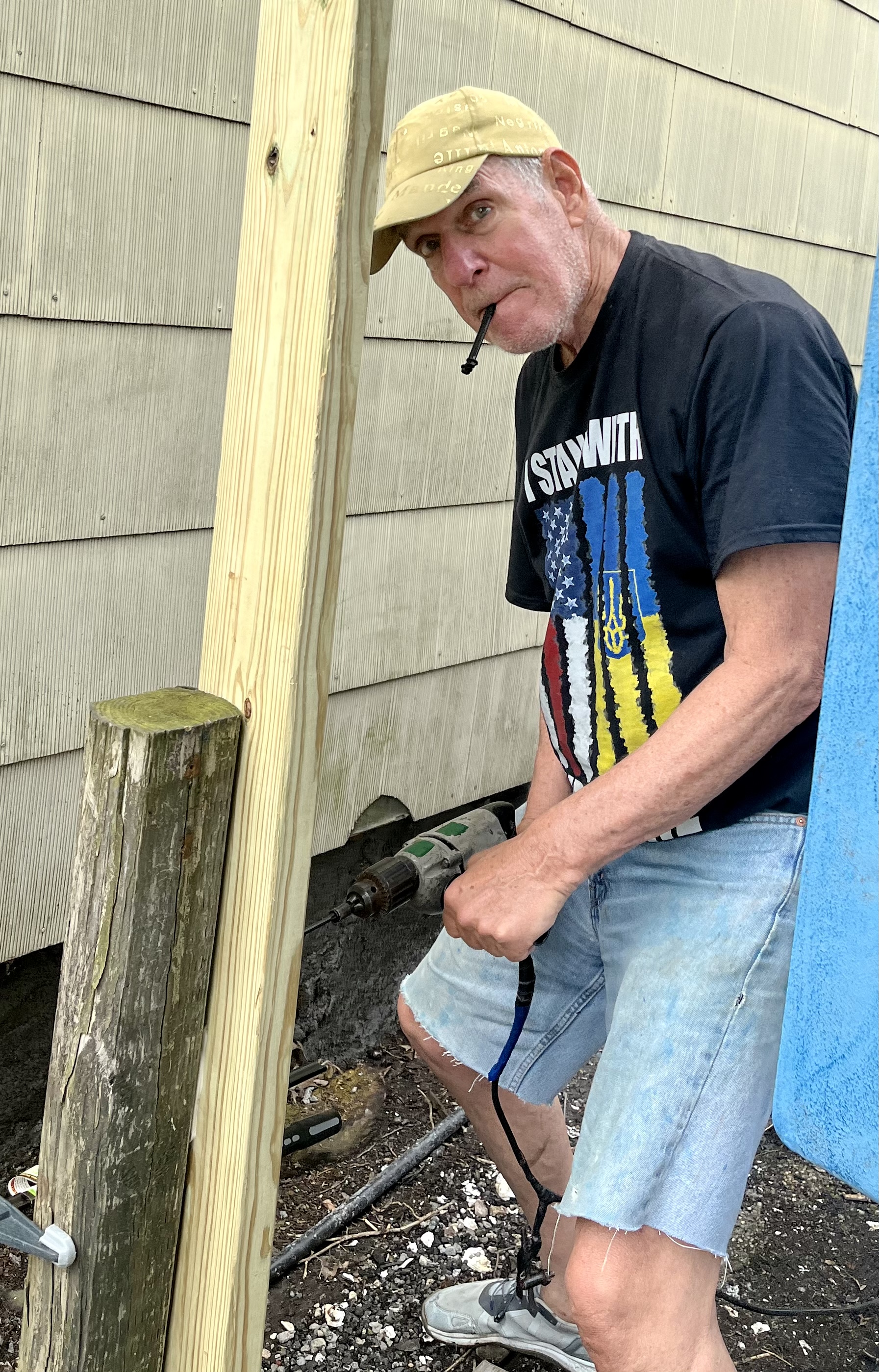
It involved providing a straight level surface to attach the five by eight foot panels of posts, strengthening each panel by glueing and screwing additional horizontal boards across their backs. To make them stronger and more rigid. Others with more skills lined up the mounting boards to existing posts. Those are 4.5” long hex head screws I’m screwing in with a powerful electric drill.

I also drove in about 400 shorter screws to hold the bracing boards together using a less powerful portable electric drill. The learning curve that the team climbed made the job much faster for the later panels than the earlier ones.

My safety taboo in this picture is not the risk of my accidentally swallowing the screws, but that I averted my eyes from the work.


And the Harlem’s 139th annual Going Into Commission Ceremony and Party was another success. The weather cooperated with a nce sunny afternoon and evening and the party is always timed for a Saturday with high tides when the club looks its best. 

The highlight of the ceremony was the announcement of the new name of the newly refurbished launch, after our late honored and beloved Past Commodore Fred Haymon. During the winter our Luanch Chairman had spent months completely refinishing it’s underwater hull, it’s brilliantly gleaming dark blue freeboard and the multi layered coat of varnish or poly on its teak rails. It literally looks better than it did when it was launched some 40 years ago.

Changes to the ceremony and party since  COVID, however. The new additional deck (for outdoor dining mandated by COVID) at the north side of the lawn reduced the lawn area making for several ranks of uniformed honored past and present commodores and Flag officers.  But more significantly we finally came to grips with the reality that the full sit-down  multi-course dinner in the upstairs ballroom with several entree selections could never be successfully accomplished in a timely fashion out of our small kitchen. And the hot and cold hors doeuvres during the cocktail hour between the ceremony and the dinner were better than the dinner itself. So we they eliminated the sit down entirely and extended the duration, quality, variety and quantity of the foods in the cocktail hours. A new cash bar will inhibit alcoholism and drunk driving. A lovely party  except that I put on a few pounds.


I was on City Island during nine of the twelve days reported on in this post — summer has arrived.

Monday, May 9, 2022

May 4-9 — Yes, Launched, But Not Sailed — Due To Currently Unsolved Water Problems.

 Before motoring away from the Huguenot on Tuesday I checked the bilge and it was essentially dry. The next check was on Thursday, with plans for David and I to help each other mount sails on each others’ boats. But there were about 40 to 50 gallons of water in ILENE’s bilge and my half of our time together was devoted to removal of the water and trying to find out how it got there. Then we mounted the Main on David’s boat. 

The bilge is only about six inches wide at the bottom, but widens to about three feet at the top. The water was still six inches or so below the bottom of the cabin sole so no harm done. But the automatic bilge pump,  like a sump pump (controlled by a float switch) in suburban homes, was not working. And it still is not, despite a couple of hours work by David to try to find out what is wrong. He found that electricity is flowing to the switch on the circuit breaker that controls the sump pump, but it does not turn on when that switch is turned.

I’ve started using a hand-held battery-operated liquid transfer pump and a five gallon bucket to measure how many gallons I pump out each day. 

Five on Friday, and salty. There is also a separate shallow square sump under the diesel and I noticed that it was full and took out four more gallons from there. This suggests the water if coming in from aft, possibly the bearing where the propeller shaft exits the boat. Maybe the large volume came in while motoring for an hour on Tuesday.

Saturday the Harlem’s scheduled work party was rained out by heavy rains and winds.

Sunday, Mothers’ Day, was supposed to be the first sail of the season with some new friends, but it got rained out and also thwarted by the fact that the sails are not mounted. The day was a huge success for our caterer, with many families dining in the restaurant in two seatings. Checking the bilge after two days with all that rain, the shallow sump under the engine was rather dry, I pumped twelve gallons from the bilge and tasted it. A lot less salty. This suggests rain water from the top.

Also, after removing the boards of the aft cabin giving access to the propeller shaft and exhaust “elbow”, I ran the engine for a few minutes and even put it in forward for a few seconds, straining against the mooring, to look for water entry, but found none. If the theory that the water is coming from back there is correct, maybe I have to run the engine at a higher speed for a longer time (after the sails get mounted, and I can take it off the mooring).

Meanwhile I have obtained a sheet of rubber to fashion a better barrier against rainwater entering the boat from the top, through the mast partner — the hole in the coach roof through which the mast passes on its way to its base just above the bilge.

Frustrating, but this too shall pass.

Saturday, May 7, 2022

April 20 - May 3 — LAUNCHED

 Four work days, two with Ilene’s help and one with Fred, who lives in our building and has sailed with his wife and us. Lene concentrated on the interior and Fred on the exterior topsides.  A lot of cleaning still needs to be done. But the inside looks pretty good again after removal of all the winter work supplies. The salon table top looked cruddy but washing, abasing with toothpaste and pledge has restored its luster. My eagle eyes detect that the narrow center panel and the port wing, which are left up most of the time gave developed a very slightly blonder shade of cherry than the starboard wing which is normally closed down in the vertical position and hence gets less sun. Modest amounts of mildew on the overhead this past winter are all gone. I trashed the old reading lights in the Salon and butt connected the wires and mounted the shiny new ones. But there was a fifth light, in the aft cabin, so I took the least tarnished of the old and spent an couple hours applying brass cleaner and elbow grease and then polyurethane, rather than order a fifth fixture. 

I purchased two LED “bulbs”  to fit the floor lights, as an experiment, to see if they fit. Doctor LED  knows his bulbs and the ones he sent, subject to refund, do fit. But at $27 a piece, I will not replace the other four. I got one in red for nearest the companionway. Red light does less harm to night vision than white light. In removing the fixtures to get to the sockets I removed 23 years of accumulated grime from the reflectors behind the bulbs.


That may be the reason, or part of the reason, that the LEDs appear to be brighter than the older bulbs.

It was a thrill to restore the blocks, lines and life sling to their useful exterior positions on ILENE, to get her rigged for summer. For one set of shackles, those holding the blocks for hoisting the dink to the davit bar, installation must be done ashore; in case a piece is dropped by Mr. Butterfingers, it might be found by diligent search in the gravel below rather than being irretrievably swallowed by the seawater and the mud below. No droppage this year.

I’ve used pieces of the vinyl tape normally used to “paint” boats’ names on their sides to hide scratches and peeled spots in the dark blue boot stripe. I asked the BoatUS Boat Name department  for scraps of Navy and offered to pay and for shipping, but they sent me a large supply, not scraps, totally free. Sadly one can’t look a gift horse in the mouth and the color is just slightly lighter than desired. If you look carefully you can see the spot:

I worked with Bennett of “Ohana” at our mastheads, using the services of his talented and brave friend Jesse and my new electric winch handle to install wind instruments.


Bennett’s now works fine, but we discovered problems at my masthead, and following a reply by Davis Instruments, a return trip will be required. 


The hole at the top of the post into which the instrument should screw seems blocked. I can either drill out the bad parts or buy a new mounting post. 
And it’s a long way down!  
And the port tank is full of fresh filtered water.

The actual launching on May 3 was uneventful. David, of “Hidden Hand”, helped me. We drove to the Huguenot in my car and after lunch and painting the bottom of the keel he drove my car to the Harlem Yacht Club to wait for me to motor the boat over there. The launching was exactly at 2 PM, as scheduled, at the high tide. But the yard men who have to reinstall ILENE’s forestays before I could leave the dock had to launch another boat while the tide was still high enough, so there was about an hour’s delay. David persuaded me that I did not need to further delay to mount the small jib before departure — that in the unlikely event of engine failure, I could anchor before ILENE went on the rocks and mount the sail while on anchor. But the sail was laying on the foredeck and the wind started to whip it around a bit so I let auto pilot steer for a few seconds, re-folded that sail and secured it to the deck.  

At the Harlem end of the short passage, I found my mooring but the pennant had gotten wrapped up in the pickup stick and I had to use the boat dock to catch the pennant and attach it at the midship cleats. Then I ran another line from the pennant to the bow of the boat, released the pennant and tried to pull it to the bow cleat. But the wind was too strong for me to actually physically pull it all the way in. I could hold the line by the friction of the cleat but not pull it in. And then the Cavalry came riding to the rescue: David on the launch. I had negligently failed to check the very early-season hours of operation of the Harlem launch. It was scheduled to operated only until 4 PM and David persuaded our competent and helpful chief launch operator, also named David, to remain a few minutes later to come out and get me. Also, when David came out on the launch he was able to board ILENE, and at my direction put her in forward gear, very briefly and slowly. This relieved the strain on the temporary line so that I could properly attach the mooring pennant to her bow cleat.

David and I plan to return to our boats in a few days to help each other mount our sails. And I already have a sailing date for the weekend. Ilene will be away for a week at a spa in Baja California.

But it has not been all boat work either. I attended both a zoom meeting of the City Island Yacht Club‘s Cruising Committee with which we are cooperating, and a live slide show meeting at that Club by a knowledgable local resident of Norwalk, Connecticut. He described each and every one of the 25 so-called Norwalk Islands (some mere sand bars) where a two-day mini-cruise that CI YC has organized for themselves and Harlemites is scheduled to anchor in June. The speaker also described many famous and not so famous people who have had experiences in the Norwalk area since colonial days.

I’ve also solicited the members of both clubs who may want to take a longer one or two week Joint cruise this summer to attend a Zoom meeting to find out who can go on such a cruise, whether they can all get time off from work the same time and on the proposed itinerary. I plan to offer the eight day cruise that the Harlem did not “use” last summer as a starting plan, subject to the changes any of the participants want and can agree to. The Fleet Captain is not a commander but a volunteer unpaid “trusted (somewhat) servant” whose job title could be “cat herder”. But ILENE cannot actually sail with the group, if such a cruise comes off this summer because we plan to be sailing to Canada.

Learning that a new couple who have joined the Harlem has bought a Catalina sailboat lying in Greenport that has to be brought to City Island, with their permission I solicited all of our members for an experienced sailor who may want to accompany them. If no one accepts the opportunity I may volunteer myself.

Another member wanted to bring a very classy antique Herreshoff ketch from Eastern CT where they bought her to the Harlem in a three day sail and requested my advice on good spots to spend the two intervening nights, which it was my pleasure to give them.

But the most fun of all in this route planning activity was to create the first draft of ILENE’s scheduled itinerary from the Harlem to and in the St John River in New Brunswick, Canada during the period July 5 to August 12.  The homebound portion of the cruise, back to the Harlem to arrive around Labor Day, is still entirely unplanned except that I’d like to stop a few days in rugged unspoiled Grand Manan Island, in the Bay of Fundy, and at a port on the western coast of Nova Scotia to meet up with Greg and Wanda, our Scotian friends. Planning cruises is almost as much fun as going on them!

Social life has also continued, including four evenings of theater, one with Bennett and Harriet, dinners with Tom and Marie who are not sailors but love to sail with us, and Bruce and Linda, former Harlem sailors who now belong at the Huguenot  and drive a trawler, “J-ERICA”. Bruce taught me a lot about racing back in the early 90’s and sailed ILENE with me and others on her first voyage out of the Chesapeake (to the Harlem) back in 2006.

A highlight of the social scene during this period was the very imaginative, well planned and very tasty “1812 Dinner” at the Harlem. It was conceived by Rear Commodore Doug, planned by social chair Erin and executed by Caterer Anne. It was based on a menu of foods that might have been eaten by Captain Aubrey and Dr. Maturin of Robert O’Brian’s swashbuckling novels of the Royal Navy during the wars against Napoleon. Those flawed heros would have been very lucky to have had such good food.

Soon my posts will be shorter, more regular and hopefully more interesting,  now that sailing season has commenced.

Saturday, April 23, 2022

April 4 -19 — Slow Going, But We Are Getting To The Launch Date

 In a sense, the season starts when the Club launches its Launch; this newly painted loyal old one is on the car and moving toward her splash.

ILENE’s progress has been slow, partly caused by delays by David, of Marine Detailer, in doing her bottom prep and freeboard.  But this is obviously his busy season and ILENE is sitting so far back in the corner of the boatyard that if she was ready, I would still have to wait for her launch date until other boats are cleared away.

Progress has been made on each of four work days. The project that caused me the most anxiety was the reinstallation of the sliding batt cars (to which the mainsail gets attached, on their track,  mounted on the aft side of the mast. The hardest part of the job, was removing and reinstalling the boom from its attachment to the mast, below the track, such removal needed to gain access to the track. Expert mechanic, Ed Spalina worked with me on this. We supported the forward end of the boom with the main halyard and tied it off to port, out of the way,  with a piece of short stuff. The insertion of all the Teflon ball bearings in their rectangular races at each side of each slider car was easy, if tedious. Lining up the car on its plastic special tool, made it easy to insert each ball bearing, one at a time. Then aligning the top end of the tool with the bottom end of the track, we just slid the car from the tool to the track. Easy peasy!

Oh, but wait. The cars include tall ones for the battens and short ones in between. Get them in the wrong order and it won’t work. Well I have a lot of photos in the album in the phone, right? But most of them are with the sail down, and the others are at the wrong aspect. What to do?  Well we could drive back to the Harlem, get the mainsail down from the locker and up on deck, unfold it and we could then see the correct order of the sliders which have to match the batten pockets in the sail; but that would be a lot of heavy and time consuming work, with the big sail then flopping around on the deck, getting in the way of the work. But wait a minute! Sometimes I’m not as stupid as I look. I had made a list of the order of the cars before removal and it was with the sliders!

I had also been worried about placing the metal slugs that fill the gap between the front of the track and the back of the mast, through which the bolts holding the track to the mast, assisted by Locktite, needed to be tightened. Well an old inoperative thin but stiff wire radio antenna that Lene had wanted to throw out did the bulk of the work (my idea), with final exact positioning of the slugs achieved by placing the side of the thin paint scraper between mast and track (Ed’s idea). Teamwork— its so much fun.

While he was there, Ed also drilled a right sized hole in the right place near the bottom of the new stanchion and I was then able to install the lifelines.

I retrieved the repaired Bimini from Doyle Sails and paid for the repair, which seemed reasonable to me. But I never know what the fair price is, being at the mercy of  such experts, though I do trust them, somewhat of necessity. The Bimini is back up in place, as is the steering wheel, under its protection. 


The prop and shaft are nicely painted,  enhanced in appearance by their sacrificial zincs. The interior woodwork got its third coat of polyurethane and looks good.

Several days of interior cleaning, one with Lene’s help. She also organized the tool drawer identifying several redundant or never-used tools that are now stored in “lower priced real estate” on the boat.

…We took off the mattress, a 4’ by 8’ piece of four inch thick upholstered foam rubber (with curves and other irregularities) from the aft cabin. At home we took off its cover, stained in several places after 23 seasons, ordered new fabric and gave the old to Economy Foam, on East 26th Street, to fabricate a new one.

The interior reading lamps were rather ratty looking and four new ones have arrived from Defender, ready to be installed. With enough elbow grease and time I could possibly have gotten the old ones shined up …. but nah! Life is too short.

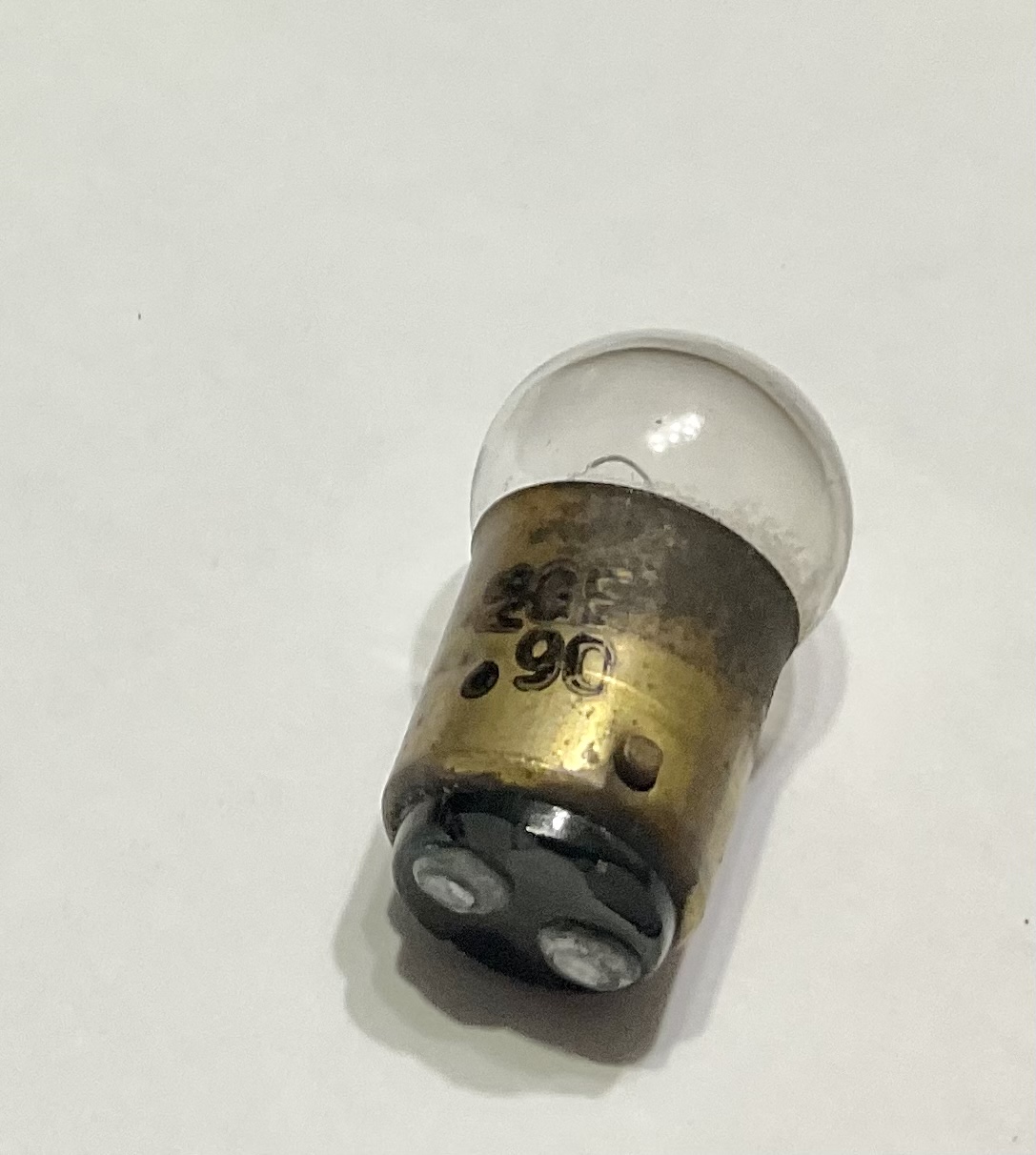
I’ve also finally tried to replace the light bulbs that provide dim floor lighting in the cabin at night. The existing ones work perfectly well (after all, they are turned on at most five minutes per night, only on nights when we sleep aboard) but the risk is that someone might accidentally leave them on all night or for days at a time when we are away, draining ILENE’s batteries. So replacement with extremely low energy LED bulbs is called for. But finding the ones that fit has involved quite the search among various venders. I think that is part of the reason why such items are so expensive— vendors’ high priced talent is tied up with me on the phone after looking at the photos I’ve sent them. Here is one of the old ones, and it is easy to find ones where the brass side prongs line up with the electrical contacts, but these are 90 degrees apart. And the new LEDs can’t be longer than the length of the original ones, installed in 1999. In May be that I will have to use Doctor LED’s generous returns policy if the new ones do not fit.


Boating life, and other life, goes on off the boat as well. 

Lene and I were laid up by a URI for a few days, I devoted a few more to preparing a huge dinner for nine for the Passover Seder and enjoyed theater and my book group.

As Fleet Captain, an appointed position at the Harlem, my mission is to promote cruising, especially the Club Cruise. This year we were approached by our friendly  neighboring club, the City Island Yacht Club, to “merge” our cruising program with theirs. I obtained approval from the Officers and have met, by Zoom and email with them. Their idea of cruising is different from ours: we háve had one long cruise of upwards to 16 days while they have planned monthly weekend cruises. So the trick has been to offer both of these differing experiences to all the members of both clubs. Early polling of the Harlemites suggests that some of us want the type of one or two week cruises we have been doing since I joined about 39 years ago, while others of us are quite content with weekend cruising. Time will tell, and all I can do is help them organize because Lene and I plan to go away to Canada for a two month cruise.

Points East magazine is getting ready to publish the article on our 71 day cruise mostly in Massachusetts last summer in their May issue. They like to edit my prose so I’m curious how it will come out. Here is a rough version of our track during the 48 days we were in Massachusetts, drawn by hand in red ink on a roadmap for Points East to adopt to their style. The red lines in the SW show our entry and exit from Massachusetts while those at the North end show our jaunt into New Hampshire, with the blue circle being the area, at a larger scale, to the left, of greater Boston Harbor, with each of the 24 ports visited labeled in black. 


Soon the fun season will start. My mate is excited about it, issuing invitations to her friends, which gives me joys of anticipation.

Wednesday, April 6, 2022

Feb 20 to April 3 — A Very Long Time Without A Post

Yes, I apologize to you, dear readers, for the long drought of fresh news but the good news is that ILENE should be operational and afloat within three weeks. 
I. TRAVEL
Thirteen of the 42 days in this period were out of state. First a family wedding in landlocked Gainsville, FL. We saw some puddles but nothing to write home about. Next was a visit to our friends, Marie and Tom, in Las Vegas NV, again landlocked but near enough to Hoover Dam for a visit to that behemoth engineering miracle which created Lake Mead behind it.


 The lake had some marinas but unfortunately a real drought, caused by both lesser western rainfall and greater human and farm extraction of water has left the lake/reservoir only 38% full with a 140 foot high white stripe around its rim.

The third destination was Portland Oregon, to visit my daughter and the town of Astoria, near the mouth of the mighty Columbia River with its frequently shifting bar making it a killer of ships trying to enter or leave during storms when wind and tide oppose. We drove into Washington State on the two lane bridge (one each way) across the River, with a high arch over the channel on the Oregon side and then a much longer low causeway the rest of the way across the flats. (Think Tappan Zee Bridge). The highlight, other than being with my daughter, was Astoria’s Columbia River Maritime Museum. Good display of the exciting things about that particular waterway: fishing, navigation, history (think of Lewis and Clark’s destination) shipping and rescue work. Not much of sailing — though they did have a full size sailboat used for fishing. This was not my favorite of the 20 or so maritime museums I have visited, but provided a pleasant informative few hours. 


I also took in the Portland Art Museum where I “curated” for my own pleasure, a show of three paintings in different rooms of the permanent collection. I called it “New England Places I Have Sailed”.
Isles of Shoals, 1907 by Childe Hassam.
After the Hurricane, 1938, by Marsden Hartley, with lobster pot thrown up onto the Maine rocks.

Provincetown Bay, 1950 by Helen Frankenthaler.

Also taking time and attention in this interval was being mindful of the horrific news out of Ukraine where Vlad,  the destroyer, started a modern mechanized war of aggression against his neighbor to conquer the land and its people. And when the war news was south for his war machine he decided “well if I can’t possess it, I’ll destroy it.” Our wonderful president has been able to unite most of the free world to stop the aggression without getting us into WWIII, at least so far. This is how we won WWII: despite the horrible loss of American lives in that war, our losses were tiny compared to the losses of our Allie’s. We supplied the materials but they did the dying.

II. BOATWORK

Only seven days (only four hours per day) of boat work. It has been a light winter for boat work compared with years past. And made lighter by my willingness to pay others to do work that would likely have wrecked my rotator cuff, still healing from last summer, and thereby ruined the summer of 2022, had I done them myself. Chief among them are tasks that David of Marine Detailer and his crew will be doing next week: prepare the bottom for painting by scuffing up its surface with a maroon 3M plastic scrubbing pad, and compounding and waxing the freeboard. I will tape the waterline and apply the bottom paint (which cost more than $300 per gallon with tax this year!) The rear broad navy blue boot stripe that was carefully painted on a few years ago with Awlgrip has spots where the slapping of the water against the flat near horizontal surface has beaten away the “new” paint. My proposed solution is to obtain some scrap navy blue vinyl sheeting used to make boat names and, leaving no sharp corners on each patch, place the patches of this vinyl tape over the paint holes. I’m hoping that from five feet away, no one will notice the patchwork nature of this fix.

The prop and shaft, seen in the last post were sanded quite clean, primed and covered with three coats of ridiculously expensive Marlin, Velex Plus anti fouling paint — imported from Italy!  The bleached out port side interior woodwork was sanded down, stained to its original vivid cherrywood color and has gotten its first coat of protective polyurethane.

The winter covers were removed, the forward half, with its hole for the mast (to the left in the photo) was folded up neatly and placed in the locker in exchange for the small jib which is now aboard and has to be bent on in case of emergencies with the potentially balky Diesel engine during the short passage from the Huguenot to the Harlem.The lighter color in the center of the cover is where it has lain flat in the bleaching winter sun for 20 of the last 23 years. The darker parts at the sides are more vertical, at ILENE’s sides, where the cover gets less direct sunlight. The aft half of the cover suffered a zipper casualty: I could not remove it from the boat without cutting the zipper, and I took it to Doyle’s for a zipper transplant.

Doyle also has the Bimini. It needs patching along its front edge, not just for appearances but to prevent it from ripping out and flogging us at the worst time in a storm far from home. Here too, Doyle got some zipper work. The Bimini is held in place with seven stout zippers. But they need to be lubricated with special zipper grease (fancy Vaseline in a tube that emits a thin bead of it when squeezed). These zippers had been attached and zipped up maybe four of five years ago and I neglected them. By applying both the grease and elbow grease I was able to unzip five of them. The last two were more stuck and I used WD40 as well; but no luck and I had to pry (break) the slider off. Tanks to Dave for his help on this. The good news is that I think Doyle can slide new sliders on a lot less expensively than cutting out and replacing the entire zippers.

III OTHER RELATED ACTIVITY

Dinners 1) at home with Bennett and Harriett, 2) with our club member/cat sitters, Dave and Christine, 3) with our nephew and frequent sailor, Mendy at a steak house to celebrate his being licensed as an RN., and 4) with my book group, all but one of who have sailed with me, at our home to discuss a book set in Trieste, Italy, with foods and wines of Triestian design. Also a lunch in NJ with Roy, who lent me his Maine chart book after mine went missing. His is newer, having been obtained the day we departed from Robinhood Cove to the Harlem last spring on his ketch MS GALSJM last summer.

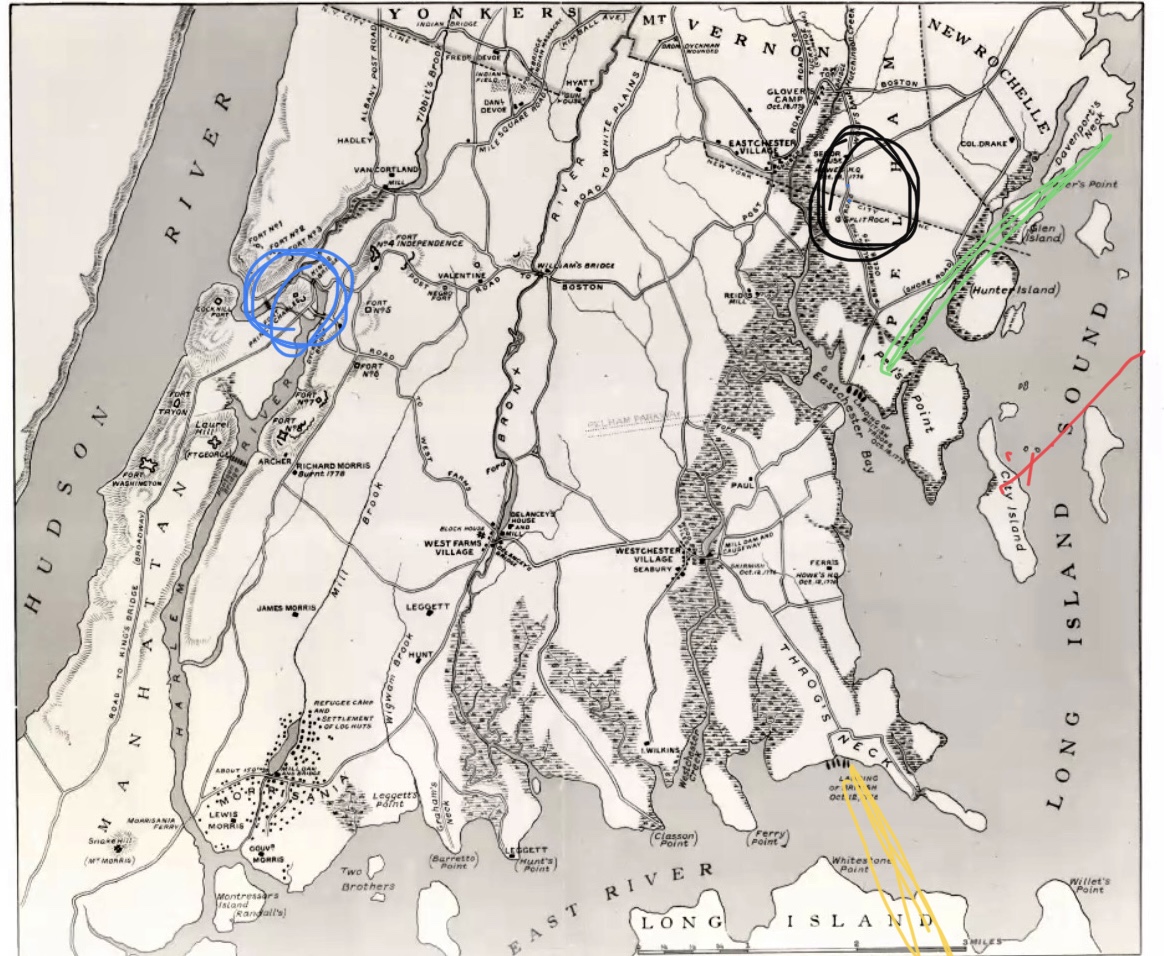
I enjoyed an extremely informative Free Zoom lecture about “The Bronx During The American Revolution. The speaker was the historian of the Bronx Historical Society and the heart of the action was very close to home. The British tried to capture what was left of George Washington’s army in Washington Heights, Northern Manhattan (where I grew up) before he could escape across the Kingsbridge, a narrow bridge a block from where Broadway crosses the Spuyten Duyvel from Manhattan to the Bronx, to go up to fight the battle of White Plains.  The first amphibious landing was on Throggs Neck, where the NY State Merchant Marine Academy is now. The 4000 men were set to hike west across The Bronx to Highbridge, but they were unaware of the swampland they would have to cross, got bogged down, backed off, regrouped, and landed on the west side of Rodman’s Neck. That is the peninsula of land directly in front of our dock, where the Police firing range is today. The 4000 landed, again without opposition, but were confronted by about 750 colonists under John Glover with orders to retard their progress. His men hid behind a series of parallel stone fences. When things got too hot for them at one fence they repeatedly fell back to the next fence.  This battle of Pells Point delayed the British advance long enough for Washington’s army once again to effect a Houdiniesque escape. This map shows the action: The red line points to the Harlem YC on City Island. The blue circle is Kingsbridge, the escape north from Manhattan. The Yellow lines point to the site of first landing and the green lines point SW to the second landing site in Eastchester Bay. Finally, the black circle is where the battle of Fells Point was fought.
Back yard history that I had never known!

A membership meeting at the Club which almost did not come off due to a lack of a quorum, which in turn was due to the lack of controversial business, in fact the lack of any business at all. But our hard working Officers and Board had prepared reports on their recent accomplishments and near term plans. So we had the meeting anyway, without the quorum (except that “approval of the minutes of the prior meeting” — everyone’s favorite part of a meeting, right! had to be defered).

We had an open house to show the Club to anyone who might think about a good place to keep a boat. They drink our wine, taste our food and experience friendly members. I’m a lousy salesperson, except when I’m convinced of the superiority of the product in question. Met some interesting new members.

Our hard working Board member, Erin, tasked with both the social committee and the restaurant and bar committee has come up with some interesting events. Erin is a “social” member: lower dues, no boat -yet and no membership vote. We wisely amended the Bylaws a few years ago to permit up to two members of the Board (also known as “hard working unpaid servants of the members”) to be Social members. I’ve tried to pay Erin, in praise in lieu of cash, by telling her that with her dual portfolio she is, “Doing the work of two men!”

 The Club’s St Patrick’s Day traditional Irish dinner — you know the menu — but more varied, plentiful and excellent. Thank you Chef Anne!
Before dinner, Erin arranged for a troop of young people and their leaders to entertain us with Irish Dancing. This picture shows the most essential element of their uniform: the smile. After their performance each dancer picked a partner from among us older sailors and we danced some square dance moves to the Irish music they brought. I believe that the last time we were entertained by such dance was perhaps 25 years ago, when Sean Doran was social chairman. The Club’s floors, underfoot, were recently refinished.


“Knot Night” was, to my knowledge, a never-before event that Erin dreamed up for us. Free admission and each person received a coffee mug decorated with knots and with a cleat for a handle, two lengths or line, a booklet prepared for the event from a thick treatise, illustrating how the most essential sailing knots are tied as well as a delicious Dark and Stormy and a tray featuring Anne’s Hors D’oeuvres.

Rear Commodore Doug led the class with John assisting at the rear, and several others who “know the ropes”,  like me, unofficially assisting as well. Social, educational, eating and drinking: this event had it all!

My next post will be LESS than 42 days from now; I promise!

Tuesday, February 22, 2022

Feb 1 - 19, 2022 — Only One Work Day On The Boat But Lots of Activity With Sailing people

 The one work day was Feb 18, a beautifully warm uncharacteristically spring-like day. I got supplies from our locker at the Harlem and spent 3.75 hours at the boat st the Huguenot. There I connected our boat, Bennett’s, Roy’s and David’s to shore power. Roy had connected ILENE twice, for a total of 2.5 hours in the interim, but she was not hooked up with the battery charger on, as she is now, so those hours were wasted and her charge was low. Next time I’ll get her batteries filled to the brim. 

Primary activity was final scraping and first sanding of ILENE’s prop and shaft, and lubricating her prop.

This picture shows one side of one of the three blades of the prop sanded. I did the other five as well. It also shows Roy’s boat to ILENE’s starboard side, coated with grey barrier paint. Before I finished, the merry cheerful ban of five Hispanic coworkers had returned and Roy’s boat’s bottom is now barn red. I was somewhat envious of the jollity of the painters, though my prop work is a one man job. But my constant companion, National Public Radio, makes the time fly by.

Lubrication consists of pressing fresh heavy yellow grease into the prop’s hub. It is an annual springtime ritual. Three Allen nuts are removed, one at a time, and replaced with a zirc fitting. Placing the discharge end of the grease gun over the protruding end of the fitting and squeezing the gun forces fresh new yellow grease into the propeller hub, which forces the air, seawater snd dirty brown grease out of the hub between the two sides of the hub and through the three holes in the hub from which the blades protrude. Then I remove the fitting, reinsert the Allen nut, tighten, and it’s done. Only problem this time was dropping one of the Allen nuts from my greasy fingers onto the camouflaging blanket of gravel on the ground. No problem, because I have a spare, but a diligent search discovered the errant nut.

I also brought the last two Dorade cowls home for painting the inside white and shining the stainless of the exterior. 


Lene’s birthday and Valentine’s Day occurred during this period, the first with a good steak dinner at Quality Meats steakhouse in midtown, and the latter for a good home cooked and home baked dinner at our home with sailing friends, Bennett and Harriett.Two lunches out with gentlemen from by book club and a meeting of the club to discuss our February read: “How The Word Is Passed” by Clint Smith. A very worthwhile book, it tells a lot of facts about the history of slavery in our nation by describing what the author learned during visits to eight sites that exemplify the horrors. One of those horrors was the dreaded “middle passage” in the holds of slave ships. (a nautical angle). Also, Lady Liberty, the gift from France to celebrate immigration, was first intended to celebrate emancipation: she held a broken chain in her hand rather than a book. And the chains are still in the version of the statue that has stood in our harbor for 150 years, but they are at her feet, visible only from the windows of a helicopter. Why the change?  Fund raising to build the pedestal was not successful with a racial theme. Nowadays it would not have worked out with a pro-immigration theme.  A zoom meeting of the Map Society of New York featured the presentation by its author/illustrator of her book showing the development of Manhattan over the past 400 years through maps.

Our Club’s fifth land cruise of this winter came off last week. We visited the Queens Museum, with its vast 1” = 100” scale model of the city built for the Worlds Fair in Flushing Queens and last updated in 1992. (So the Twin towers still stand on the model, not the Freedom Tower.) Above is the apartment house where Lene and I live, in the red circle with the green of Union Square to the left.

But we discovered an error in the diorama which purports to have a scale model of every structure in the city. City Island is of to the side but zooming in we saw that while the clubhouse and locker house are standing, but not our dock — and it has been there, on the same concrete pilings since way before 1939.

But why get upset. Delicious lunch was partaken at the nearby Parkside Restaurant.