"There is nothing more pleasant than cruising on a boat with the whole family."
Letter from Empress Catherine the Great

Wednesday, May 17, 2023

May 9 - 14 — Six Days. — First Three Sails, One That Did Not Come Off And More Repairs Needed

 Before the sail days, one devoted to getting the dink ready for use. Thanks first to the Harlem’s Marine Committee for forklifting it from the top of the dinghy rack and transporting it via forklift the hundred yards to the edge of the seawall. I got its air pump, paddles. Anchor, thwart, fuel tank and fuel hose from the locker, inflated it, pushed it off the seawall into the Bay (at high tide), and towed it (by pulling its painter) out along the pier to the floating docks. There after clearing a temporary space by crowding its neighbors, I pulled it up onto that dock, washed the worst of the winter’s dirt from it and accepted the help of Pat, who has helped me so many times in the past. Yes, it was time to carry the outboard down the flight of stairs in the locker house, transport it from there to the floating dock and mount it on the transom of the dink. The last, the mounting, is a task that I absolutely cannot do alone, but Pat helped with the whole dink process. Pat also pointed out that the outboard’s sacrificial zinc is getting eroded and I’ve ordered a replacement for 2024. All the dink needed at the end of the day was fuel in her tank and that my prayer that the winter had not caused damage be answered.

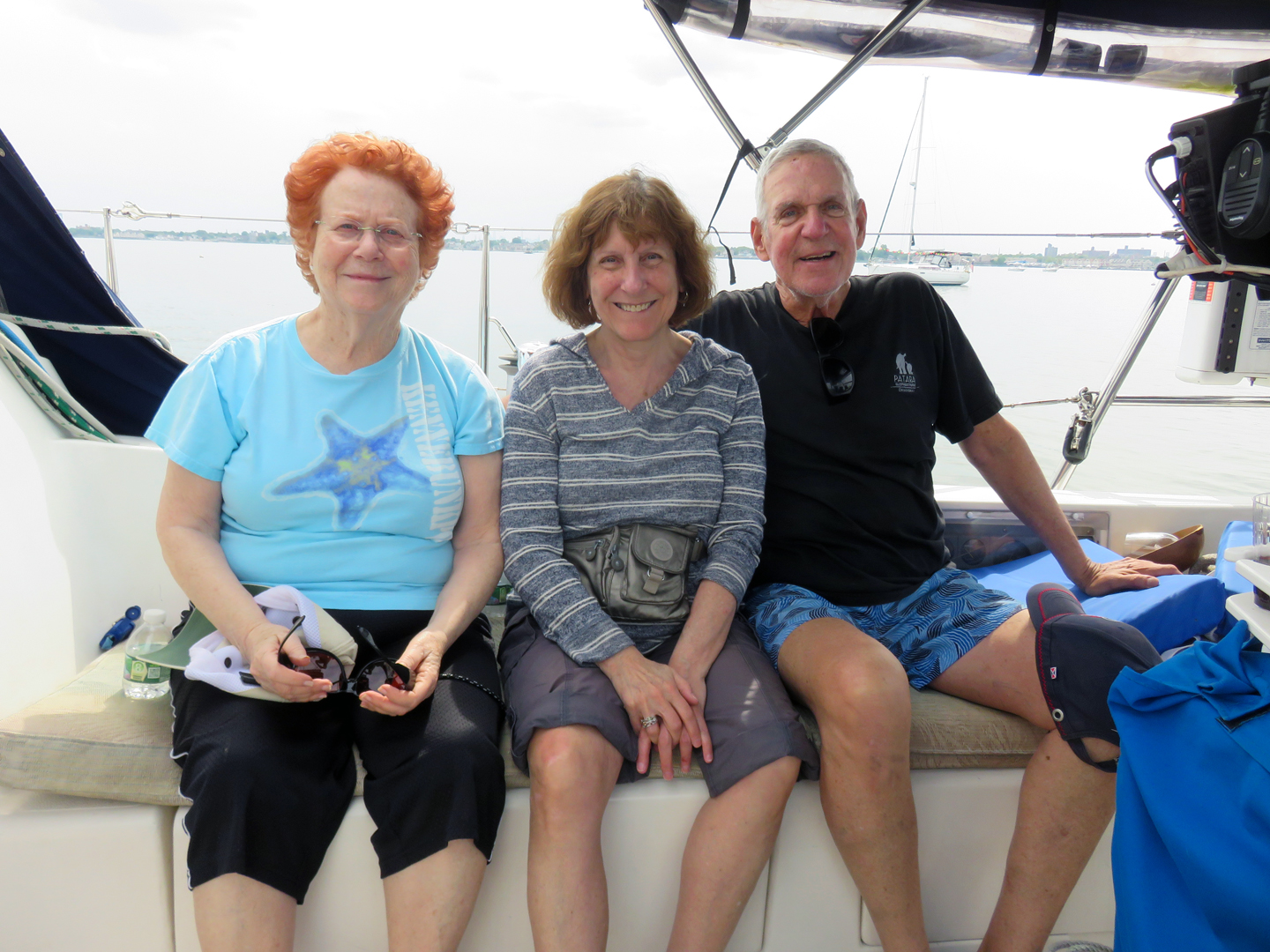
The first sail was with the Old Salts on Wednesday afternoon after lunch at the Club. With eleven souls, we would normally have used only two boats, but three were available and each Captain wanted to sail his own boat — at long last!  ILENE’s crew consisted of my helpful friend Samuel (left) and Phil, who is in the process of getting qualified to use our Club Boats. Both are avid punsters (which I tolerate fairly well)  and cat lovers.

We were underway for two hours (with .2 hours of engine use) and we tracked five NM. The wind was light at first, disappeared totally in the middle and came back up as we were heading home.
We headed in the general direction of the Throggs Neck Bridge, tacked to pass south of Belden Point and soon after that essentially retraced our course on the return. (With variations, we took the same general route the next two days as well.) Today’s was not exciting sailing though ILENE did achieve a big five knots at the end. The other boats were Bennett’s “Ohana”  and Dave’s “Lady Kat”.  The après-sail:


Friday we were set to meet at two with Tom and Marie but a bit of a late start and the short hours that the Harlem is operating the one launch in the water in this early season (with most of our boats not yet launched) meant we would have to be back on the mooring and ready for pickup by the launch by 3:45 pm. This would have made for a very short sail indeed. So instead of sailing we tried to entertain our guests on the mooring, before dinner. Actually, it was Lene who did the entertaining because I spent most of the time on launching and starting the dink (yes, she started right up); driving it out to ILENE, hauling it up on its davit bar and securing it to the aft pulpit. Hauling and securing is normally a 15 minute job but it took an hour. This because I failed to remember that the aft davit bar, from which the dink hangs, was still lashed vertically to the aft tube of the radar arch in its winter position. I had not swung it aft and lower to its summer position. I was wondering how the tackles had “shrunk” so much; they were not long enough to reach down to the lifting straps in the dinghy. Anyway, in the end I figured it out, lowered the davit bar and everything fit. We made it ashore by 4 o’clock. However, that interfered with the dining room’s schedule which called for the kitchen and dining staff to have an hour off between four and five. But the bar was open and we entertained ourselves until five and had
dinner and called it a day. 

Saturday I sailed with three people from my Temple’s Torah Study Group. Tacking by Throggs Neck and on that tack going  just past  Ex Rocks with the return through Hart Island Sound. There was little wind except for about 20 minutes when we were able to achieve 5.4 knots shortly after the turn toward home. Then came half an hour of motoring in dead calm.

                     My companions consisted of Bette, a veteran of last year’s Torah Study cruise, and rookies: MIke and Marlene. 
                     As we were approaching Big Tom 2 from the East, my AIS displayed Hidden Hand, headed south. David did not have VHF turned on, and again I had accidentally left my phone home with his number in it. So I closed to within hailing distance and yelled my Ahoy. David replied that this was his first sail to which I replied “My second!
               

    Sunday I sailed with two young fellows, Julian, to starboard, a social worker, who sailed with me once before, and Manuel, a Corsican born IT guy,  in blue.  Manuel  had sailed in Europe. Julian is handicapped by a visual impairment.  He valiantly tried to steer by the compass card alone, which is difficult to do even for an experienced helmsperson. But without also being able to look at what was ahead, his attempt proved impossible; I had to reassign him to winch duty which he accepted cheerfully. Julian’s indomitable good spirit caused him to enjoy the day. The course was essentially the same as Saturday’s and in only a slightly shorter time period, but we had gusts to 20 knots on the long outbound tack which, with main and small jib, got ILENE’s boat speed up to as high as 8.4 knots. We went farther than the day before, half way across the mouth of Hempstead Harbor toward Matinecock Point before tacking over to the New Rochelle side and then turning back. And instead of motoring back at 3-4 knots as we had done the day before, we sailed back with very light air at 2. The wind shut itself off suddenly when we were off New Rochelle and came back softly, very near our stern. So we experienced both the thrill of speed and the joys of a gentle ride.
                    A new problem emerged that has to be solved very soon (before we leave for Canada on June 1): after three days of good service  Auto is not working: the display powers up but pressing “Auto” only gets an error message “AUTORELSE”  that is not described in the manual and a soft beep. And the display of the angle that the rudder is turned shows the rudder turned  extremely to port when in fact it is rather centered. My preconceived speculation was that the failure is in my rewiring of the “rudder angle indicator” component.  I  read the manual and called Raymarine; the tech support person confirmed my suspicion and gave me some tests to make with my Multimeter, to find and fix the problem. But sadly I fear I’ll need some help to understand exactly how to do this.  During the sail I was very pleased with Manuel’s  sailing experience, when I had other things to do. Back at the mooring the guys lowered a bucket for water and scrubbed the guano that the birds had left on the sail cover.
                     More to come.

Tuesday, May 9, 2023

April 28 - May 8 — Floating And Ready For First Sail

The day after I brought ILENE around from the Huguenot to the Harlem I retraced that path, helping Bennett bring Ohana around. But Ohana’s sails were mounted and we enjoyed a pleasant sail. - our first of the season. On both days I passed David’s “Hidden Hand” on her mooring at the City Island YC.  And on both days we had a brief wait for 2Cs to put the bridles on the moorings.

Three days at the boat on its mooring to report — short days partly because launch service ends at 4 pm. The mission, each day in addition to cleaning, was primarily to mount ILENE’s sails. The first try it was blowing with gusts to 26 knots. That is not a condition in which to be trying to mount sails on a mooring. When up or part way up, before furling, the boat veers and the headsails cross from side to side and are likely to blow me overboard. The other two days I was helped by Samuel, who had a day sail with me last summer and is an eager and quick learner. Thank you Samuel! But we only got the small jib and the main up. And the main still needs one short batten - all five were cradled together on the deck last fall but one walked away. Fortunately, Mark, P.C., bought a new Mainsail this winter for his catamaran “Deuce of Hearts” and offered me one of his old ones. Thank you Mark! 

The Genoa is not up because once up it must be furled and before the attempt, I tested it and the furler drum is corroded and does not turn freely on the forestry. So Rigger Jeff Lazar will be visiting ILENE soon, to fix the furler. The Genoa our least used sail;  Lene, if she had her way, would never fly it. 

In any event, once I provision her with bottles of beer, water and seltzer ILENE will be ready for the inaugural outing of the Old Salts on Wednesday.

The longest day was Saturday, May 5. It was the Harlem’s annual Spring Work Party, and by all accounts the best attended and most productive in memory. Thirteen separate projects were accomplished including three to repair and protect the docks, one for the winch house (used to launch and haul out boats), groups that polished all the silver sailing trophies and did the gardening and the group I got assigned to which lightly sanded and painted the railing around the deck. We started with only six of us doing the sanding, which was not done as thorough as I would have liked, and grew when we got to the painting until, at one time we had ten brushes working, six of them shown here. 


It is kind of like the building of the a Great Wall of China: throw enough of us peasants into the job and it is amazing what can be accomplished. When they first opened the can the paint looked pink but it dried a nice shade of barn red. Our club is grateful for its leaders who planned the projects, shopped for all the supplies and tools and organized the rest of us into teams. Inside and out the rail now looks pretty good and hopefully will last a few seasons. I went around at the end pushing extra paint into all the upward facing cracks and crannies, to try to keep water out. We “charge” a $25 fee for those who do not attend, which is very cheap compared to four hours of physical labor, but the charge is more of a request for a contribution—unlike the practice at some clubs, the fee is not enforced. In fact, the two work parties per year are great social opportunities to get to know members and make new friends. It reminds me by a weak analogy of Tom Sawyer’s fence painting party.

The bagels and coffee had been served inside the greenhouse before and lunch was on the patio, after. I have to hand it to our caterer, Anne and her crew. She had served a packed Cinco de Mayo party the night before,  a baby shower in the part of greenhouse behind the painters while we epwere working, a first communion party for a family of about 16, our ”free” lunch and then she ran a bourbon and mint themed Derby party in the evening. 

But between the work party and the Derby party we had a well attended membership meeting. All good news: the Small Business Administration loan that we took to repair the Clubhouse after “The Storm of the Century” nor’easter in 1992 has been paid in full and SBA returned a thousand dollar overpayment and reported that we had never missed or been late with a single payment.  We have more money in the bank than usual, membership is increasing, activity, the lifeblood of any club, is bounding and perhaps best of all, there was none of the snide back biting “questions” that made such meetings a hostile environment when I joined about 30 years ago and during my first decade. We have come to appreciate the diligent competent work of our elected volunteer leaders.

I had come to the Club by public transportation and got a ride to his home in Alpine NJ with Bennett, where Lene had driven, and we had a gourmet dinner cooked by Harriett before a round of games and a drive home. A long but fun filled day.

My next post will report on Sailing!

Saturday, May 6, 2023

April 24 - 27— LAUNCHED Apr 26; On Home Mooring Apr. 27

 This was a crazy tense period due to the pressure Huguenot puts on boaters to get launched early under threat of financial charges. It is not that they need the land on which the boats are stored on jackstands for parking cars or any other summer usage. Nor is “the rush” needed so they can lay off their yard people for the summer because they keep their staff salaried year round. I like to launch early which is better than the Harlem’s policy, under which launching is just getting underway and our parking lot is still full of cradled boats. It seems a friendlier middle ground would be preferable. For me, the rush  involves responsibility (to get launched)  without authority (over those whose efforts I need to coordinate to get me launched) which combine to aggravate my underlying anxiety. Here’s what happened.

Monday April 24: I got two calls five minutes apart. David Detailer called to say the freeboard was done. “What about the bottom?”I asked. ‘Oh, you wanted me to do that too?”  He had forgotten (it is the height of his short busy season) but he promised it would be done on the 25th. Next a call from the Huguenot: “We will launch you on Wednesday the 26th.”  “When is the high tide that day?” was my question. “At around five in the afternoon.”  So I figured this might actually work out. I called 2Cs, our mooring maintainer, saying I’d be on my mooring on Thursday, the 27th, and please call me if for any reason you won’t have my mooring set up for use by then.

Tuesday April 25:  I was there from 2 to 5, but David’s crew was painting another boat and told me they had one more to do after that before they would get to ILENE.  I used a roll of their tape to tape off about half of the waterline and some of my half gallon of bottom paint to hit the spots that need two coats: the leading edges, the tough to get spots and those where the barrier coat was showing through. At five I looked up and David’s trailer was gone! So that leaves tomorrow morning for the painting and I called David when I got home but he said that his team had gone to dinner and was actually painting ILENE’s  bottom as we spoke.

Wednesday April 26: I took the three sails down from my locker at the Harlem and loaded them into the SUV. Arriving at 1:30, with plenty of time to get ready for a launch around 5, I found the Huguenot’s yard men, Orlando and Gus, busy removing the tacks of ILENE’s two head stays. Her bottom was painted except for the seven spots where the jackstand poppets were pressed against her hull. It turns out that with the dredging done during the winter, the Huguenot is not dependent on high tide to launch and planned to launch me much sooner than I had thought. I carted each sail from the car to the dock where they would tie me up for the night. That way it is a lateral heave of each sail from dock cart to deck. Parking the car I returned  to the boat and she was up in the slings already with one of David’s guys rolling bottom paint onto the seven poppet spots. Not a lot of time for that paint to dry. Hope for the best. They were ready to drive the travel lift to the launching well but I said wait a minute, put the ladder back up and went aboard to reconnect  the raw water intake hose with its hose clamps and check that the seacock was open so as to be able to turn on the engine when the seawater intake got lowered into the water.


Launched at about 2:30, and that’s when the problem started. 1) The Yanmar purred to life as if she had only been shut down two minutes ago; that’s good. 2)  No water running into the bilge; that’s good too. 3) But unless cooling seawater is pumping through the engine, it will burn itself up in a few minutes. And no water was coming out of the tailpipe, seen to port in the upper photo, above. I let it run for about a minute hoping for a delayed reaction, but no luck. So I shut the engine down. What to do? I called the ever helpful Dean of “Autumn Born”. He was still in Vero Beach, Florida, awaiting the start of their migration north to their summer berth in Catskill, New York, near Albany. Dean is an engineer and has helped so many people so many times. When I told him what had happened he said, “Oh, that’s an airlock.”  My next question: “What is an airlock?”  He explained that an air bubble can block the passage of water to the raw water pump and what I should do about it. Meanwhile, I helped the yard men tow ILENE about 100 feet from the slings to the dock where she is seen in the lower photo above using her dock lines. I put the sails on deck, filled the port fresh water tank with the dock hose through the filter, and washed off much of the topsides before taking the ladder back to my locker at the Harlem for the summer. Not a good night’s sleep - worrying about how I was going to accomplish something I had never done or seen done, just by following Professor Dean’s advice.

Thursday, April 27: I dropped off the SUV for an oil change at the auto mechanic and walked the last .8 miles to the boat, arriving at about ten to fix the airlock and get ILENE out of Dodge. When the water enters the boat (through a seacock, so it can be shut down when a link in the hose is open)  it goes through a raw water strainer, then by hose to and through the condenser of the refrigeration unit and finally by another hose to the raw water pump on the engine which pumps the same seawater through the engine and out the tailpipe. First step was to remove everything from the aft cabin including the mattress and the boards covering the aft end of the engine, setting up  work lighting and the heat gun used to soften the rubber hoses so their ends can be taken off the fittings they are attached to  and gathering the tools needed. Then came the hose removal. I took off the one from the raw water strainer, opened the seacock,  saw water gush into the boat, closed the seacock and reattached the hose. This was proof that the airlock had not been reached. The same operation at the other end of the same hose where it enters the bottom of the Condenser. Open seacock, see lots of water gush in, close seacock. Next came the hose from the top of the condenser.


This photo shows the condenser, it’s discharge vent, top left, with it’s hose taken off, sticking up on the right, next to the toe of my blue sneaker. But this time, when the seacock was opened, no water came running out of the Condenser. Airlock found! But how to get rid of it. I couldn’t pour water into the plastic fitting shown at the upper left because water does not flow uphill. (Later I figured that if I took a short hose, inserted it inside that fitting, bent it upward (U shaped) to a higher level than the fitting, and put a funnel in the other end of it, I could have poured water into the condenser. But all I could think of was Dean’s reference to the dock hose. But how? I tried to tape the end of the dock hose to the empty fitting but this wouldn’t work. 
Then came what for me was an inspiration! I reattached and clamped down the hose shown in the picture and went back to the hose end where water exits the raw water strainer (where I had started) and re-detached it. I stuck the end of the dock hose into it and clamped it tightly using the hose clamps. Then I turned on the spigot at the dock, held my breath and turned on the Yanmar. SPLUSH, SPLUSH, SPLUSH!  It worked! The air lock was pushed through. I called and thanked the professor.

But by now it was after two, time to shove off if I’m going to get on my mooring before Harlem launch service ends at 4 pm in this early fringe part of the season. No time to mount a sail as I usually do. I came out from behind Glen Island on its western side and ran the engine at 2000 rpms. With both seas and 12 knot winds on my port quarter and a perfectly clean bottom I was making 7 knots!

And great news: the 24 year old reinstalled autopilot worked like a champ. One feature of it is a three digit display of the boat’s magnetic heading on the key pad in inch high LCD numbers. I had always ignored it, looking at the actual compass instead, because the LCD display was always some 20 to 35 degrees wrong. Now it matches the compass reading. It is better than when I got the boat! After testing it I let it steer us home while I went forward to gather the dock lines and fenders, etc. and coiled and stowed them and the hose etc. Rounding Belden Point into Eastchester Bay, we were in the lee of City Island. I got a phone call on my cell phone, from who?  Oh, it’s 2Cs: “We saw you come into the Bay, we are on our way, and will have the bridle on your mooring ball in ten minutes. So I circled, they attached and the bridle hardly had a chance to get wet before I picked it up. Boat secured I called the Harlem’s Senior Launch Operator, David, a constant at the Harlem for many years. He came “alongside shortly” as he responds to the VHF, and took me to the dock. I chatted with him about my plan to have Uber drive me to the auto mechanic to retrieve my car and he said if I could wait til he got off, five minutes, he would drive me there because he passes the place on his way home.


So while sails are not mounted, the season has begun . But ILENE is lonely out there (in the gap between the right two Adirondack chairs).

Wednesday, May 3, 2023

April 15 - 23 — Four Work Days, Three With Lene and a Maritime History Lecture

Good news and bad about this summer’s  cruise. Well my mate had five separate medical problems in March and April! Most have a new drug to try to control them. But the potential effects of the drugs on her and interactions between them are not yet known. So Newfoundland, where medical care may be as much as 36 hours away, had to be scratched. I often stubbornly take abandonment of goals badly, but not this time.  And Prince Edward Island, another place that neither of us has ever been to, much less sailed to, is being added. So the bad news is not that bad.

The good news is that I’ve never seen Lene so enthusiastic about a cruise before. She has purchased enough cat food and litter to last into September as well as pharmaceutical supplies. She is arranging for our crew to see their vet and actively planning with me. And she has worked on the boat three times during this period, partly inventorying what we have so we can determine what we need to bring on board. Because we plan to live aboard for a week before cutting the plug to home — to let our contractor move our furniture — to rip out the old and lay in new wood flooring, we will have time to “remember what we forgot”. The rest of her time was devoted to interior cleaning, a task in which I joined.

I also put the steering wheel in place, reinserted the canvas covered rubber rollers on the transom lifelines after a good scrub in strong cleaners and zinced and lubed the prop.

Lene watched the rudder while I pressed the Auto Pilot’s buttons and not only did it move, but it moved in the correct direction. Whether or not  it is calibrated remains to be seen. I finally got the wood around the back of the galley range back into place. I applied some stain to portions of the interior woodwork trim where needed.

I also poured 1/3 of a gallon of distilled water into the 18 cells of the six ”house bank” batteries. The boat is starting to look good. The only disappointment among so much hope is that when it rains hard water still comes into the boat through its coach roof. 

But it was not all work. Club Freetime advised of a free lecture on the concept of “Maritimity” in the time of Russia’s Peter the Great. He called St. Petersburg “The New Amsterdam”. I’m always interested in things salty and having cruised from Amsterdam to St. Petersberg and back on a floating hotel, and visited the Svarlbard Achipelago last summer on a different such craft, I figured this lecture would be in my wheelhouse. Our lecturer, who escaped from Putin to a position at the University of Genoa, his introducer, me and seventeen faculty and PhD candidates were in a seminar room in Columbia’s School of International Studies. His argument was that “The Great Divide” between the wealthy Western European nations and the poorer ones to the east, including Russia, was the result of the western nations developing and exploiting the sea.
Peter, he thought, was a visual rather than an analytical thinker. He made a grand tour of many European capitals which just happened to coincide with the year that the Atlantic yielded record tonnage of fish, and he could not contemplate that fisheries could become commercially extinct. 
Our lecturer described a nation’s “maritimity” in terms of its having a great port and an “Admiralty-like” organization. He tied in “Cabinets of Curiosity”, namely museums of sea specimens and cuisine: oysters and herring, which, after the Tzar acquired a taste for them, the lesser classes did as well. But those sea foods could not be grown in Russian waters. Though Russia had access to the Baltic and the Med, his fishermen, having fished out the whales from Svarlbard, reported to him that whaling could not be accomplished with commercial success. Peter ordered his shipyards to build Dutch style ships but they simply did not know how to obey his orders. So the lecture was somewhat more theoretical and abstruse than I had expected, though interesting.
Two other nights of theater with Lene and sailing friends who are also actresses. One with with Elaine in a MFA production up on Morningside Heights and the other with Dana, playing Titania in scene from A Midsummer’s Night Dream at the Player’s Club on Gramercy Park.

Friday, April 14, 2023

April 4 - 14 — Slow Progress and Hidden Hand Has Already Been Launched

 Yes, my friend David’s boat, bring one of the last to be hauled out last fall, was located rather near the water, thus blocking in other boats including ILENE, that were hauled earlier in the fall. David faced a fine or penalty if he blocked another boat on or after April 11. He got his boat ready and she was launched on time, on the tenth, but ran into trouble, fortunately no injury, because the Huguenot forced him out at New Rochelle before his own club was ready to help him get in from his mooring at the City Island end. Huguenot has always forced people out before the rest of the sailing world’s season has begun. In my early years with them, the deadline was before many insurance companies began “in water” coverage. And I have never understood the artificial deadline pressure so imposed.

I have not prepped ILENE so quickly but she is blocked in by many other boats and is ready to be painted and polished by the professional contractor who will get the job done on time.

Six days at the boat of eleven days in this period, about 4.5 hours per day.

Winter covers, poles and accessories are in my locker, under the sails which get removed from them first.

Stanchions and lifelines inserted and locked in. The reason I had so much trouble bolting in one of the stanchions last spring was that despite what I had thought was careful labeling of each of the six stanchions with bits of masking tape, I got two of them mixed up with the hole for the securing bolt through one socket base misaligned with the hole in the stanchion in it.All went smoothly this year once this got straightened out.

Most running rigging restored to summer position. I got help from Samuel hauling me 3/4 way up the mast in the bosn’s chair to reinsert the port stack pack halyard  that had come loose and blew down during the winter. Sam also helped with reinstalling the cabin ceiling panels in the salon. These were two tasks that I could not have done alone unless I had at least three hands. He also helped me by controlling a line around my waist and run to a winch while I stood on the edge or the transom to reinstall the two antennae and the blocks to haul the dinghy back up there. These transom tasks were not impossible to do alone, only unsafe. Freed of the need to use one hand to hold myself on and prevent falling 20 feet to the ground below, I could use both of my hand for the work, which was done easily and quickly. Thanks, Samuel, you were also a better companion than my radio!

Final coat of poly in the galley; it will look good once the tinker toy parts are all in their proper places, which can be done after launching.

I reinserted, physically and electrically, the five pieces of the Autopilot after their return from Florida. For two of the five the  wires simply get plugged back in. For each of the other three parts, I had been required to cut the electrical wire connecting it to the other parts, to remove it from the boat. Rewiring was when the frustration set in. I could not crimp on the butt connectors with the tool that I have been using successfully for that purpose for decades:

My problem was that each wire contained five plastic covered thin wires  (they call them “high gauge” wires for some perverse reason) in close proximity to each other, I could not get the crimping part of the tool, the part between the pivot point and the red handles, into place between the separate wires because it was too wide and I did not have the grip strength, from the awkward position I was lying in to grip the handles strongly enough to push the bump part of the crimper  through the plastic cover to crush the inner metal tube onto the wire firmly enough to prevent the wire from slipping out of the butt connector.  What to do? Or as the Psalmist wrote: “from whence shall come my salvation?”  Dean, my ever helpful “professor”, who has helped me from the first day me met in the Intercoastal Waterway off Beaufort, South Carolina in the spring if 2012, was only a phone call away, on his boat, “Autumn Borne” in Vero Beach, Florida, where he was about three weeks before commencing his migration north. He said I should get myself a Klein brand single-purpose crimper tool for about $30. He sent me a picture of his, with his boat’s initials marked on it:
The crimping vise is small enough to get in between the separate wires to do the work, and the tool is nine inches long, allowing lots of pressure to squeeze the butt and secure the wires. I bought the Klein tool and set to work. Another problem was that ILENE’s manufacturer had not left an extra turn of wire so the two ends barely met. This was fixed by connecting about three inches of spare white wire between the two ends. The next picture shows to assembly, before sealing with plastic, at the most accessible of the three, the electro-compass, just below the cabin sole. Five red butt connectors are toward the left and two connector blocks are to the right. The green wire is easiest to see, starting from the compass wire side, through its butt connector and white extender, to the topmost white block and then to to end of the wire at the bottom leading aft the the computer. It is all folded, wrapped in a sheet of plastic,  its seams sealed with electrical tape and the bundle secured by a plastic wire fastener screwed to the wood at the lower left.

Two of the five parts attach physically to parts of the rudder so the work had to be done in the cramped dark uncomfortable space below the cockpit, aided by a strong task light and flash light. For one of them I had to disconnect the other end from the rudder and in so doing, being a klutz, I dropped one of the two small machine bolts which had been in place since 1999. Fifteen minutes of searching with a strong work light proved fruitless so a trip with the remaining bolt to Buddy’s Hardware Store on City Island was required to buy a box of five replacements. And anxiety builds over whether the auto pilot will work at all, and if so, properly, after all this investment of time and money.

I mixed up four tiny batches of two part epoxy and “micro bubble” dust into a paste to apply in layers to fill the nick in the trailing edge of the keel and the four holes I drilled into the rudder to let out potential water and sanded them all smooth to be ready for bottom paint.

And the final task accomplished so far was sanding bare, wiping with Acetone, applying one coat of primer and three coats of  $pecial expen$ive Italian Velex bottom paint to the shaft and prop. 

David Detailer’s crew will scrape and paint her bottom and clean her freeboard next week. All I have to do is  lubricate her prop and apply new zincs. 

Spring was short, with summery near ninety degree days.

Tuesday, April 4, 2023

March 8 to April 3 — Well The Winter Cover Is Off; A Sign of Progress

Four work days totaling sixteen hours. One with David of Hidden Hand. We have a symbiotic relationship: he needed to bring paint from his locker at the City Island Yacht Club to his boat. I needed to pick up and pay for my repaired sails from Doyle Sails and bring them to my locker at the Harlem. His prime activity at his boat was to find out if his batteries had held up through the winter with assistance from his solar trickle charger —they passed the test. Pleasant conversation makes the work go faster.

I’ve applied two coats of polyurethane to the cherry wood but at least one more coat would be useful generally. But after a light sanding, the third cost is definitely needed in this case, because the old brush I used for coat two (now discarded) had not been cleaned thoroughly enough Tiny specks of dried paint came off the brush and are “glued” on the wood.

I also attached the new slippery ring/spectra lead for the snubber line, but I think maybe I should attach it to the stem of the boat using a thicker diameter shackle that will more fully fill the hole through which the shackle passes. I did smear more sealant into the top of the new rubber mast boot cover and believe the leak is finally fixed. Samuel, a non-sailing friend  (well we did enjoy a day of sailing together), is scheduled to come out next week for fellowship, but primarily to be useful. He will hold up the cabin ceiling panels while I screw in the battens of wood that hold them in place.

But as noted above, the heaviest job was removal of the two halves of the canvas winter cover. After untiring, unzipping and dropping to the ground beside the boat, each must be stuffed into a cart, dragged to a flat plot on the far side (the leeward side) of the hill, dumped out, spread out flat, folded into a neat package, tied up, carted to the car and loaded in in it, together with its poles, pads, and tie down lines. The covers are now in the car, at home, awaiting my next trip for shlepping up stairs at the Harlem for stowage into the locker. 

All five pieces of the Raymarine Auto Pilot are back on the boat, waiting for me to reinstall them. Their travel and the work of testing and shipping cost almost $500. But the techs, having fitted all the pieces together on their test bench and tested each singly and in combination with each other found nothing wrong!  I credit them with actually doing the work they claimed to have done, and with not intentionally trying to gaslight me, but I was not crazy when I saw the system stop working properly late last summer. So after I get all the pieces physically remounted and rewired, I need to find a local tech to recalibrate and hope it works. Frustrating! 

Several events at the Club. 

—A traditionally delicious  St Patrick’s Day dinner after a club membership meeting. No pressing business to transact, which was a good thing because we were one member short of a quorum — probably because of the lack of controversy. So the meeting went merily along as an info share, but without legal effect.

—An open house to show prospective members our charming friendly selves and our Clubhouse and to give them some of our good food and beverages. If I had been in sales, my family would have starved to death. But I’m a pretty good advocate, especially for a cause in which I believe and lovingly sold the Harlem to folks who were not members — yet. Actually, our club sells itself!

—And the first of what I hope are many more Sea Story Parties has come off with seven members telling each other five sea stories. There was no planned theme into which the stories had to fit, but all five were about storms or groundings survived or avoided: in The Med, rounding Cape Horn, west of Key West, east of Shelter Island and in the Gulf of Maine. I predict that future parties will be better attended and involve more diverse stories.Here are our story tellers and if I hadn’t told you the truth, I could use them to claim that all five stories were about “the big one that got away”. It seems we talk with our hands. Thanks and photo credits to Harlen.


Six days during this period involved a vacation in an all inclusive adults only beach hotel at Cap Cana on Punta Cana, the Eastern end of the island that contains the relatively wealthy Dominican Republic and poor blighted Haiti. Good food in multiple restaurants, bars and pools everywhere, but a short private beach and no sailing at the resort or elsewhere, except crewed party boats. Here is the view from our large luxurious room and balcony of one of the pools and the beach behind it.


 The blue horizontal line seen through the palm fronds is a barrier about the diameter of a duffel bag designed to keep seaweed from piling up on this windward shore. The white horizontal line higher up is waves crashing on a barrier reef. If there is a passage through that reef through which a Hobie Cat could pass, it is not marked. And the lifeguards were not really guarding the pools and knew nothing of tides. So with lots of good food in several restaurants, the resort was rather like a cruise ship, but without going anywhere or a library. We read, ate and rested a lot. There was a bike ride, a gym, exercise bikes in the pool, meditation and yoga, so we were not totally sedentary. Very friendly staff. My first and last Club Med-style vacation.

Another event, and I have to confess that this has absolutely no relationship to water or boating whatsoever, was a lovely breakfast with my granddaughter near JFK Airport during a layover on her flights from The Bahamas to her school in California.


And I held a dinner party in our house for four sailing couples.


Thursday, March 9, 2023

Feb 2 - Mar 7 — Winter Has Been Mild But Soooo Looong

During the time since my last report, I have visited ILENE only five times and worked on her only fourteen hours! That’s pathetic, but I cannot lie to you. A lot more evening performances of shows and concerts so my priority has been out of whack.

I retightened the propane tank apparatus and the hose is holding the gas pressure firmly; I installed the new AA battery for 2023-24 in the ship’s brass wall clock.

I returned the two bottles of diesel-water mix from my car for safe storage tied upright under the boat — so as not to subject myself to a fine for earth removal if they leak.This storage is until an event to be scheduled in the spring at nearby Orchard Beach for environmentally sound disposal, not into The Sound! 

Two of the lower halyards, not those that hoist the sails, became unsecured, blew down, and have been coiled and secured to be raised to their proper places once the winter cover is removed.

I spent a lot of time both at and off the boat figuring how to rig up a “low friction ring” to be hung a few inches below the level of the bowsprit, off the bow, through which to run the snubber line.This picture shows such a ring on a sister boat, so I did not invent the idea, but a whole lot of figuring went into adapting it for ILENE and getting the correct sized parts.
The snubber, line is 37 feet long, of strong, stretchy, shock absorbing nylon. It has been in use for 20 years but does not look worn or abraded. It attaches a hook at its lower end to the anchor chain under the water and the other end inoffensive it is attached to a strong cleat near the boat’s  bow. It takes the load of the wind trying to push the anchored boat away, and it’s stretchiness gives an easier and quieter night’s sleep than unsnubbed chain. Such chain, when a link of it rolls over from side to side on itself as the boat is pushed from side to side by the wind, called “hunting”, the click sounds like a hammer blow!  The problems all these past years have been twofold.  First, attaching and retrieving the snubber with a boat hook while hanging over the side, involves danger, especially if it must be done at night in a storm in a hurry. But also, the cleat to which the top end of the line is cleated is not at the bow, but about four feet further to the right of the right side of the photo. This aggravates the boat’s hunting while moving the connection point at the very tip of the bow will reduce hunting. Also, the snubber line currently runs from deck level, an inch above the top of the bowsprit, down and forward to the chain, below sea level. This caused the snubber line to rub against the stainless steel rod, shown running from just aft of the slippery ring down and aft toward the right side of the photo. And occasionally rubbing past the second anchor, adjacent to the first, which the owner of the pictured boat had removed. Leading the snubber through the ring will eliminate these hazards because the snubber line will not lead down until it is forward of all of the boat.

And while I was at it I purchased a new hook for the underwater end of the snubber line. The first hook is shown:


The problem was that while the hook held to the chain nicely in wind (under pressure),  it had the nasty habit of falling off the chain in calm air, with no tension on the line. It had a second bad habit as well. Well, you really can’t call it a habit because it only happened once. In strong wind, the wind was so strong that it straightened out, i.e.,  unbent the hooks, and hence fell off, dangling from the line and not working.  


This is what the current hook looks like, with the chain fitting into its slot. It never unbent but it did fall off, dangling uselessly on the end of the snubber.


The newly purchased expensive, heavy Mantus hook shown below is a massive casting, will not bend, and will not fall off because of a rubber strap seen trailing off below my pinkie toward the right. That strap has no role  in big wind but in light wind it is strong enough to keep the hook from falling off. And with the slippery ring will be easy to launch and retrieve:

I measured, ordered cut and fit a new rubber mast boot, the intended final solution to the leak of rainwater into the boat from the top, around the mast. But this has not YET worked either. Very frustrating. Perhaps more glue to fill gaps can do the trick. I hope so. If not, I’ve got to call in a professional.

But the biggest project so far, in terms of time,  has been sanding down the cherry woodwork around the galley for the application of several coats of  new polyeurathane. Slow going and I partially disassembled some of the the wooden pieces to give myself a better angle to sand on it and to get into corners. But alas, the next problem is figuring out how to put Humpty Dumpty back together again. I’ve not given up on this either.         

And having reinstalled the touch pad and the computer of the Autopilot in the boat when they came back from Florida, I had to take them out again after the techs   next  tested the motor, and asked me to send back those two previously tested parts, plus the electro compass so they can test all four parts together to figure out what is wrong. This meant cutting a black wire from the compass, leading to a lot of thought about how to reconnect  the four thin color coded wires within it. Too many butt connectors too close together. The solution will be a terminal block and I’ve figured out where to place it, high above the water in the bilge.

The compass is held on place by the two screws in the notch in the strong transverse stringer that holds up the cabin sole above the bilge on the right side of the photo with the wire seen running up from back aft under it. Each of the tiny plastic cooler cored and covered internal wires in it will be fastened to one of the four lower screws of the connection block it will be fastened to the same board to which the compass will be reattached, and then the color coded internal 
Wires get screwed to one of the four top screws, the one with the same colored wire leading in from the bottom.

I’ve done a few things for the Club. The date of the Club Cruise has been selected as well as a weekend jaunt to Oyster Bay. I went to the Brooklyn Navy Yard to scout out an event for one of our Club’s winter “land cruises” — the museum there: free admission, easy parking and several options as to places to eat. I also read an article in Points East magazine by a guy who in 2004 created a series of social events in the bitterly cold cabin of his docked sailboat in Salem MA, under its snow covered canvas cover. His concept was simple: BYOB and tell each other sea stories. This does not require a lot of planning, preparation or equipment. We can adopt it and do it in front of a cracking wood fire in the Clubhouse living room. If it catches on it can also give our bar and restaurant some patronage. I love both telling sea stories (as readers of this blog know) and listening to them as well. Let’s see if we can make this happen.

I attended a meeting of the New York Map Society, in a member’s living room, with refreshments. I did not present a chart and the other presenter’s charts were not particularly interesting to those who love the water. (I did enjoy the fellowship and learned the name of the river that runs through Berlin and a lot of geographic history.

Also related to water are oysters. Lene and I had lunch in the historic Oyster Bar under Grand Central station on our way home from a Doctor’s visit, and coincidentally I attended an excellent free slide show on current methods of oyster cultivation in the recently cleaned up waterways of this nation at the National Arts Club, complete with free samples shucked while we were hearing about them. I thought I knew everything there was to know about oysters after reading Mark  Kurlansky’s excellent book, “The Big Oyster”,  about oysters and their role in New York’s waters and economy. But that was 1997 and a lot has changed since then.

Speaking of eating, we have had three dinners with sailing friends, two with Bennett and Harriett, who we have known since 2010, and one with Jim and Wijnanda, new friends who want to cruise to Newfoundland in their boat this summer with us.  Very interesting people who are currently invited to our house, with others, later in March.

But and the Doctor visit that brings up a sad subject. Lene has had a number of mysterious ailments recently and until the remedies are applied and prove effective, uninhabited fjords deep into the coastline of Newfoundland, with potentially iffy communications, and at least a day’s sail from medical attention, is just too risky. So while we will go back to Nova Scotia, to some places there we passed on last time, and possibly to St. Pierre, off the Newfoundland coast, this summer’s itinerary has required abridgment.