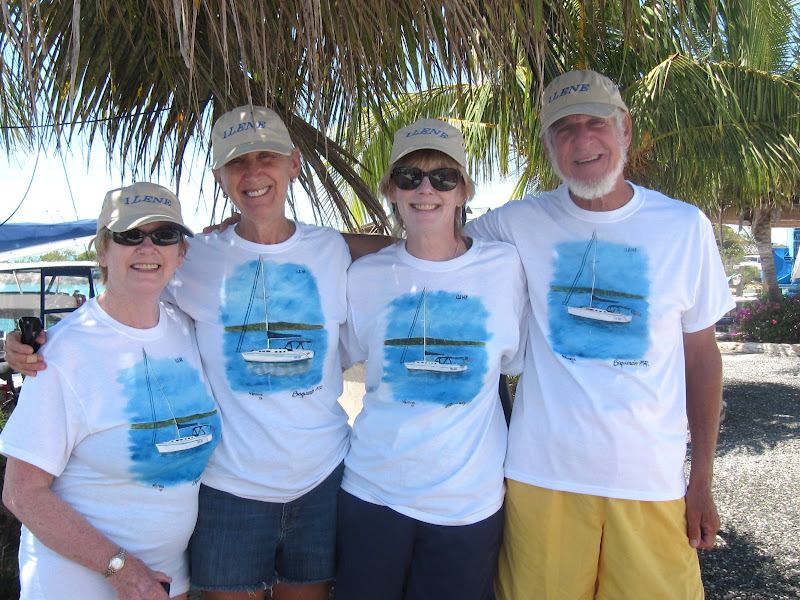
"There is nothing more pleasant than cruising on a boat with the whole family."
Letter from Empress Catherine the Great

Friday, April 13, 2012

Slogging Through the Lower Bahamas

These lower Bahamas  from Turks and Caicos to George Town, are not tourist destinations except for people who really want to get away from it all.  They are conveniently located stepping stones between the mid and upper Bahamas and the Virgins or Puerto Rico. We made six passages in seven days, aggregating 248 miles.
On the first day out I caused us a bit of excitement by my stupidity. I had put up the small jib before we cleared the Sandbore Channel, out of the west end of Providenciales and the Turks and Caicos, to aid the engine. And I used the thin yellow lines that I had tied to the clew of that sail and run to blocks on the toe rail and then aft, to pull the aft lower corner of that sail downward and outward more than the sheet on the car on the cross-boat track allows.
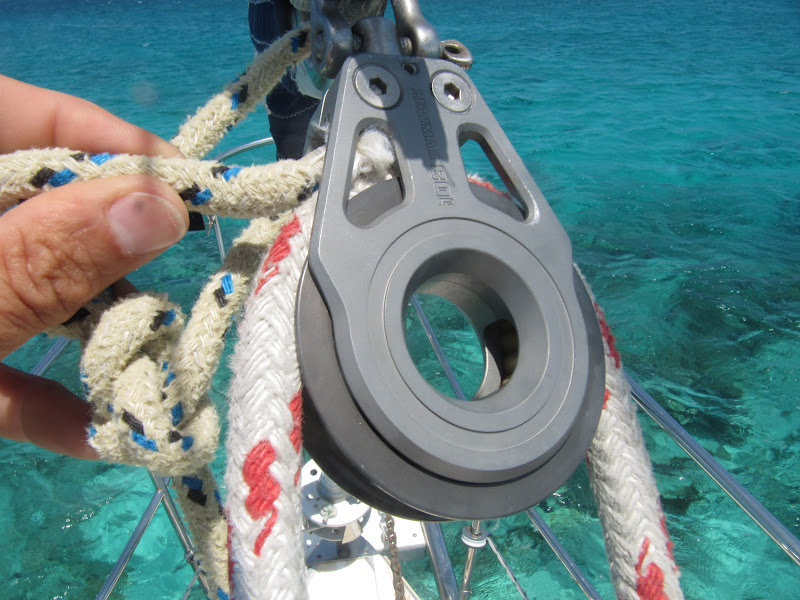
Good idea (from another Saga owner) for getting more performance out of that small foresail when the wind is aft of the beam. But when it was time to hoist the main sail, which requires Lene to steer straight into the wind, this thin yellow line was left unattended and loose. It somehow flogged a bend of itself (two thicknesses) into the block, between the sheave (the wheel itself) and its housing, jamming that block. As a result, I could neither ease the sail out nor trim it in; and more problematically, I would not be able to furl the sail at the end of the day. So what to do? Donning life preserver and harness and clipping onto the jack line, I went forward with knife and ice pick and cut the last foot or so of the line, used the ice pick to pick out fibers from the log jam and cut the loose fibers off. I asked Lene to tension the sheet so that if and when the jam gave way, the sail would not jerk out and pull me overboard. We were heeled at about 35 degrees and water was splashing over the bow, cooling me off. After about a half an hour, it worked.  Hence plan B, to lower the sail on the bouncing foredeck and gather it together so it did not wash overboard, was not needed.
The 47 miles went by quickly. From noon to 4:30 the half hourly readings showed we made a steady 8 knots. But the destination, Abrahams Bay, in the SW corner of Mayaguana, is coral head strewn and the outside reef stops the big waves but not the wind. We entered the Bay through its safer, wider western entrance, but this left us anchored five miles from town, where we were supposed to check into Bahamian Customs. A ten mile round trip dinghy ride that evening was not going to happen. Instead, we became illegal aliens in the Bahamas from Mayaguana until George Town, except that we did not step ashore but once.
Next morning’s excitement came when the GPS couldn’t get a fix. All of its other chartplotter functions in showing us our direction, speed and many other things depend on its knowing where it is. What to do?  I went into the pieces in the lazarette where the antenna connects, like I had watched Herve, Grenada Marine’s electrician do, but the best I can say for these efforts was that I was able to put things back together again.  Plan B again:  We have two very old hand held GPS devices. These do not have chartplotter functions, but if they work, slowly, using lots of AA batteries and working from only three rather than 12 satellites, they give you a fairly accurate digital display of your latitude and longitude so you can find yourself on the chart. So we filled them with fresh batteries but first of them would not start at all, no way. So remove the fresh batteries and put the dead unit in the garbage. The second unit, to the left of its more powerful big brother in the photo, took a long time, but came to life at last, and eventually got a fix!  

Well they always act slowly at first, especially when you start them at a great distance from where they were last turned off, which it this case had been Long Island Sound. I think they are checking their internal logic saying “They can’t be that far away, can they?” Next step was to put in waypoints, the place where you want to go, so the toy can tell you the direction to steer to get there. I used to know how to do this, but we haven’t used this unit for at least ten years so there was a new learning curve. Half way through climbing this curve, the boat’s chart plotter got its fix. So we were off.

Soon after, we learned that Avatrice had incurred a much more serious problem than we: failure of her transmission. The sails are great for the open waters but in narrow twisted channels through reefs, you want your engine. I was able to give them, from our cruising guide, via VHF, the names and phone numbers of some diesel repair guys on the islands we would be passing and suggested they call in to The Coconut Telegraph, a SSB network. Later, we heard a call on a different net for any sailors to please give them assistance. We have not heard from them since then but hope to connect with them later on their trip to Maine. 
At the end of this day we anchored off West Plano Key and bought a nice sized Grouper from three boys in a rowboat with an outboard, who cleaned it and, at our request, brought half of it to “Tamera Sue.” $20. The boys said they were from the Dominican Republic and worked (sunup to sundown  seven days a week, no doubt) from a “mother ship” which was anchored about three miles away, where they lived. This was a six week trip for them. West Plano Cay is a beach.
Then it was the 50 miles to Landrail Point, on Crooked Island. Wind too light and behind us so a motor sail, mostly motor, to another beach. But it has a pretty lighthouse, don’t you think?
Next day it was 40 miles to Clarencetown on the southern end of Long Island. Here we took our only lay day of the week and went ashore. This sign:
says it all, except it says more than it all, because the “historic sites” are the churches, and its post office and police are the government complex, and the restaurants are two in number, only one worthy of the name. At Rowdy Boys we had lunch and devoured their wifi via the iPad. Here is the town, home to about 200 of the 3000 folks who live on the island, taken from the Church steps, Lene lying on the wall lower right, ILENE, anchored behind the trees to the right.
The two churches are vaguely similar and interesting. The first, built by an Anglican missionary, recently had part of its roof blown off in a hurricane.   
The second, built by the same man after he had converted to the Roman Catholic faith, has an even more commanding presence, on a higher hill but it too has suffered damage: the cross on the right steeple is missing.
Friendly people. Some boats stop here at night—generally after sailing northwest, with the prevailing winds behind them, like us. Others leave in the evening to sail at night, when the winds are lighter – generally those heading SE, into the wind.
Next the length of Long Island, along its SE coast, from Clarencetown to Calabash Bay, 49 miles. On this trip, I miscalculated our time of departure and did not figure on an adverse tidal flow, or that it was a beat. So we had to motor sail a good part of the way in order to make sure we got into Calabash Bay, past the unmarked invisible but charted reefs, well before dark. Another beach on another blowy night.
 And finally the 24 miles on broad reaches, from Calabash Bay to George Town, Great Exuma Island, where we had fun. The subject of the next post.

Posted from Warderick Wells, Sea Land Park, Exumas, Bahamas


Wednesday, April 4, 2012

Judy and Meridel and Turks and Caicos - Part II


We spent five nights and four days in Southside Marina, the "land" part of our time in T&C.
Three of the days were with Meridel and Judy, who flew out the last day. They took a room in a hotel at the larger and more commercial but equally tricky-to-navigate-through-the-reefs-to-enter Turtle Cove Marina on the north side of Provo. Below: three beauties, and you can see part of their marina reflected on the window to the right.

 They wined and dined us with dinners in elegant restaurants on the beach such as this one.

And, oh yes, they let us shower in their hotel room under hot water, lots of hot water. (Most non-classy restaurants have only cold water in their sinks and the marina’s shower is of that flavor as well.)
I can’t quite get over how developed and hence different this island is from most, especially from other islands of this nation, like Grand Turk. The others have a tourism industry but it is small and low key. We should have been tipped off about Provo by the volume of the passenger jets we saw taking off from the airport while we were sailing there from French Cay. Most of the tourists are from the US and Canada. We even heard a rumor that the Canadians, being a British nation (well except for Quebec) put out a bid to buy the whole nation a few years ago. The rumor may even be true! The north shore is a huge long beach, protected by a reef, with hotels, clubs, condos and private residences cheek by jowl almost its entire length. This is mostly luxury type housing with lots of private security guards, because it only takes one violent incident to kill the goose that feeds the entire tourism-based economy of the island. The difference between this and Florida is scale and that here there are no buildings higher than seven stories and most do not top four.
Meridel and Judy took us to the supermarket where we suffered sticker shock; yes they have Jarlsberg cheese, but it is $19 per pound! Everything is imported and expensive. They make and grow nothing on this rather arid island (except that they make reverse osmosis water). Tourism and services is the island’s only industry. The girls took Lene to a pedicure one afternoon while they shopped for souvenirs. We tried to snorkel one afternoon but the places along the beach we selected were not the best and wind and the surf were up, so we simply swam a bit. 
On our last day together, we all took a snorkel boat tour with about 20 other people. The captain knew the best place on the outside of the reef to stop and drift and from which, in water that varied from 10 to 20 feet in depth, we saw large schools of large tropical fish. At the next spot the water was only about five feet deep and many of us picked up conch from the bottom. The boat's mate cleaned these, took the meat, polished the shells for souvenirs, and diced the meat with diced peppers, cucumbers, tomatoes and lime juice, while we explored a low island where large iguanas fought with each other. I forgot to ask how the iguanas survive hurricanes which wash across this island. Upon our return from exploring, the crew served up a most delicious cerviche salad of conch.  Their beer was OK too, but the rum punch tasted like coolaid with a few drops of rum in it. It was good for Judy to finally get an opportunity to don the snorkel gear they had schlepped all the way here from Portland OR.  One negative side effect of our guests being good photographers is that I took fewer photos. If Meridel and Judy send me some of their photos, I will try to add them to this posting.
I mentioned shirts and hats in the prior post:
WARNING: The rest of this post is likely to have little appeal to those who are not interested in sailing.

We also did some things for ILENE while in the marina. I had fortuitously found the sheared off head of an Allen bolt (a bolt with a hexagonal pit in its head) lying on the deck; it should have bounced off into the sea, unnoticed. But finding it, I  poked around and discovered that it had come off one of the two bolts that holds the cage of the furling line drum to the bottom of the forestay. Here is a picture of the drum. When we pull on the aft corner of the sail to unfurl it, we loosen the white line with green markings shown in the lower left, which gets wrapped around the drum. When we want to put the sail to bed, by pulling on the same white cord with green markings, the sail wraps up on itself on the forestay, of which you see only the bottom inch.The lower photo shows the bottom of the drum, with the Allen bolt in the center. I had thought that as long as the bolt’s shaft was screwed in place, the cage would hang together but I showed the problem to our rigger. He showed me that the threads at the head end of the bolt had been properly intentionally ground off and hence that the remaining lower threaded shaft of the bolt, without its head, was holding nothing. So he took the broken shaft out and put a new bolt in place.
The  rigger had been called primarily to fix our boom vang. He replaced the rivets which had failed with stainless steel machine bolts for which he tapped threads and applied a strong adhesive, Dow’s 5200, as a barrier to prevent corrosion of the aluminum against the steel. He pointed out that the winch mounted on the starboard side of the mast is attached with Stainless steel screws, which persuaded me that stainless steel could work with aluminum. He also freed a frozen pivot point which he said may have been the cause of the vang’s failure. Four of the bolts are shown to the left of the blue line at the right of the photo, with four more holding it on the port side. The formerly frozen up-and-down pivot point is show with a wire circlip hanging from it in the center of the photo.

We polished some stainless, took on some water and some diesel, attached the big horizontal fins at the base of the outboard,  and finally got the piece of madras cotton we had obtained in Guadeloupe hemmed. This last was done by Sharon, who with her husband Larry, are sailing a 44 foot Pearson ketch, “Avatrice”

out of Freeport Maine, where we had visited on ILENE in 2008. Freeport is the home of L.L. Bean. Sharon teaches women how to sail aboard Avatrice in the summers and has a sewing machine aboard. They have GPS but not a chart plotter, preferring to navigate a bit more like the old fashioned way.  They are going our way and we hope to meet up with them along the way. And I got a haircut and a beard trim so I don’t look as shaggy as Darwin any longer.
                 A bit of high excitement happened one afternoon while we were away snorkeling. A 31 foot Freedom sloop, while looking for a mooring in a bay near our marina, took instruction from a passing boat. Either the advice was erroneous or it was heard incorrectly, but after turning, a coral head caught the boat, and punched a hole in it. The boat is considered “totaled” for insurance purposes. Our marina staff, hearing the mayday calls, organized a rescue and no lives were lost. The only injury was to the mate, who, while in their dinghy, got bruised by the anchor line which had been set out to try to prevent further damage. It snapped taught against her arm. Next day, the couple went out to try to salvage a few personal effects. All any of us sailors can say is:  “There, but for the grace of God, go I.”
Posted from Georgetown, Great Exuma, Bahamas.

Tuesday, April 3, 2012

Judy and Meridel and Turks and Caicos - Part I


[Computer charger cord finally came in today, April 3, so we are back in the blogging business from George Town!]

Judy and Meridel are two lovely ladies from Portland Oregon who have been Lene's friends for 18 years, and mine for the last 15 but despite a lot of travel, had never before visited Turks and Caicos.

We beat our way the 16 miles from the uninhabited Big Sand Cay, to Grand Turk (north and then east) in relatively light wind, passing the west side of Salt Cay, where Judy and Meridel were that day. We tied up to the dock there to facilitate the embarcation of our guests the next day; what a mistake! The dock's surface was five feet above ILENE's deck and while I could scramble up and down, the guests would not have been able to do so. Also, this height difference meant that the concrete dock edge was chewing through our mooring lines. And to make matters worse, they charged an additional $20 "berthing fee" for the privilege. So as soon as I had filled out the papers and paid the $50 entry fee to Customs, we slipped from the dock and anchored about 50 yards off the ferry dock. Next to us was "Tamera Sue" which had been part of the flotilla crossing the Mona Passage. Tammy and Joe took off our three bags of garbage to the dumpster, later gave us two mangos and located a restaurant on the beach near where a Holland American liner had just departed.


Next morning after finishing cleaning we were waved at from the 40 foot ferry boat. Its operator let me tie up to the ferry, which was the only convenient way for Meridel and Judy and their luggage to come aboard ILENE.Our guests listened patiently to the full safety lecture: fire, water, man overboard and abandon ship, they selected berths, and we exchanged gifts -- hats and shirts. They unpacked other treats for the kitties a special salad dressing for Lene and life preservers for the cats. have you ever seen a less happy cat?
We dinked to the beach near the restaurant to see the island and then a disaster struck: well disaster is too strong a word, but Lene fell out of the dink while disembarking, soaking herself,  but worse,  her blackberry. Even immediate drying and emersion in a bag of rice would not revive it; but Verizon let her transfer her account to my Blackberry, which is why it is not a disaster.  We rented a car and toured Grant Turk: Its charming old sea side village;

lunched at the Osprey Inn;


and visited the supermarket, drugstore and postoffice and the historic Northeast Lighthouse.

It was built in England and shipped and reassembled here in the 19th century to warn shipping off from the reef, extending 2.8 miles northeast from the island, top right.
It reminded me of NE point on Block Island, but more rocky.
Tammy Sue had also told us of a parachute ride business which was taking out guests for free to train their crew and we took a ride-- high and exciting. Ladies first, just after launch and them Roger before take- off and high.


Next day another near disaster: As we were putting up sail, Lene went up to take Alphie from her favorite perch -- in the stack pack,


and got whacked on her left forehead by a short motion of the boom. Only witnesses, the truth, my reputation for gentleness and arnica gel have protected me from accusiations of spousal abuse. Ilene cried for a few minutes and said "I can't go on like this." But a few minutes later, she was back in action.
 We sailed most of the 32 miles to Ambergis Cays -- two small islands shaped like a backward "L" with the corner missing. We gybed first a bit south of west and then a bit north, to get the wind from directly behind us. Then after crossing the Columbus Passage (everyone here wants to claim him) we entered the Caicos Bank.  This meant crossing from water that was 6000 feet deep to only 25 feet deep in much less than 1/4 mile of horizontal distance. The effect is that the waves, which were low out in the deep, got steep as the depth sharply bottomed out.  Once we were on the Bank, we had furled sail as a precaution, the waves became small, but a new problem arose: Coral Heads.  The cruising guide warned us about them-- black against the yellow sandy bottom. Here is one, but it is not SO black, so maybe its a harmless seaweed clump. The need to look out for them gives rise to the one rule for crossing banks at night: "Don't!"


 So here's Lene, out on the bow, to look for them and hand signal me to turn right or left to avoid them.


There were more of them in the last few miles from entry on the Bank to Ambergris than the rest of the way. I once turned back, seeking a clearer way through them and we were not used to them yet. Big Ambergris is the site of a failed development project and is private, inhabited, and has an airfield  but did a poor job of sheltering us from the wind. It is ringed by reefs and shallow water and we anchored in 12 feet of water with 100 feet of  chain out. we were a mile from each key-- in the middle of nowhere.
Eventually we saw another sailboat, a mile from us, but the water was choppy and we did not explore.


 A cheesy snack before dinner:

 We did get a good night's sleep after Lene taught our guests a new card came -- and Meridel won!

Next day was the 32 miles from Ambergris to French Cay, across the southern part of the Bank in 12 feet of water -- the same depth as much of ILENE's home in Eastchester Bay, but oh so visible feet here.  It was calm and though we put up the main, we motored all the way. It was like sailing in an acquarium with its visible sandy bottom showing each clump of seaweed and rock. This photo shows our shadow on the bottom: left to right, the anchor hanging down, the forestay, Roger on lookout, and the mainsail, with bits of grass on the bottom. Next sunbeams, reflected on the surface by the alabaster clouds:


French Cay is a sandbar about .2 by .4 miles. We anchored behind it in 12 feet of water and dinked 300 yards to shore. It is a wildlife sanctuary and various flocks of birds were soaring overhead and screeching. The book says no one should land but there was no one else there to complain about our entry except "Viau" who we had passed during the passage.

 I saw flocks of piping plovers skittering along the beach, the same birds whose nests have caused areas of North Shore Long Island beaches to be roped off.  I saw the footprints of others. We soaked in the warm waters. Snorkeling was not done because it would have required anchoring the dink over a reef, which harms the reef and would require climbing back from the water into the dink, which our guests thought that they could not manage.We invited Jens and Hanne of Viau for a shared dinner.
They brought fish balls, a delicious dipping sauce and a bottle of wine. We made steaks and chops and
veggies and rice.  Jens was the organizer of our little flotilla from Puerto Rico. They live near Copenhagen and have excellent English. Meridel and Judy enjoyed the sailing talk even though they did not understand all of it. Meridel, Hanne and Lene, followed by Roger and Jens:


And humans can't have all the fun!
Our final sea day with our guests was from French Cay to the Southside Marina in Providenciales, called Provo by everyone. It is on the big developed northwesternmost Caicos, about 16 miles to the north. This meant some type of beam reach. In light air we flew full main and genoa and hit 7 knots for a bit, but the wind was too light to be exciting. We enjoyed a breakfast of pancakes filled with diced mangos, garnished with papaya,


and delayed our departure until 1:30 pm in order to try to arrive at 5 pm at the height of the tide.


 Lene, Judy (who took a lot of these photos and hence is not in them) and Meridel:


Bob Pratt, the marina owner, came out in a motor boat to the second of two waypoints he had given us, to pilot us in. Even at that, we briefly touched the sandy bottom on the final approach into the Marina where a bar had formed. Southside Marina is a small (12 slips), well run, owner operated and occupied business hewn and dredged out of the limestone strata that comprise the island.  Slips are only $50 per night and there are many services for residents: rides to markets and the barber, a cheerful daily weather report on a VHF communications net, and a daily BYOB (and bring your own snacks) to share at a happy hour under the gazebo which foments familiarity and camaraderie among the boaters. And here, after our first happy hour, the sea based part one of our visit with Meridel and Judy ended.


Monday, March 26, 2012

Temporary Interruption

Due to lack of computer battery charger, we are unable to post blogs until we get new one. We hope that will happen within 7-10 days from now. In the meanwhile, our adventures continue and will be reported.

Tuesday, March 20, 2012

300 Miles @ 7 Knots


We raised anchor at 12:45 on Saturday and dropped it again at 8:45 Monday morning so elapsed time for the 300 miles was 43 hours which averages 6.97 knots. But we could have gone quite faster and had to slow ourselves down to be assured to arrive in daylight.  When have I ever before tried to go slow!!! We left 2.75 hours after the other boats in our little flotilla and that was my mistake—we should have left five hours later in the day on Saturday. Then we could have let ILENE loose to do what she likes to do best; she is a fast girl.
At departure, the winds which had howled from the east each day, were mild and from the northwest, in our face, so though the mainsail was up, it was not working and we motored out of the channel and though some twelve foot deep shoals off shore. By three pm the wind had shifted north so we could sail on a starboard beat and then on a close reach and we unfurled the small jib. At 4 pm we shut off the engine. Our course put us too far north of Mona Island (after which the Mona passage is named) to see it; but we did see Isla Descheo, an ex volcano about a mile square,  that I had never heard of, ten miles to starboard. At 6 pm, anticipating nightfall, 

we reefed the main but we were still making 7.5 knots.  These rollers are coming at our starboard side.

Lene stood the early watch from 8 to midnight, alone, while I tried to sleep, but we were crashing through some big seas so sleep was difficult to obtain. We both listened to music on Lene’s iPod, which made the watches fly by. “Standing” is perhaps the wrong word to use for our watches because as the automatic pilot steered, we lay down on comfortable cushions, rising at the ends of “cuts” of music to get up and carefully scan the horizon searching for the light of other boats in the neighborhood and being ready to change sails or their trim if conditions warranted. We were also wearing foulies because of the cool weather and spray and were tethered from the harness to a line that was secured around the cockpit, with jacklines to tether too if we had to go forward of the cockpit.
Before nightfall, one freighter crossed our bow, at a distance of about five miles and during Lene’s watch, another passed us, going the other way, port to port, several miles southwest of us. We overtook the other boats in our little flotilla, but at distances too far to see them, except for one sail that we saw on Sunday, far behind us and whose lights we watched Sunday night, who turned our to be Viau. Otherwise: no other boats. Calling in at 4 pm and 8 am gave us the assurance that the others were OK and available should we need help.
We saw the northeast coast of The Dominican Republic starting during the first night when we saw lights on shore, and then the rugged mountainous coast until mid afternoon, but at a distance of 12 to 20 miles.  On Sunday morning we were still going too fast so we furled the jib, making the rest of the passage under reefed main alone.

Three bad but not terrible things occurred. First, a little round bodied, bright yellow bird with grey wings landed on the dinghy behind me during the afternoon, about 30 miles off shore, seeking a respite from the winds which were about 25 knots. Lene saw it and alerted me to look behind me. The bird next flew into the dodger, where there was less wind. Alphie saw it too. Her eyes widened as big as I have ever seen -- the eye of the tiger. You cannot take the hunting instinct out of cats. Alphie sprang and caught the bird in her mouth. Lene sprang too and freed the bird which flew away, probably thinking “Some refuge that was!” But in saving the bird, Lene banged her left rib cage against the back of the port coach roof. Ouch! Arnica gel prevented the visible black and blue mark but not the pain of her bruised ribs. All this too quick for the camera.
Second, our new US flag, that Jerry and Louise had brought to us in the Virgins, had a burial at sea. I had affixed it to our new and improved flagpole, but not securely enough for the sustained 25 knots of Sunday. It blew off.
Third, our boom vang broke.
 This is an adjustable length aluminum tube that forms a triangle between the mast and the boom. It is attached at the back of the very lowest point on the mast with about eight large rivets. It’s aft end is attached further aft to the bottom of the boom. Its primary purpose is to hold the boom down; the boom would lift above horizontal due to the wind pushing against the sail, if not held down. Well the rivets gave way and its forward lower end was rubbing against the deck and the boom was high. I called to Lene to come out to operate the line that controls the length of the vang while I went to the mast with a length of green line and lashed the vang to the boom so it was out of the way. The next step was to tie another line around the boom, lead it to the midship cleat and then aft to the winch so we could pull the boom back down to horizontal.
We also ran into a torrential rainstorm for about an hour Sunday afternoon. I saw a big cloud and diverted from NNE to E to try to outrun it and we did outrun that cloud, but it was merely the vanguard of the bigger cloud behind it. The good news was that there was no thunder or lightning or the high winds usually associated with the passage of a cold front. The winds clocked around and we used the motor for that hour. After the storm the air was colder; the boat had a good freshwater rinsing, to wash off some of the caked on salt that had accumulated from the spray.
Sunday night we were still going too fast with just the reefed main, so I depowered that sail – trimmed it to NOT optimize the wind for speed. As a result, Viau was much closer to us, though still several miles behind, when I came on watch at about 1 am Monday morning. I calculated that we no longer had to worry about being too early, trimmed the sail and sped away from Viau.
Our diet of hot cereal for breakfasts, salad for lunches and hot food for dinner was excellent; my compliments to Chef Ilene. One night we had a dish she invented that I have suggested she send in to the sailing magazines which publish recipes for “one pot” meals for underway sailors. She fried up rounds of chorizo sausage with cubanel peppers, onions and a few mushrooms and stirred in precooked brown rice with chick peas. And topped it all off with grated parmesan cheese. Filling, warm and delicious!
Lene is really getting the hang of this. She can tell from the color of the light, which side of the other boat we are seeing, and by looking at the light against a fixed point on our boat such as a stanchion, from a fixed point on our boat of her head, she can tell whether it is going to pass in front or behind us or hit us. She now uses the computer’s “cross track error” reading to keep us on our path. I am very proud of both ILENEs.
Here is Big Sand key looking south and then looking west. We did not go ashore.


Posted from Providentiales, Turks and Caicos.

Sunday, March 18, 2012

Boqueron, and Farewell to Puerto Rico

Since our entry into Puerto Rico at Culebra on Valentine’s Day, we have put into eight of its ports, the last being Boqueron, for seven nights, leaving Saturday, March 10 after 26 days in this “nation”. Boqueron is a big “V” shaped bay, with a wide rounded bottom. It is two miles wide at its mouth and perhaps two and half miles deep, indented into the west coast of  P.R., toward its southern end.  It is protected by a big reef across its mouth, with two channels through it, one toward the south, with a big green buoy in the middle, is about .2 miles wide. The other is at its north side and well charted but not marked. We came in through the southern channel and left through the northern one.
The southwest tip of Puerto Rico is Cabo Rojo which means Red Cape, because there are some reddish rocks in its cliffs (sort of like Gay Head on Martha’s Vinyard). It has a large beautiful lighthouse on it and although you may not be able to experience its majesty from the picture, passing Cabo Rojo in our boat, right to left, was indeed a majestic sight!
Our passage to Boqueron from La Parguera was rather fast and we used only the small jib, with no main. It got more exciting after we had rounded Cabo Rojo and headed north, bringing the wind abeam, and very exciting shooting the passage and heading into the bay on a beat in 28 to 30 knots apparent wind. The town is in the northeast corner of the bay, with a big marina for power boats easily seen. To the marina's right is the main yachtie restaurant/bar, Galloways, though when we went there the yachties had taken the night off. Further right is the dinghy dock plaza, focal point of the tourist town.
Then comes a private canal cut into the beach for the big boats of the condo owners whose apartments on both sides, provide pretty good hurricane protection.


They had to build a draw bridge for pedestrians, which connects the town to the right with the beach to the left.


 Finally comes the beach, about a mile long, with palms planted in rows behind it.
The waterfront area is filled with restaurants and bars, many of which are closed during the week. The town fills up on weekends, especially with kids from the colleges nearby who love to strut through the town in their bikinis. The residential areas are set further back from the beachfront with a school, a Catholic and Seventh Day Adventist Church, a fire house, post office, a small market which refills propane tanks, etc. One of the town’s specialties is clams and oysters, small, dug from the nearby mangroves, arrayed in piles on counter tops of  the stands that line the streets, such as this one at dinghy dock plaza.
 I must confess that we did not partake, partly because ice was nowhere evident. Several restaurants offer patrons free wifi but no coverage is available out in the anchorage.
We anchored in 16 feet of water with 80 feet of chain out, and there was plenty of room for more boats. The wind as all along the south coast of Puerto Rico, blew pretty hard every day but died down to dead calm at night. The next three photos show dawn—before the wind stirred the waters-- followed by sunrise and sunset. The first and third are views to the west and the middle one looks east.


Two of our days here were cloudy and one had a steady light rain while the other had a light shower. These cloudy days were less windy.
You would think that the town of Cabo Rojo would be near the cape itself, but you would be wrong. The Cape itself is south of Boqueron and the town of the same name is north of it. Go figure. Further north, in a different bay, is Mayagues, P.R.’s third largest city and an entry and exit point.
Like San Juan and Ponce, it is a port city.

                                                    During a rental car shopping trip, we looked for the US Customs and Immigration Office in Mayagues so we could know where to go to check out. But like the US Virgins, no checkout is needed we were told. And just to make sure we called the 800 number in San Juan where the information was confirmed.
Highlights of our stay  in Boqueron were the aforesaid shopping trip for which we shared the costs with Jim and Lindy, a lovely retired couple aboard “Snowbird” a  38‘  C&C. They are from a small town about an hour north from Toronto, educated, informed, good sailors and fun.  They have spent the last eleven winters down here, staying in a different island group for the three months they allot themselves and then hauling the boat at a marina for the long nine month summer. They emigrated to Canada from Northern Ireland in the ‘70s. We enjoyed discussions of family, religion, history, politics, good books and other subjects. We hope they will visit us when they pass through New York and we have a standing invitation if we ever get up to the Toronto area.
During our shopping excursion we had lunch at the White Pelican, a Cuban style restaurant on the second floor 10 yards from the bay, in the beachfront town of Joyuda. 
We later had a shared dinner aboard after which Lene taught them some new card games. Still another time, we shared a mess of mango pancakes. Jim is a retired engineer and was very essential and generous with help for two of our mechanical problems. 
The first was the oil change which was overdue. ILENE came with a built in electric “X.change.R” pump which makes the oil change easy. But by pressing switch B before switch A, I had caused it to stop so I dinked over to Snowbird to borrow the old fashioned hand pump, which pulls the stuff out through the dip stick hole, which always takes a long hard time, makes a mess and gets out most but not all of the black waste oil. But Jim came with his pump and helped me disassemble the electric pump, guessing, correctly, that it was the impeller I had burned up. Then it turns out that the oil filter is supposed to be only hand tight and I have a plastic wrench marked “Yanmar Oil Filter” but it did not fit the filter so another trip to Snowbird and Jim let me borrow his wrench with a rubber strap with which I was able to get the old filter off.

The second distress call came when we were about to leave. Lene had run the engine in the morning to make the refrigerator cold and everything worked fine. When she turned on the ignition switch at about noon, nothing happened except the beep that occurs when the switch is on but the engine is not. My guess was that the problem was the wiring behind the switch and we started disassembling its cover plates to gain access while Jim dinked over with a jumper cable His idea was to bypass the switch and go directly from the battery to the starter, with his fear that the starter motor was defective. We carry a spare starter motor but I had hoped that that big disassembly and reassembly job would not be required. Once everything that had just been carefully packed away in the aft compartment for the passage was removed, giving access to the battery and the starter, Jim looked in and saw a red wire. Where did this come from? he asked.  He stuck it back in place, Lene turned the key, and Yanmar purred back to life.

Other things we did here were to hire a diver, Macho, to scrape the barnacles from ILENE’s bottom. I can do this down to a depth of about two feet deep, but he did the lower bottom, after directing us to move from the northeast corner of the bay to the southwest corner, where the water was much cleaner so he could better see what he was doing.  We also bought a new pump to replace the one that pumps water overboard that flows from the refrigerator, and the aft shower and sink into a plastic sump. The marine store assured me that Atwood, the manufacturer of the sump unit, had said that the new pump was a replacement for the existing model which no longer works. But the new unit’s discharge hose would not connect to the discharge hole in the side of the plastic sump box. One was an inch higher than the other. The Chandler graciously gave me a refund.

We toured down to Cabo Rojo lighthouse which gave great views of the sea and land from its height on the cliff. Lucky to catch the lightin this shot, which blinks only once every 20 seconds.


                                                     The  people on the cliffs give a sense of their size.
And the surf crashes at their foot.
We had watched the sailboat below trying to sail west against the wind; here she is after giving up and heading back to Boqueron. Wait til nightfall!
Happy campers:

We also finally tried and succeeded in getting weather reports from the single sideband radio. A fellow named Chris Parker broadcasts his intelligently analysed reports about the wind and wave speeds and directions for various parts of the Caribbean, and then answers questions from paying subscribers who are planning passages, always asking the same question: When is the best day to go?" Based on his advice to others we decided to leave Puerto Rico on Saturday for the 300 miles to Big Sand Key in the Turks and Caicos, because the strong winds were expected to moderate for a few days starting then. We met up with Jens and Hanne, of Copenhagen, sailing their 37 foot “Viau.” Jens organized a meeting with us and Jenny and Albert of “Magus”, Tammy and Joe of “Tamara Sue” and Chip of "Balmacara" who single handed the 400 miles he went to Great Inagua at Galloways. We all shared information about our boats and agreed to try to speak on set channels at 8 am and 4 pm, on VHF if we were close, or on SSB if we were too separated for the 20 mile range of VHF.
Here is Miguel, at his post at dinghy dock plaza. He is a graduate of InterAmerican University in art, and has one of our boat cards and a magnifying glass in his left hand and a T shirt with a now familiar image stretched on his easel.


Curious Alphie looking down through a hatch with the boom overhead. 


Posted from Providentiales, Turks and Caicos