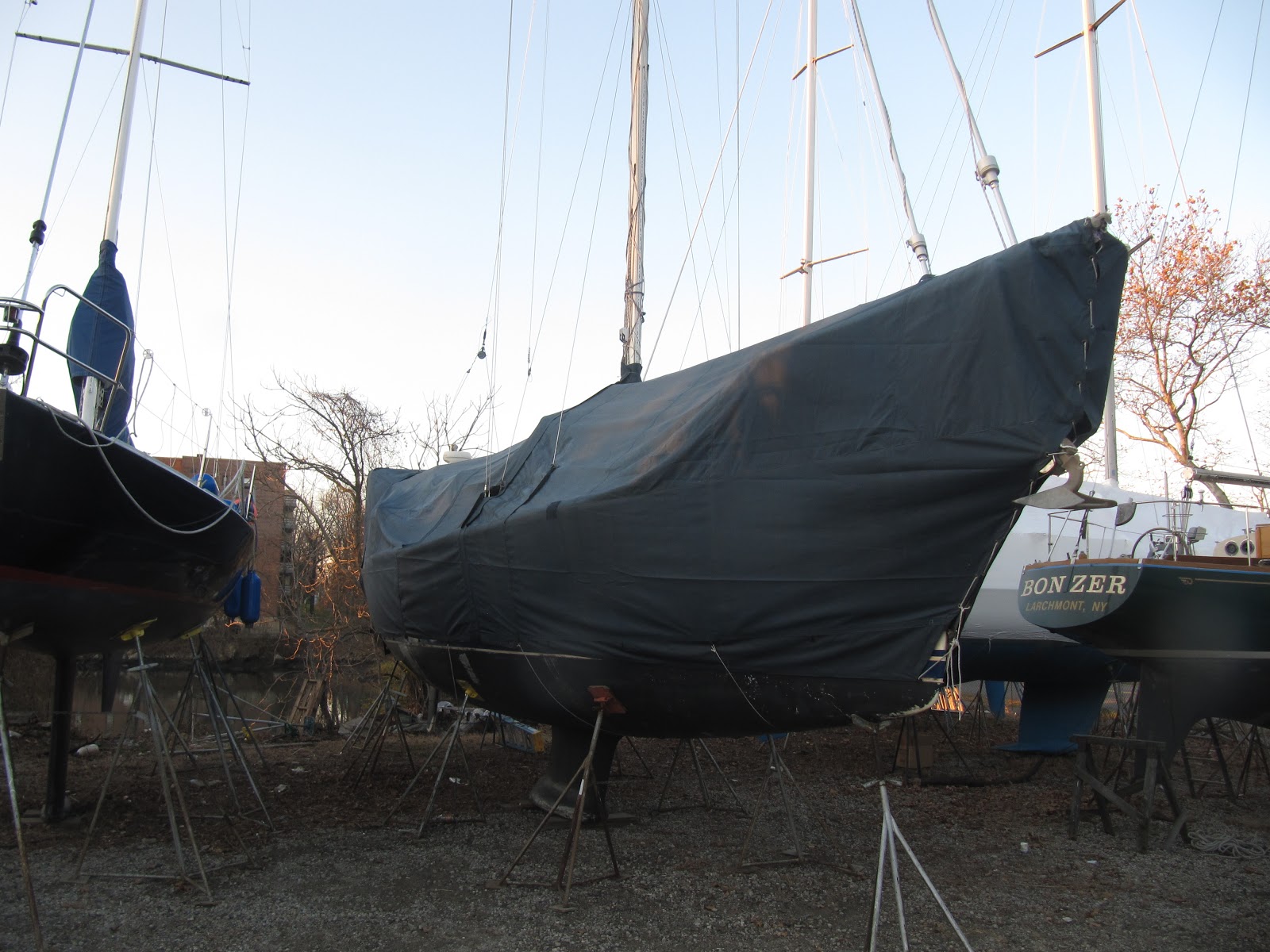
Yes, after six more work days (well, average of only 4-5 hours per day) ILENE is finally all trussed up like a Thanksgiving turkey, under her blue canvas cover. (Starboard quarter look an starboard bow look)
Her oil and filter have been changed, her water systems winterized, her fuel tanks filled, her deck washed and she is ready for winter and winter projects.
Amidst those work days was a trip to Atlanta to visit my brother and my Mom, which provides the excuse for me to post a picture of my really cute grandniece and grandnephew.
No more sailing in 2012. Only 164 days up to and including our arrival back in New York on June 12 and 50 more sailing/living aboard days thereafter for a total of 164. Plus, with a month and a half to go, 19 "boat work" days so far and 16 "other boat" days. So it has been 189 days related to boating this year. I can no longer complain about being boating deprived.
As thanksgiving approaches, one is reminded how blessed we are in so many ways; we have so much to be thankful for.
I hope to have things to say on this blog during the winter, but of course the posts will be less frequent.
"There is nothing more pleasant than cruising on a boat with the whole family."
Letter from Empress Catherine the Great
Sunday, November 18, 2012
Sunday, November 4, 2012
We And Our Boat Were Spared
My last post had a "Perils of Pauline" or "cliff-hanger" ending. So I began this post with the resolution right in the title because I dislike being kept in suspense.
The weathermen had predicted a 13 foot "storm surge" and I feared that 13 feet on top of the normal high tide would have "floated my boat," and its dock, off its pilings to their probable destruction. But it seems that I had an inaccurate definition of "storm surge" in mind. The apparent definition is the height of the water from "mean low water", the normal level of the water at low tide, up to the crest at the top of the storm-caused high tide which was thirteen feet. This definition ignores the fact that the first six feet of the rise of the so called storm surge is unrelated to the storm itself but happens normally, about every twelve hours, every day, even on the most tranquil days. So the portion of the "storm surge" that I would have give that name, is only that portion the rise above mean high water. So the storm surge, the increment of additional tidal rise caused by the storm, above the normal high tide was only seven feet, not thirteen and not high enough to cause destruction.
Other docks at the Huguenot YC were not as fortunate as the remote one they assigned us to. Pilings bent over
and having floated part way off the top because the diagonal shortened the height of the piling, crashed through the dock. The square of rollers in the lower right is what this piling used to come up through!
This dock, at which our friends' boats: "J-Erica" of Bruce and Linda, and "Windsong" of Jerry and Louise, had been tied, are rather wrecked, but those two boats and many others tied to it, were relocated to other docks where they apparently survived.
The club let me use a nice twin ended rowing boat to get out to the dock to inspect and load a few winter things aboard. One of the three fenders I had hung at ILENE's port side as cushions between boat and dock was lying on her deck and someone had hung a fourth small one at her side during my absence. The seven lines seemed a bit looser than I left them. A six foot branch of a tree was lying on the dock and what appears to be a large blue plastic port-a-potty booth was floating just beneath the surface of the water between the port quarter of the boat and the dock.
Meanwhile, at the Harlem, there was storm damage. Two boats, including Bennett's "Defiance", on which I enjoyed the Club Cruise during the summer of 2011, is lying on her side on a sandy beach of Rodman's Neck, awaiting the insurance company's appraiser to determine whether she shall be repaired or scrapped. [Note: Defiance was spared with only superficial damage!] At the Clubhouse, the steps and ramp from the lawn to the dock was ripped off from its proper place and moved about two feet inland. The patio deck had wrenched about two feet seaward, away from the clubhouse and one of the concrete pilings on which it is mounted was bent over; two ground level windows of the water-facing greenhouse-like restaurant were broken and the several inches of water that had warped the floorboards and the rug, had receded; there was debris throughout the parking lot; a ramp to the locker house had been ripped away from that house a few feet (The metal ramp and the wood platform used to abut the locker house).
One boat, Tom's "Odyssey", with a retracted swing keel, which consequently was sitting very low on its cradle had floated part way off this cradle and is hanging on but not my much, very near Jim's "Aria". The blue carpeted wooden blocks in the foreground were holding the boat in place until it was washed about six feet backwards!
I will undoubtedly go to a work party to help clean the place up, but not until the insurance company gets a chance to assess the damage.
All told we all fared a lot better than the large square rigged "Bounty" replica, lost off Hatteras, and have lots to be thankful for.
And how about the home front? We do have a land base, seven floors (six flights of stairs) above the streets of Manhattan, but near Broadway, "high" on the island's north-south spine. No water, salty or otherwise, entered our apartment. Fresh water was cut off as a consequence of loss of electricity (which powers the pumps that bring the water up). Power went out below a non-straight line that crossed Manhattan from east to west somewhere in the 30's and 40's. This started in the height of the storm's fury at about 8:30 Monday night and was not restored until about about 5:30 pm Friday, about 93 hours later. A Ginko tree planted outside our window, its branches having been cropped off at about our level, was whipping back and forth during the high wind but the tall remaining branches neither broke off not broke our windows. Another tree, planted in a small piece of unpaved ground at the curb, had a huge limb torn off which blocked the street but was quickly pulled to the side of the street where it lies, awaiting final removal in due course.
Many huge old trees went down in parks, which were closed to all but parks employees.
It was eerie to walk on a deserted Broadway in broad daylight. Usually it is crowded with cars and people even at night. Here are view north and south from Tenth Street on the morning after the storm.
We had an old battery powered portable radio and the NY Times was delivered after the first day, (not to our door as normal, but to the lobby). The corridors and stairways have no windows and were completely black. We had one not very strong flashlight (plus a detachable Kindle reading light) and no way to charge phones or other devices, which did not work from home anyway, probably because power to our local cell phone tower was out. Until Thursday, our refrigerator retained its cool and we used matches to light the stove to make tea; no coffee because our brewer here is electric. We had set out two huge multi-gallon pots of water for washing, but it was not enough to flush the toilets, except once, so we used a bit of bleach to retard odor, but the place was a bit stinky for a while. Each morning we went out and headed north to get coffee and from Wednesday on we visited friends and restaurants and theaters north of the no-power zone. We brought towels and were permitted to take showers -- just like on the boat when we frequently go ashore for showers. My objective was to stay out well past 7 pm, at which hour we would have gone to bed and listened to the radio had we stayed home. We are young and fit enough to handle the six flights of stairs. Many older people in the building, especially those who would have had to climb as many as 19 flights of stairs, were more stuck. Our large and friendly building staff performed heroically in helping them. We got to know the busses that serve our city even though until the last night, they terminated at 23rd Street after dark because of lack of street lights below there, out of safety concerns. So we had to walk the last 13 blocks in darkness. The fare during this period was zero -- a free ride -- and folks were friendly.
We had an available more comfortable alternative to our apartment, one with light, water and heat: ILENE, but Lene could not be persuaded to go there. I believe that her months of living aboard had accustomed Lene to the more rugged life style we enjoyed for four days.
We are so blessed to have been spared and think of friends and strangers in New Jersey and elsewhere who are still without power, and some of who were killed.
The weathermen had predicted a 13 foot "storm surge" and I feared that 13 feet on top of the normal high tide would have "floated my boat," and its dock, off its pilings to their probable destruction. But it seems that I had an inaccurate definition of "storm surge" in mind. The apparent definition is the height of the water from "mean low water", the normal level of the water at low tide, up to the crest at the top of the storm-caused high tide which was thirteen feet. This definition ignores the fact that the first six feet of the rise of the so called storm surge is unrelated to the storm itself but happens normally, about every twelve hours, every day, even on the most tranquil days. So the portion of the "storm surge" that I would have give that name, is only that portion the rise above mean high water. So the storm surge, the increment of additional tidal rise caused by the storm, above the normal high tide was only seven feet, not thirteen and not high enough to cause destruction.
Other docks at the Huguenot YC were not as fortunate as the remote one they assigned us to. Pilings bent over
and having floated part way off the top because the diagonal shortened the height of the piling, crashed through the dock. The square of rollers in the lower right is what this piling used to come up through!
This dock, at which our friends' boats: "J-Erica" of Bruce and Linda, and "Windsong" of Jerry and Louise, had been tied, are rather wrecked, but those two boats and many others tied to it, were relocated to other docks where they apparently survived.
The club let me use a nice twin ended rowing boat to get out to the dock to inspect and load a few winter things aboard. One of the three fenders I had hung at ILENE's port side as cushions between boat and dock was lying on her deck and someone had hung a fourth small one at her side during my absence. The seven lines seemed a bit looser than I left them. A six foot branch of a tree was lying on the dock and what appears to be a large blue plastic port-a-potty booth was floating just beneath the surface of the water between the port quarter of the boat and the dock.
Meanwhile, at the Harlem, there was storm damage. Two boats, including Bennett's "Defiance", on which I enjoyed the Club Cruise during the summer of 2011, is lying on her side on a sandy beach of Rodman's Neck, awaiting the insurance company's appraiser to determine whether she shall be repaired or scrapped. [Note: Defiance was spared with only superficial damage!] At the Clubhouse, the steps and ramp from the lawn to the dock was ripped off from its proper place and moved about two feet inland. The patio deck had wrenched about two feet seaward, away from the clubhouse and one of the concrete pilings on which it is mounted was bent over; two ground level windows of the water-facing greenhouse-like restaurant were broken and the several inches of water that had warped the floorboards and the rug, had receded; there was debris throughout the parking lot; a ramp to the locker house had been ripped away from that house a few feet (The metal ramp and the wood platform used to abut the locker house).
One boat, Tom's "Odyssey", with a retracted swing keel, which consequently was sitting very low on its cradle had floated part way off this cradle and is hanging on but not my much, very near Jim's "Aria". The blue carpeted wooden blocks in the foreground were holding the boat in place until it was washed about six feet backwards!
I will undoubtedly go to a work party to help clean the place up, but not until the insurance company gets a chance to assess the damage.
All told we all fared a lot better than the large square rigged "Bounty" replica, lost off Hatteras, and have lots to be thankful for.
And how about the home front? We do have a land base, seven floors (six flights of stairs) above the streets of Manhattan, but near Broadway, "high" on the island's north-south spine. No water, salty or otherwise, entered our apartment. Fresh water was cut off as a consequence of loss of electricity (which powers the pumps that bring the water up). Power went out below a non-straight line that crossed Manhattan from east to west somewhere in the 30's and 40's. This started in the height of the storm's fury at about 8:30 Monday night and was not restored until about about 5:30 pm Friday, about 93 hours later. A Ginko tree planted outside our window, its branches having been cropped off at about our level, was whipping back and forth during the high wind but the tall remaining branches neither broke off not broke our windows. Another tree, planted in a small piece of unpaved ground at the curb, had a huge limb torn off which blocked the street but was quickly pulled to the side of the street where it lies, awaiting final removal in due course.
Many huge old trees went down in parks, which were closed to all but parks employees.
It was eerie to walk on a deserted Broadway in broad daylight. Usually it is crowded with cars and people even at night. Here are view north and south from Tenth Street on the morning after the storm.
We had an old battery powered portable radio and the NY Times was delivered after the first day, (not to our door as normal, but to the lobby). The corridors and stairways have no windows and were completely black. We had one not very strong flashlight (plus a detachable Kindle reading light) and no way to charge phones or other devices, which did not work from home anyway, probably because power to our local cell phone tower was out. Until Thursday, our refrigerator retained its cool and we used matches to light the stove to make tea; no coffee because our brewer here is electric. We had set out two huge multi-gallon pots of water for washing, but it was not enough to flush the toilets, except once, so we used a bit of bleach to retard odor, but the place was a bit stinky for a while. Each morning we went out and headed north to get coffee and from Wednesday on we visited friends and restaurants and theaters north of the no-power zone. We brought towels and were permitted to take showers -- just like on the boat when we frequently go ashore for showers. My objective was to stay out well past 7 pm, at which hour we would have gone to bed and listened to the radio had we stayed home. We are young and fit enough to handle the six flights of stairs. Many older people in the building, especially those who would have had to climb as many as 19 flights of stairs, were more stuck. Our large and friendly building staff performed heroically in helping them. We got to know the busses that serve our city even though until the last night, they terminated at 23rd Street after dark because of lack of street lights below there, out of safety concerns. So we had to walk the last 13 blocks in darkness. The fare during this period was zero -- a free ride -- and folks were friendly.
We had an available more comfortable alternative to our apartment, one with light, water and heat: ILENE, but Lene could not be persuaded to go there. I believe that her months of living aboard had accustomed Lene to the more rugged life style we enjoyed for four days.
We are so blessed to have been spared and think of friends and strangers in New Jersey and elsewhere who are still without power, and some of who were killed.
Monday, October 29, 2012
End Of The 2012 Sailing Season - Hurricane Sandy
The Club's annual Going Out of Commission dinner dance was held last week. Here are all the flags at the top of the flagpole, and then after the ceremony of our Flag officers backed up by all of the past Commodores and the firing of the cannon, the same flags after being lowered.
Good food and less excessive than in prior years. I commended the Club's cruisers and got a pewter thing thing announcing ILENE's third place finish in the "Sprint to Louie's" race. Met up with Richard and Rosemary, who having sold their boat, will continue to commute between New Jersey and Florida, but no longer by sea. They sailed to Nova Scotia a few years ago and have promised to help me plan a route.
I sailed five more days during the second half of October, mostly with men and women of the Old F__ts, though not necessarily on Wednesdays. Some with more wind and others with less. One memorable sail was under the Throggs Neck and Whitestone Bridges in good wind beating and against the strong tidal current, followed by a quick return with the wind and tide at our back. Because ILENE was one of the few boats still operational, I had little difficulty finding companions.
A sixth sail, with Cynthia, was prevented by lack of wind; overcast grey skies but no wind. We ate our lunches aboard and were talking when I asked if she minded if I did some work in the cockpit while we continued our conversation. I removed the dodger and bimini. This was made difficult by the fact that these blue canvas covers had not been put up last October. Normally they are not up for more than six months. The metal parts of their plastic zippers has corroded somewhat and liberal application of lubricant was required to get them off. Cynthia was happy with a day out on the water despite the absence of sailing and, noticing some rust on the stainless, asked if she could help remove it. I broke out the Never Dull (cotton padding impregnated with an anti-oxidant solvent) and she did a good job.
The last passage of the season was with Rhoda and Lloyd, from the Harlem to the Huguenot Yacht Club, where ILENE will be hauled this winter. I had planned to move to the Huguenot next week but the imminent arrival of Hurricane Sandy sped up the time table. We motored the five miles, except I put out the small jib on the longest stretch, a starboard beat from Hart Island to the channel into New Rochelle Harbor, which heeled us a bit and gave us an extra knot. The only disappointment on this passage was the thwarting of my plan to fill ILENE's diesel tanks, en route, for the winter (to prevent condensation of water on their empty insides which means water in the fuel tanks). Both of the fuel docks in New Rochelle had been rented out to boats trying to find a safe place during the coming storm, preventing access to the docks. So several trips between local gas stations and the boat with jerry cans are in my near future. I had helped Lloyd and Rhoda bend on and remove their two smaller sails from "Jazz Sail" several times and they eagerly helped me remove ILENE's. But while I can do their sails alone in 20 minutes, it took 3.5 hours with their help to remove and fold ILENE's three large sails. So again, as with Cynthia the day before, I was the grateful recipient of several hours of unexpected free labor.
ILENE is currently on a floating dock at the Huguenot in a narrow strait, protected from the winds by the mainland to the north and Glen Island to the south. None of the huge waves that the Hurricane will kick up will bother her. She is tied to this dock with seven dock lines. All of her canvas has been removed as well as blocks, and lines -- thus further reducing windage.
But unfortunately she is not safe as of this writing. The floating dock to which she is tied is held in place by pilings -- telephone poles driven as piles into the earth beneath the water. Reinforced holes through the dock's surface surround the pilings. Thus the dock slides up these poles when the tide rises and falls when the tide goes out, and the boats tied to it rise and fall with the dock so that adjustments in the lengths of the dock lines are not necessary. The problem is that these pilings stick up about eight feet above the surface of the water at normal high tide. The problem/risk is that the water could rise A LOT MORE than eight feet above normal high tide. If this happens, the dock will slide off over the top of the pilings and, with ILENE attached, and her keel sticking down 5' 8", the combined unit will go where the winds blow it, onto rocks or other boats or docks. The largest cause of an abnormal high tide is the hurricane's winds which have been blowing from the northeast for several days and will intensify as the storm's center gets nearer. These winds blow ocean water into the Sound's eastern end, and with no place to go (Hell's Gate is too narrow), causes the water level to rise several feet above the normal tidal level. Three other factors aggravate the problem. (1) low atmospheric pressure (they call them tropical depressions or troughs) cause higher tides; (2) the full moon was only two days ago and full and new moons cause higher highs and lower lows; (3) all of the heavy rain falling into the Sound itself and on adjacent land and flowing from the rivers will further raise the water level in the Sound.
Our friends, Dean and Susan, of "Autumn Borne" are also on a floating dock in Portsmouth Virginia. They are living aboard during the storm and we are praying for each other. Our boats are insured, but that is not a claim anyone wishes to make. The highs of the tidal cycles in New York will be between 1 and 2 AM and PM these stormy days and nights. There is nothing else we can do for ILENE until the storm passes. We can't get to her by foot or by boat. Yesterday afternoon I joined with many other members in hauling several boats and finally hauling the launch itself. We also took the ground floor furniture upstairs. A six foot above normal tide will flood the ground floor.
We are home, on the seventh floor, far from the edge of Manhattan, with food, water, flashlights, portable radios and phones. Let's read a good book. Will let you know how it ends.
Good food and less excessive than in prior years. I commended the Club's cruisers and got a pewter thing thing announcing ILENE's third place finish in the "Sprint to Louie's" race. Met up with Richard and Rosemary, who having sold their boat, will continue to commute between New Jersey and Florida, but no longer by sea. They sailed to Nova Scotia a few years ago and have promised to help me plan a route.
I sailed five more days during the second half of October, mostly with men and women of the Old F__ts, though not necessarily on Wednesdays. Some with more wind and others with less. One memorable sail was under the Throggs Neck and Whitestone Bridges in good wind beating and against the strong tidal current, followed by a quick return with the wind and tide at our back. Because ILENE was one of the few boats still operational, I had little difficulty finding companions.
A sixth sail, with Cynthia, was prevented by lack of wind; overcast grey skies but no wind. We ate our lunches aboard and were talking when I asked if she minded if I did some work in the cockpit while we continued our conversation. I removed the dodger and bimini. This was made difficult by the fact that these blue canvas covers had not been put up last October. Normally they are not up for more than six months. The metal parts of their plastic zippers has corroded somewhat and liberal application of lubricant was required to get them off. Cynthia was happy with a day out on the water despite the absence of sailing and, noticing some rust on the stainless, asked if she could help remove it. I broke out the Never Dull (cotton padding impregnated with an anti-oxidant solvent) and she did a good job.
The last passage of the season was with Rhoda and Lloyd, from the Harlem to the Huguenot Yacht Club, where ILENE will be hauled this winter. I had planned to move to the Huguenot next week but the imminent arrival of Hurricane Sandy sped up the time table. We motored the five miles, except I put out the small jib on the longest stretch, a starboard beat from Hart Island to the channel into New Rochelle Harbor, which heeled us a bit and gave us an extra knot. The only disappointment on this passage was the thwarting of my plan to fill ILENE's diesel tanks, en route, for the winter (to prevent condensation of water on their empty insides which means water in the fuel tanks). Both of the fuel docks in New Rochelle had been rented out to boats trying to find a safe place during the coming storm, preventing access to the docks. So several trips between local gas stations and the boat with jerry cans are in my near future. I had helped Lloyd and Rhoda bend on and remove their two smaller sails from "Jazz Sail" several times and they eagerly helped me remove ILENE's. But while I can do their sails alone in 20 minutes, it took 3.5 hours with their help to remove and fold ILENE's three large sails. So again, as with Cynthia the day before, I was the grateful recipient of several hours of unexpected free labor.
ILENE is currently on a floating dock at the Huguenot in a narrow strait, protected from the winds by the mainland to the north and Glen Island to the south. None of the huge waves that the Hurricane will kick up will bother her. She is tied to this dock with seven dock lines. All of her canvas has been removed as well as blocks, and lines -- thus further reducing windage.
But unfortunately she is not safe as of this writing. The floating dock to which she is tied is held in place by pilings -- telephone poles driven as piles into the earth beneath the water. Reinforced holes through the dock's surface surround the pilings. Thus the dock slides up these poles when the tide rises and falls when the tide goes out, and the boats tied to it rise and fall with the dock so that adjustments in the lengths of the dock lines are not necessary. The problem is that these pilings stick up about eight feet above the surface of the water at normal high tide. The problem/risk is that the water could rise A LOT MORE than eight feet above normal high tide. If this happens, the dock will slide off over the top of the pilings and, with ILENE attached, and her keel sticking down 5' 8", the combined unit will go where the winds blow it, onto rocks or other boats or docks. The largest cause of an abnormal high tide is the hurricane's winds which have been blowing from the northeast for several days and will intensify as the storm's center gets nearer. These winds blow ocean water into the Sound's eastern end, and with no place to go (Hell's Gate is too narrow), causes the water level to rise several feet above the normal tidal level. Three other factors aggravate the problem. (1) low atmospheric pressure (they call them tropical depressions or troughs) cause higher tides; (2) the full moon was only two days ago and full and new moons cause higher highs and lower lows; (3) all of the heavy rain falling into the Sound itself and on adjacent land and flowing from the rivers will further raise the water level in the Sound.
Our friends, Dean and Susan, of "Autumn Borne" are also on a floating dock in Portsmouth Virginia. They are living aboard during the storm and we are praying for each other. Our boats are insured, but that is not a claim anyone wishes to make. The highs of the tidal cycles in New York will be between 1 and 2 AM and PM these stormy days and nights. There is nothing else we can do for ILENE until the storm passes. We can't get to her by foot or by boat. Yesterday afternoon I joined with many other members in hauling several boats and finally hauling the launch itself. We also took the ground floor furniture upstairs. A six foot above normal tide will flood the ground floor.
We are home, on the seventh floor, far from the edge of Manhattan, with food, water, flashlights, portable radios and phones. Let's read a good book. Will let you know how it ends.
Donnie Cahn, Rest In Peace
Donnie Kahn died last week at 87, from the cancer that had
attacked her body. She was a member of the Harlem Yacht Club for 40 years and though
I met her when I joined, 22 years ago, I didn’t get to know her until 2006 when
I retired and joined the “Club Within The Club” (See Blog, 7/26/12), of which
she was a charter member.
Donnie was born in Prague, Czechoslovakia and escaped
when the Nazis were invading. She continued to sail her boat, a lovely and well
built and very well maintained Bristol 36’, “Dido,” after her husband died,
before I joined the Harlem, and up to and including 2011, after which her
illness sapped her strength this summer.
I attended her funeral service on
Manhattan’s upper west side, her burial in Mt. Carmel Cemetery near the
Brooklyn-Queens border, a Shiva call in her apartment overlooking the Hudson
River and a small informal dinner in her memory at the Harlem. She was always
cheerful and always game. She will be missed.
Tuesday, October 16, 2012
Rendezvous with "Autumn Borne"
We met up with Dean and Susan of "Autumn Borne" in South Carolina and Maryland. They are live aboards, this being their sixth year without a land base. I had hoped to visit with them by auto in Hop-O-Nose Marina in Catskill NY where they spent this summer during a projected trip to the Berkshires, nearby. But best laid plans .... We're having too much fun so the Berkshire weekend hasn't come off yet and they are headed south. They are holed up at the Atlantic Highlands YC on a mooring behind the seawall, on their way south, waiting for a good weather window So I drove to Atlantic Highlands (just a bit over an hour) to spend a few hours telling stories and what else, oh yes, eating. And having a car, I was able to take them to West Marine (for a fresh water pump -- and how could I resist picking up a few little useful things for ILENE?) and later to the supermarket -- the two sites that cruisers sometimes need a car to get to. Their plans this winter, past Florida, are up in the air. I guess the obvious meaning of that idiom would be wind related -- important for sailors, but in their case it also depends largely on what the friends who they plan to meet there will decide to do. Dean and Susan have promised to stop by at the Harlem on their way north next summer. Fair winds, AB!
OK I admit it. With this visit and reading the blog of our friends on Pandora (southbound and currently in the Dismal Swamp canal -- sailpandora.com), I am a bit jealous of my southbound friends. Even Lene has expressed a longing to be back afloat!
Monday, October 15, 2012
A Fun-Filled Non-Sailing Weekend
Saturday was "work
weekend" at the Harlem. This event is held each spring and fall to get a
lot of projects done at the Club with free labor -- except that a delicious
"free" lunch is served. "Will work for food" is what my sign
reads. If you don't show up you are encouraged to pay $25, but this
"rule" is not enforced and I do work on other days for the Club so I
did not pay when we missed the event the last few years. But I like work
weekends because they are a great way to meet our members - working alongside
them and talking. Such members, co-workers really, become friends in the process.
I was assigned first to pull
weeds on the north side of the clubhouse. This was a solo job and damned hard
work. The last stage was pulling little ground weeds like the ones a person would
find in a garden. These did not become visible until the huge vines, growing
through the chain link fence, were cut away. The vines blocked the narrow
passage between the property fence and the refrigeration equipment hidden away
near it and removal of this thicket was the purpose of the project. I would
have been well served by a pair of pruning shears; lacking such,
wearing work gloves, I ripped the damn things out. All except one vine that
looked to me like poison ivy. Then, before and after lunch, I worked
with two others on scraping, priming and painting the wrought iron outdoor deck
furniture. After washing all the green paint off my hands (when will I learn to
wear rubber gloves?), I helped Rhoda and Lloyd remove their sails, it being such
a windless day.
Finally a
Club membership meeting from 5 to 7. I rather enjoyed the civility of it all,
especially compared to the past, when ad hominem attacks
were regrettably common.
Sunday I worked from 6 am to 6:30 pm,
cooking a “gourmet dinner for six” that I had offered to the Club in a "Goods and
Services Auction". The auction was held last winter while we were
away. In the past, for other organizations, I have offered a ride on our boat,
perhaps a dozen times, but such an offering would not work at the Club because
we all have boats. This dinner had been "won" by three of our past
commodores, Ernie, Stu and Mark, and their wives. The guests were all friends
who we have sailed with and hence people who I would have liked to have invited
to a dinner party even absent the auction.
.JPG)
Today's work (may I call it a labor of love) was after more than a day of planning the menu, shopping for ingredients and doing the cookie baking beforehand. But the folks came and enjoyed so the challenge was worth it. Lene helped with preparing some of the ingredients, printing out the menu, setting the table and serving and clearing, tasks which would have been quite difficult for me without her. Unfortunately for Lene, her current dining plan precluded her from joining in the eating part of the evening -- enjoying the fruits of her labors.
The menu:
Dinner for Three Past Commodores and Their Commodorables
October
14, 2012
Theme: Circles
Wines:
Shiraz -- Nine
Stones -- Mclarenvale, Australia – 2008
Pinot
Grigio – Bollini – Fruili Grave, Italy – 2008
Before:
Green
olives, Dates with edible pits, Pate of truffled livers
Bread,
home baked, with butter
Soup: Peach
and Pumpkin
Salad: Beet,
Orange, Fennel and Calamata, vinaigrette
Entrée:
Pork
Loin stuffed with Drunken Prunes
Garlicky
Mashed Potatoes
Stir
Fried Snow Peas, Scallion, Ginger, w/ Pecans and black and white Sesame Seeds
Desert:
Roasted
spiced pineapple a la mode (pineapple and Vanilla) over Strawberry Coulis
Rugelach
and Biscotti
Coffee or Tea
After: La Grenade
Liqueur -- product of Grenada
I always search for themes for our dinner parties. This time
the theme of "Circles" came into my mind
when I realized that many of the dishes were
round: olives, dates stuffed with almonds, soup (in
bowls), beet and orange slices, pork and pineapple. So I cut
little circles of the pate with an apple
corer and portioned the mashed potatoes in a half-cup measure to form timbales,
to augment the theme.
Altogether
a very fun filled weekend, without being aboard a boat, other than a
boat on the hard in removing sails.
Friday, October 12, 2012
Warm Feelings About a Good Deed
Enjoyed a very pleasant day with Nick and others. Nick is a member of the Harlem who has been placed in a nursing home, probably for the rest of his life, as a result of memory issues. But his non-recent memory is fine. While visiting a while ago, he expressed a keen desire to go sailing again. I thought: Why not?! And the nurse said "Sure, you can take him out for a ride as long as you do not keep him out overnight." I am a member of a group who is trying to look after Nick's interests. The leader of this group, Alan, "cleared" me with the authorities there, viewing the need for such a clearance to prevent strangers from "taking Nick for a ride," in the slangy sense of that phrase
On the day in question, after several adjournments due to questionable weather days, Harry, a long time friend who is not from the Harlem, joined me in picking up Nick before 11 am. He was crying, literally, when we arrived and complaining about his “prison”. We said: “Well not today; you're going sailing today!” and that was the end of tears for the day. He drove with us to the Harlem YC where we all got sandwiches from the local IGA because the Club dining room is closed on weekdays for the remainder of the season. We ate aboard after getting underway. There had been some fear about Nick’s ability to walk the length of the dock, climb into the launch and from the launch onto the boat, but he handled these tasks as well as the six others of us. There were seven men altogether. The four in addition to Nick, Harry and me were fellow members of the Harlem: Brian, Al, Mike and Howard, of "The Club Within The Club." Every man enjoyed the day. Both before and after the sail, Nick went over to his boat, on its cradle, at the side of the Club parking lot, and admired her lines.
We were underway from shortly after noon until just before six pm. The winds were moderate and we used the full main and small, self-tacking jib. Nick took his turn at the helm and handled the boat well and conservatively. We went out to close by Rye, NY and then tacked on the way back and used the motor for the final hour because our launch closes at six these pre-winter evenings so we had to hurry. Nick and all the rest of us amused each other by telling each other stories. After returning to shore, Harry, Nick and I had dinner at Artie’s Italian restaurant (Thanks Harry) and we drove Nick back to the nursing facility, arriving at about 7:30.
I will definitely be looking forward to a repeat sail with Nick, et al., next season.
On the day in question, after several adjournments due to questionable weather days, Harry, a long time friend who is not from the Harlem, joined me in picking up Nick before 11 am. He was crying, literally, when we arrived and complaining about his “prison”. We said: “Well not today; you're going sailing today!” and that was the end of tears for the day. He drove with us to the Harlem YC where we all got sandwiches from the local IGA because the Club dining room is closed on weekdays for the remainder of the season. We ate aboard after getting underway. There had been some fear about Nick’s ability to walk the length of the dock, climb into the launch and from the launch onto the boat, but he handled these tasks as well as the six others of us. There were seven men altogether. The four in addition to Nick, Harry and me were fellow members of the Harlem: Brian, Al, Mike and Howard, of "The Club Within The Club." Every man enjoyed the day. Both before and after the sail, Nick went over to his boat, on its cradle, at the side of the Club parking lot, and admired her lines.
We were underway from shortly after noon until just before six pm. The winds were moderate and we used the full main and small, self-tacking jib. Nick took his turn at the helm and handled the boat well and conservatively. We went out to close by Rye, NY and then tacked on the way back and used the motor for the final hour because our launch closes at six these pre-winter evenings so we had to hurry. Nick and all the rest of us amused each other by telling each other stories. After returning to shore, Harry, Nick and I had dinner at Artie’s Italian restaurant (Thanks Harry) and we drove Nick back to the nursing facility, arriving at about 7:30.
I will definitely be looking forward to a repeat sail with Nick, et al., next season.
Subscribe to:
Posts (Atom)