"There is nothing more pleasant than cruising on a boat with the whole family."
Letter from Empress Catherine the Great

Friday, April 26, 2019

April 9-26 -- A Lot of Work Days And Some More Work Days For The Club

We did spend one day visiting our friend, Fran, in Kent CT. Before lunch, we took a hike on a short piece of the Appalachian Trail, just below Bulls Bridge, on the Housatonic, which runs into Long Island Sound at Stratford CT. The river was running high.
After lunch I checked out Fran's canoe, at the side of her lake, Clifford Pond, which had been rebuilt and made water tight again.

The rest of the activity was work, of three types. The first was two days (ten hours) for a work party led by Dan, the Marine Chairman of the Harlem Yacht Club. I was the sixth member of the team and the least skilled. The tasks related to the marine railway by which the boats stored at the Club are launched in the spring and hauled out in the fall. It was preventative maintenance and
very heavy work. One project Involved lifting the platform on which the boats sit to let the railroad wheels and axles set in boxes beneath the platform fall out so we could detach the axles and wheels, clean them and re-grease them before reinserting them. Heavy truck jacks were used to lift the platform. This task was accomplished on the first day. The second task was to replace the "sleeves" that hold up the columns at the sides of the platform. Slings are strung between pairs of these columns which hold the boats it place, in the air, during hauling. The sleeves fit into pits at the base of the platform and are inserted and held in place by "pins" so the columns can be rocked back or forth to accommodate boats of different widths. The sleeves were rusty, very rusty, and to get each of them out we used the fork lift. First, one of its tines would push them to one side and then a heavy chain connecting the column and the fork lift pulled them back the other way.

After several repeats of this manoeuver, the rust's hold had broken free and the fork lift was used, with a long heavy crowbar through the top of the column and across the tynes of the lift to lift them out. Tony was the driver and it was a game of inches to line things up and keep the tires of the lift on boards on the platform so that its weight did not break through its grate. Very careful driving and all of the men contributed imaginative  ideas. I was quite impressed by the skills as well as the dedication of this well oiled team. But the replacement sleeves, were perhaps 1/16 of an inch too wide to fit into the columns! And the holes for the pins did not match up precisely. What to do?  Someone pointed out that 1/16th inch of steel will be 1/2 inch

thick or more when it rusts up. So the team ended up grinding off the rust, observing that there was plenty of good solid steel left and taking the sleeves to Newark to be re-galvanized. The second work party was to reinstall the system so the  Club will be able to launch boats this spring. I was the outsider but they accepted me and I tried to be useful, getting tools and blocks of wood and making a small contribution. Without members with skills and willingness to volunteer their time, we could never afford to pay contractors to do such jobs. Because we will be away on the date of the Club's annual spring work party, I was pleased to have this opportunity to serve the Club.
All new-shiny and  back together again, with two new pins:

I also did several non-manual tasks. I contacted Jamie, who we connected with in Maine last summer. Jamie and Laurie have been to Newfoundland many times and he spent almost a full hour filling my head with information, about how to get to Newfoundland with another hour needed after i absorb this, to find where to go in Newfoundland. There are three routes from Nova Scotia to Newfoundland, West, Mid or East of Cape Breton Island. Because visiting Newfoundland will require both going there and coming back, we will have the opportunity to use two of these routes. And several alternative first stops north of Nova Scotia were also outlined including Prince Edward Island and two small islands that are part of France. Lots of time ahead to think about how we want to spend our three months on cruise this summer. The Central route is through the Bras D'or Lakes that we visited in 2017.
I also spent some time getting the tiny microchip that contains the charts of the waters we sail out of the MFD and back to my home laptop where the free updating was installed. Next year it will be $100 for another updating or a replacement chip.
I had to return the barrell zinc to be placed on the propeller shaft -- wrong size and material.
Jeff Lazar, the rigger, came by and noted, that in addition to the general examination of the rigging that I asked him to do (so the mast won't fall down) the VHF antenna atop the mast is rusty and needs replacement. I also had the pleasure of reading the first of my two part article in Points East Magazine (pointseast.com) "Our Favorite Maine Anchorages". The editor did a good job of  dividing up and reorganizing my text and adding charts to illustrate the first part of the route, but the on-line version omits most of the photos.

But eleven days during this period, 54 hours (plus 3.5 by Ed Spallina and eight by our nephew, Mendy) were devoted to getting ILENE ready to splash. A total of 65 hours of labor and a few more are needed, by Mendy, to wax the port freeboard.

The bulk of this work was on the hull, scrubbing it, taping and painting below the waterline, removing yellow stains with FSR and applying six different paints: 1) a green primer on the propeller and its shaft, 2) four coats of white paint on this underwater metal, 3) blue bottom paint, several coats in some places with moving of the jack stands and chains to get the spots they cover, 4) some varnish in the interior of the cabin, 5) white rustoleum primer on the steering compass stand and at fifteen foot intervals to mark the anchor chain and 6) white enamel Brightsides paint over the Rustoleum.
Then came washing the freeboard with soap and water and a brush (and Scotchbrite on the dirty spots) compounding it and finally the paste wax. Mendy also helped me lift the three heavy sails from ground level to ILENE's deck so they are now staged to be bent onto their roller furlers and spars. I always like to have at least one sail available for the short first voyage from ILENE's winter home  back to the Harlem in case of engine trouble.

Lene and I, with Bennett and Harriet of s/v "Ohana," will be enjoying a bareboat charter of a 39 foot catamaran from April 27 to May 7 in St. Vincent and the Grenadines. My first sail of  2019. The next post to this blog will report on that cruise.


Tuesday, April 9, 2019

March 31 -- April 8 -- The Explorers Club, The Salmagundi Club and A Social Event With Sailing Friends Plus 4.5 Work Days

Pleasurable business before pure pleasure. Why 4.5 work days? Because one of them lasted only 2.5 hours due to 36 degree temperature in light rain, no fun out there. But all told I worked 26 hours and also derived the benefit of three and a half hours of help from Ed Spallina. Ed mixed up a batch of Epoxy to 1) repair the two small broken pieces of cabin sole that surround the mast, 2) the holes for the lowest hinge of the aft head door and 3) filled a notch in the fiddle at the galley sink. We also reinserted the ball bearings in the car of the mainsheet traveler.

We disassembled the gooseneck fittings and discovered the cause of the rattle. I had previously been pleased with the phone advice given promptly by Charleston Spars, the manufacturer of the unit, from its location in South Carolina. But that company was acquired by the very fine French marine devices company, Wichard, and it being in the rush season, the gentleman there did not return my calls. The casting riveted to the back of the mast has two vertical holes through which a pin is bolted. The pin also goes through two vertical holes in a casting at the forward end of the boom.

There was a bearing in the top of the two holes of the mast fitting. It was loose but I cut a strip of plastic from an old retired yellow cutting board. That piece, wrapped  around the outside of the top bearing, filled the gap rather neatly. The bottom was more problematic. A bearing was supposed to be in there but was not. Hence the offensive rattle. Ed measured for it and ordered one from Carr McMaster ($4.50 plus shipping). During our next time together, the problem should be solved. Meanwhile the boom is suspended from the main halyard at its forward end and its topping lift
aft, and tied off to both sides so it cannot swing.

I asked Ed to help me install a replacement diaphragm in the Whale brand manual bilge pump located under the cabin sole in the galley.  He said it is aluminum and corroded and should be replaced with one of reinforced plastic. We took it out and I searched for the replacement on line and from catalogs. It uses another name but is also made by Whale. Here are the similarities and differences: The plastic one pumps the same volume as the aluminum (good) but is lighter in weight and slightly smaller in its dimensions (good). And in addition the new plastic one is half the price! I ordered via the internet from a place in Florida, at a price considerably lower than Defender's, and it arrived next day and is ready to install when next I meet up with Ed.

I spent almost four hours sanding the sides of the repaired cabin sole boards, which had expanded a bit with the epoxy. They now fit again, and I polyurethaned them. I got the prop and shaft and its fittings down to bare metal for their coating with four coats of specialized bottom primer and paint and replaced all three zincs. Well. not so fast: The barrel zinc for the shaft that I had bought at Defenders (I got two to have a spare) were aluminum, not zinc, and 1 1/4" rather than 1 1/2" inch so I had to return them and get the right ones. And the tiny zinc for the Spurs line cutter cracked so two more are on order from Florida (the cracked one replaced at no cost, no questions asked). I also lubed the prop. It reminded me of the first time that I tried to do this in the spring of 2006 in Annapolis, and did not even know what a zerc fitting was, much less how to use it to get the grease into the prop. It was the evening of the last day before the launch and I knew the task had to be done before launch. Finally I asked a truck driver who was parked nearby, who showed me how to do it.

Then I rigged up the new hose and sprayed the dust and particulates off the top and did a "proof of concept" trial on using FSR (fiberglass stain remover - blue non-toxic goo in a jar) to erase the organic stains caused by leaves, before using that same product all the way around the water line, to get the gelcoat in that area from tan back to white. And I used a maroon Scotchbrite pad and water to lightly scrub the bottom. I was not nearly as thorough as usual but I got it ready to tape and paint. And I have decided that I will not compound the entire freeboard, about 450 square feet of white gelcoat above the waterline, this year, but will only do the bad spots, before waxing it. At least two days of work shedded, and with my shoulders being as they are, I will live with a boat that is imperfectly clean.
Lene and I enjoyed a brunch and matinee with our sailing friends, Harriett and Bennett.

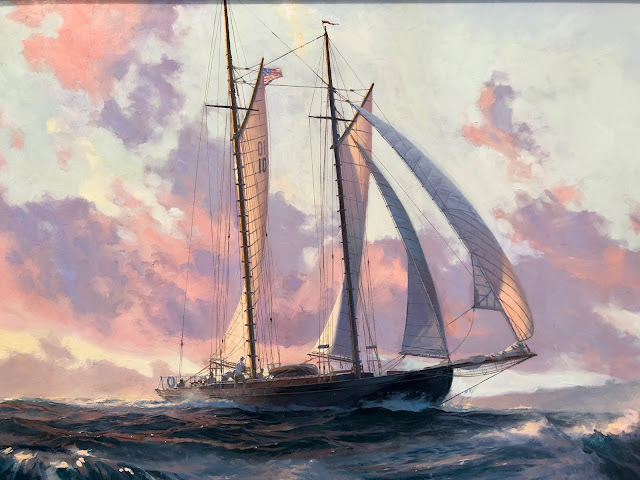
The Salmagundi Club was created by artists for their own pleasure about ten years before the Harlem. On Fifth Avenue at 12th Street, it is about a seven minute walk from my house. They had a show of maritime art so I alerted the members of the Harlem who might enjoy it. The work was beautiful and expensive, e.g., up to $30K, but it was a small show -- only fifteen pieces, six of them seascapes without boats.


The Explorers Club was founded 20 years after the Harlem and has a lovely clubhouse on East 70th Street. It promotes and celebrates exploing by land. sea and air, on the earth's surface, in space and underwater and in caves. Their program was an all day series of excellent, well illustrated lectures by name brand circumnavigators. It included breakfast, lunch, snacks during breaks and a cocktail hour with enough food that it sufficed as dinner. The sister of the chairman of the event was very pleased that three of us Harlemites were present, and asked me to thank our Commodore for publicising the event, which is how I learned of it. Hoch, who has a Pearson 36, drove up from suburban Philly and Matt, who is a social member (does not own a boat -- yet!) were my clubmates in attendance.  Matt is scheduled to crew on a passage from Hawaii to Seattle next month and offered to crew on passages with ILENE in the future.

The best part was the speakers.
Halsey Herreshoff was there to introduce one of the speakers. I got to speak with John Rousmaniere about his recent article in Cruising World announcing that his age, the same as mine, had compelled him to decide that he was not alert enough to do blue water sailing anymore. He admitted to me that he would do overnights, such as Nantucket to Nova Scotia, but not longer than one night out at a time. He spoke about the Americas Cup (mentioning that like me, while recognizing the advances of technology that that race has inspired, he is not really a fan of the new planing craft). He also described the Fastnet tragedy, which is the subject of one of his many books.

Dave Rearick went around solo on a modern Open 40 racing hull, "Bodacious Dream" with corporate sponsors. He told us his technique of sleeping with a kitchen timer in his pocket, set to wake him up every fifteen minutes. I asked why, given the infrequency of meeting other boat once far off shore and his radar alarm, he needed this, but he likes doing it his way. He took 8.5 months to get around and asked himself "Was it worth it?" And he answered that it seemed like a self indulgent activity, until he thought that by writing about it he thereby was helping others so indeed it was worth it. And while I have never and will never circumnavigate, I like to think that this blog is intended to help others too.

Frank Blair circumnavigated on a 63', gaff rigged wooden schooner, Maggie B, with 30 of its 70 tons being its lead keel. he praised the schooner form as fastest and easiest at sea. He took 26 months to get around (38,400 NM) but noted that despite long passages between continents he spent two out of every three days in port. Hmmm! -- the same ratio as on ILENE's cruises. He had about three crew at all times, but 27 individuals comprised those three. He said: I can teach a neophyte to sail but I can't teach a jerk to not be a jerk. He told us many lessons he had learned:
Every new noise is a bad noise, a sign of trouble.
Save all manuals and label all chargers.
Night watches are the most pleasant past of the day.
Customs is crazy; in Australia they confiscate ALL of your food.
Always get propane as soon as you clear customs because it can take a long time.
Use meteorological forecasts to place your boat where the best winds are.

He agreed with Dave Rearick that autopilot is more accurate after an hour that a human helmsperson.
He put his boat in the yard in Lunenberg Nova Scotia, where it had been built, after his return for some refurbishing and lost it when the yard completely burned down. But he got a new boat with the insurance money and plans to cruise Newfoundland this summer. Perhaps we can connect there; I'll be looking for him.

The last two speakers were women. One lost her fiancee overboard from a 46 foot delivery from the south seas to San Diego in a dismasting/rolling/pitchpole and spent the next 41 days jury rigged to Hawaii using celestial navigation. She wrote a book that was made into the movie "Afrift" released in 2016. The other circumnavigated on a 28 foot boat "Inspired Insanity" with a severe budget and many system failures, but made it.

Lots happening already this young spring.

Monday, April 1, 2019

Tuesday Mar 26 -- Saturday Mar 30 -- Five Work Days And a Change of Plans

First the change of plans:
Sailors are used to changes of plans and today's may not, and probably will not, be the last version of it. The first two cruises of 2019 are not changed.

1. April 27 to May 7 -- A ten day bareboat charter on a catamaran with Bennett and Harriet in St. Vincents and the Grenadines. We were there in 2011 and 12 aboard ILENE and I have sketched out a cruise plan to make sure our friends get to as many of my favorite spots as can be packed into the limited available time. Sailing a cat is new to us (though sailing with cats is not), and the girls are thrilled about not heeling. Also, the cat in question has room for two more couples so we are making a luxurious use of on board space.

2. June 8 to June ? -- My flight to Bermuda is booked for the eighth, to give me a couple of days to explore Bermuda before the June 10 planned departure to Halifax with Yves and Greg on Yves' French built 39 foot aluminum sloop. It is a Kelt 39 (they made a lot of Kelts in Europe) named Rusee de Jersey. I met Greg in 2017 and Yves in 2018, both in Canada, both through introductions by Manu who we met in St. Martin in 2010. The question mark in the subject of this paragraph is not about  "if" we will arrive but "when". Yves, who has done this passage before, says it should take six days. Our departure is planned for June 10 but may be delayed by weather and the duration will depend on the winds we encounter during the passage. I'm figuring to get back by to New York by June 22 at the very latest.

It is for the remainder of 2019 our plan has been completely reconfigured because of a separate plan of dental surgery for Ilene, with healing periods between surgeries. The dental plan got set back four months because of her broken elbow etc. last October.  We had thought to sail (A) six weeks on a leisurely cruise in Rhode Island this summer followed by (B) a departure to the south for the winter starting in late October. Originally the projected warm destinations were to the new waters, for us, of Cuba, or Florida's West Coast, or to the familiar waters of Grenada. Then we set a less ambitious plan for the nearer waters of the eastern Bahamas-- the Abacos,  Eleuthera and Cat Island -- on which we have not sailed. But the surgeons say we cannot leave until December or January, and it's just too darn cold for us to be out in the Northern Atlantic then.  Of course, our founding father, John Adams, made several Atlantic crossings in December, as ambassador to France for his soon-to-be nation. So it can be done. But we sail for pleasure, not to endure ordeals.

3. So the new plan for the second half of 2019: TADA!! Nova Scotia and Newfoundland. We can leave as early as June 26 and have to be back by September 28.  That should be enough time and we learned some things during our 2017 Canadian cruise. So it's a good thing I delayed buying the missing Bahamian charts and instead I will need some more Canadian ones before we leave.

I did mention some work days. A total of 25.75 hours on five consecutive days; but not all were "hands on". Six hours on Thursday was by car with Dave and Gene to the big warehouse sale of Defender Industries in eastern Connecticut. Defender is a discounter to start with and I'm figuring we got another 20% off. I got the two gallons of bottom paint at only $220 each, a step to hang from the side to make it easier to board and disboard when we're alongside a dock, a new electronic distress flare, new secondary sheets for the small jib and all sorts of polishes, cleaners, waxes, zincs, etc.  It was a very efficient and pleasant trip with the two guys, our third time together, I think, and after a quick lunch in Westport on the way home we ran into Barbara, wife of PC Stu, of the Harlem.
I also spent time gathering and figuring out what I had and needed from my locker space at the Harlem, created an inventory of the used electronics for sale, created emails listing the items of work I would like Rigger Jeff and Mechanic Ed to help me with this spring, gathered various items from the boat to take with me to the sale, so that the new parts would be correctly sized and put all the newly purchased stuff away and filed for the rebates. Also, one of the days I  drove from the boat up to Valhalla NY and back to lawfully dispose of the five gallons of water-diesel mix. I created a bit of a problem for myself in trying to remove the hoop of the shackle integral to the car of the traveler for the main sheet. The hoop is wearing and I thought to replace it. I failed, and in the process I learned, the hard way, that there is a race of ball bearings in the car, seven of which came out. I captured them but replacing them is one of the projects for Ed.

I also accomplished four tasks at the boat.
1.  Finalized the reinstallation of the aft fuel tank. Attaching and clamping the two small hoses was easy but the four wooden upside down "L" shaped blocks that hold the tank firmly in place took a while because the thick vertical side of the "L" did not fit between the tank and the stringer. Hmmm? Finally I figured out why and then it was easy: the vertical part of the "L" blocks are not equal in thickness, by maybe a quarter of an inch. The ones to port are thicker than those to starboard.
2.  Cleaned out the bilge, by scrubbing its greasy and mud caked bottom and sides and the hoses and nuts in them with paper towels wetted with Fantastic. A yucky job that takes time.
3.  Reinstalled all of the cabin sole boards of the salon that had been removed to gain access to the fuel tank. This took a long time because they did not fit! The reason, I eventually concluded, is that the hull takes a slightly different shape when held up by the keel and jack stands compared to when caressed in salt water. But by squeezing and lifting the edges, eventually it all got put back together except for the two smallest pieces that surround the mast. I broke these taking them out and with help from Ed they will be fixed.
4. The last day was the most fun, though perhaps the hardest work: removal of the canvas cover, folding it up, tying it up, and carrying it, one half at a time by cart and car to the Harlem YC locker house where I got help carrying the heavier piece up to the second floor locker. I also collected the insulation padding and the underbelly strings. I plan to "finish" the ends of the strings to make it easier next year before washing them. Happy day! ILENE's solar panels are back in business.


Monday, March 25, 2019

March 12 - 24 -- A Western Land Adventure, But Studded With A Star

Yeah, the trip included Tuscon Arizona, San Diego, California and Portland, Oregon with lots of family and friends. A good time but such subjects are not grist for this blog.

The Star of the show was the Star of india, the centerpiece of the Maritime Museum of San Diego, which includes a total of about eight boats. I detached from the rest of the folks and visited for about three hours on a warm sunny typical San Diego day. The other boats include the ship built to replicate the HMS Rose (or Surprise), which was used in the film Master And Commander,  a Spanish galleon, several pacific designed racing boats, two submarines, one Soviet and one of ours and a former ferry whose main deck provides lots of exhibition space.

I checked out the HMS Rose, a replica of a British Frigate. On her port  bow, looking out over the Bay was a sail broad reaching; it made me long to be underway again. Below decks were her guns, well actually guns that were too large for her to have used, and a description of the gunnery drill.

But I spent most of my time with the Star of the show, the best renovated and maintained and probably the largest.

She was built in 1863 on the Isle of Mann, between England and Ireland and originally named Euterpe which means Delight in Greek and is the name of the Muse of Music. Her LWL is 205 feet, 278 with spars, her beam 35, her draft 22 feet fully loaded and her highest mast towers 124 feet above the water.

She led four consecutive highly productive and profitable lives before becoming a museum. First she hauled freight between England and India. Then she changed careers to carrying paid passengers (settlers) from England to New Zealand. Her third life was carrying lumber from Alaska to San Diego, which at the time was rather treeless. Large rectangular holes were cut into her aft hull (which could be covered by heavy steel plates dogged down tightly) through which tree trunks could be loaded into her hold. Finally, starting in 1901, she was sold again, to the Alaska Packers Association, and worked carrying canned salmon from the Bering Sea to Oakland, California with her name changed to Star of India in 1906.  Along the way her aft mast was converted from square rigged to fore and aft, which made her a barque.

Her hull was iron and she escaped several near disasters, dismastings and other damage, only to be repaired and live on during her 21 circumnavigations and many other passages. While this fact was not mentioned, she obviously made a ton of money for her owners during her 63 years as a workhorse, until 1926 when she was sold to the San Diego Zoo to become a museum.

 But the depression and other factors intervened and it was not until 1957 that restoration began and not til 1976 that she put to sea again, with tourists, not settlers. Here is the stern deck and one can see the effort that went into the brightwork on which settlers could sit on good days.
The Maritime Museum calls her "the oldest ship still regularly sailing" and "the oldest iron hulled merchant ship still afloat." I thought, "What about Old Ironsides in Boston Harbor". On the day of my visit there were zero docents so I was not able to ask. I think there may be disputes about the meaning of the word "regularly". I did notice that some sails were bent onto the spars and two of them were set, in the light winds that day. My thought was that such sails are expensive and should be protected by sail covers from the strong steady San Diego sun.

Below decks were many exhibits of various aspects of nautical information. A lot of space was devoted to the lives of some of the men who sailed her and the men and women who were passengers, including typical bunks for those not in steerage. One section said that ships were the first and in the early days, the only vehicles that connected the world. This was certainly true of the two hemispheres, but land caravans had connected Europe and the far east before that. Her bow hold was open, below decks. and looked huge, though not compared to today's super ships. One part was an art gallery for photos of racing on San Diego Bay.

There is much more to see in the museum -- for my next trip.

Thursday, March 7, 2019

Dear Witty: Rest In Peace

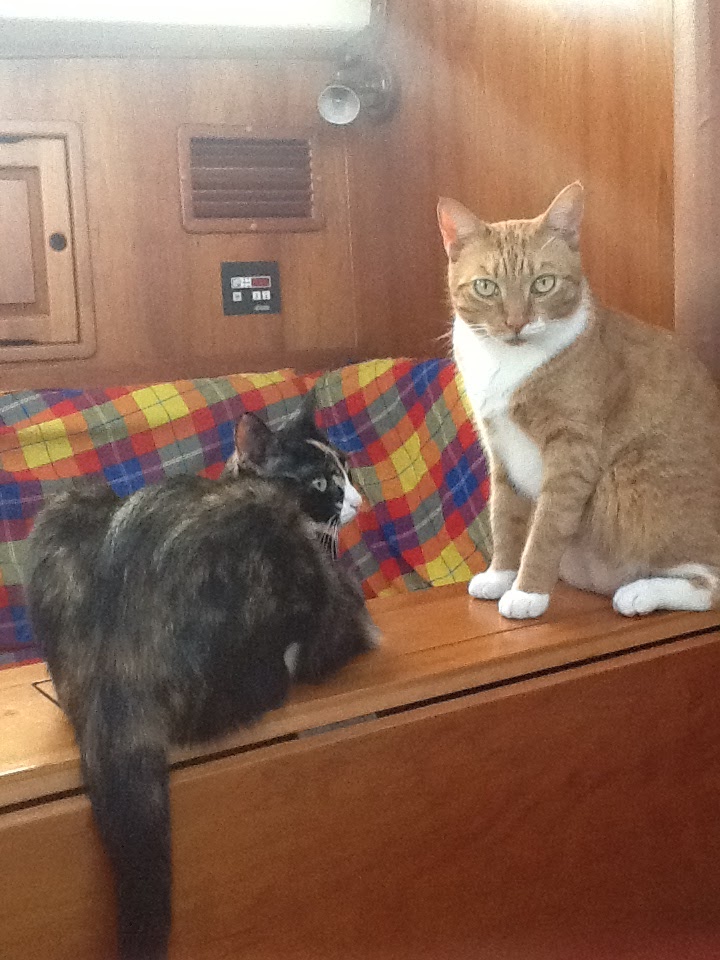
Witty was the young, orange, male, feline member of our crew. He sailed with us everywhere since the beginning of this blog in the Fall of 2010 (except for daysails and the passage from Norfolk to Tortola). I'm estimating that he spent more than two of his eleven years afloat.
Readers will recall the time he fell into the bay off Cariacou, WI and the several times we thought we may have lost him, in Oriental NC, Coconut Grove FL and Falmouth Mass.
He was born in December 2007. He was a lover, not a fighter. He was not really a "good" cat, by the measurement of obedience. He would steal food off of any open unguarded plate; he especially loved to lick the butter stick. He also awakened us when he wanted to be fed -- very early in the morning, and has knocked things off of counters which broke, to gain attention. But he was a great cat for loving to lie on anyone's lap and be petted and his faults were always forgiven.

We had to put him down today though, after a fight of more than two years with a bowel disease that may have progressed into cancer. He visited vets in Belfast and Rockland Maine as well as City Island, in addition to many visits to his home vet in Greenwich Village.
He was given a special all raw meat diet, appetite stimulants (this for a guy who lived to eat!), antacids, steroids, motility drugs, antidiarrhetics, and doses of subcutaneous IV solution. These doses used to perk him up but the last week it seemed hopeless and he we found him lying on the floor breathing with difficulty this morning. His continued life had no quality, and the vet saw no chance of improvement. He no longer suffers.
His ashes will be cast upon the salt waters of Long Island Sound this summer.
.
Lene and I and his sister, Alfie, miss him greatly. The little critters worm their way into lasting places in our hearts.

Christie's Mopelia Collection

As a member of the New York Map Society, I was invited to a reception for a display at Christie's Gallery at Rockefeller Center called "Beyond the Horizon: The Mopelia Collection of Fine Atlases and Travel Books." The brochure cover is shown and much of the display was devoted to the art illustrating the books. Someone spent a fortune collecting atlases, mostly Dutch, from the 16th and 17th Centuries
A small portion the collection was on display here, before moving to Paris before the Auction in Paris on June 5. These are objects of art that I never hope to own. I have a genetic condition: I was born without the acquisitive gene. I'm just as happy, more happy really, viewing such treasures in museums, galleries and libraries as compared to keeping them in my home and insuring them, worrying about them and taking some sort of guilty pleasure in excluding others from seeing them. And this is beside the fact that there is no way I could afford to bid on these masterpieces.
But somehow I knew to wear a suit and tie and my name was on the list with the other 50 or 60 well dressed folks.
The exhibition was co-sponsored by another company that Christie's parent company owns: Ponant. I had never heard of Ponant. It calls itself "The World Leader of Luxury Expeditions" and the brochure describes extremely elegant small cruise ships. The  company representative tied the cruises of discovery of Ponant with the charts of the discoverers. He extolled the excellence of the French cuisine and the luxury of small boat voyaging-- less than 200 passengers on a boat. I later gave him my card and told him that my way of cruising was thus even more luxurious with a maximum of only four passengers aboard ILENE and the further luxury of staying in an interesting port for as long as it retained interest as compared to the schedule of a commercial cruise line.
The liveried staff wined me and passed the most beautiful and tasty hors d'oeuvres.
But the highlight of the evening was the display of books of charts, especially of western Atlantic waters, such as the two below.
First is a Dutch view of "Nieu Nederlandt", more specifically the coast from Norfolk through Cape Cod. Interesting to zoom in, which the eye can do more easily than the camera, to find place names that I am familiar with and those whose names have changed.  Also interesting to note the gross discrepancies compared to modern charts such as the size of Long Island as compared to Nantucket and Martha Vineyard.

 The second one I photographed has a smaller portion of the world, showing a bit more of the Virginia coast heading down toward Hatteras but going only as far north as Staten Island. Interestingly, north is to the right instead of the top so that the two huge pages (you can see the grey crease in the middle) could show a greater expanse.
 All of the charts were beautiful. mostly hand colored. They were made for wealthy merchants to impress their friends with, not to be subjected to the hazards of the sea. A very pleasant experience.

P.S.:  Newyorkmapsociety.org is a 501(c)(3) organization that is open to anyone with an interest in maps or charts. Some of our members are experts, others collectors (which can be a rather pricey addiction) but others, like me, are mere users and lovers of maps and charts. We are not at all exclusive and annual dues are only $30. We hold about ten meetings a year at which aspects of maps and charts are discussed. If you are in the NYC area, you might want to look up a meeting and give it a try.

Tuesday, March 5, 2019

STYX, the Movie


Quite a good sailing movie about a German physician who sets out on her sloop, the Asa Grey, probably a Beneteau (which she tells the Coast Guard is ten metres), from Gibraltar for Assension, a suburb of St. Helena in the Eastern Atlantic.
The sailing is more realistic, than in Robert Redford's All Is Lost. Well not perfect: she failed to scribe a line on her chart along which to mark off the mileage with her dividers. But the storm, the calm, the very limited dialogue. She has an EPIRB and both VHF and SSB and uses them all well.
This is also a film of ideas and ethics, but without preaching. The title comes from classical mythology:  the River Styx is the water passage between this world and the underworld, which her voyage turns into, becoming a suspense thriller.
Her objective, as shown by her leafing through picture table books of flora, was to study the lush tropical botany at her destination, a place associated with Charles Darwin. And her boat's name is a homonym for Asa Gray, the most famous American botanist of the 19th Century and a frequent correspondent with Darwin. The internet led me to that nugget while I was trying to get it to tell me what make the boat was.
The ethical and moral choices come later and I won't spoil the movie for you by describing them.
The film has been rather favorably reviewed by the professional reviewers and is continuing at the Film Forum on Houston St., half a block west of Sixth Avenue, in Manhattan, but only until March 12. After that it may appear in art film houses and streaming.
Sailors will both enjoy and be moved by this movie.