"There is nothing more pleasant than cruising on a boat with the whole family."
Letter from Empress Catherine the Great

Monday, June 23, 2014

Two Days With Natalia in St. Petersburg

St. Petersburg was the jewel in this cruise's crown. We had two days at sea and change two time zones to get here and the same going back to Amsterdam. So they spend two days and one night here. None of us are permitted through Russian customs and immigration without a document specifying who is our tour guide. Partly as a consequence, the tours are quite expensive, but former model Natalia (with her husband, Dennis, a former ski jumper, as driver) took the four of us around in a late model VW van at a better price than Celebrity's. Mike had found and selected Natalia months ago.
Natalia's English and her knowledge of Art, Russian history and her city were extensive and entertaining. She was the highlight of our stay here. Dennis does not speak English but is an excellent and attentive driver. In contact with Natalia by cell phone, he was always where we needed him. They proved their value added when Natalia left Lene and I with Dennis in a downtown park that was having an international garden show while she drove Linda and Mike to a local hospital staffed by US doctors to look again at Linda's painful healing broken wrist, and then Dennis drove them and Lene back to the ship, about 25 minutes away, while Natalia put her art history training to work on a personalized tour of the Hermitage. I wonder what happens when you are two of forty passengers on a tour bus and your wrist starts to throb?
Hermitage from the Neva, which it fronts,

I helped Natalia with my commentary on these two strategically contrasting paintings by 18th Century Italian painters who were unknown to me. On top Tiepolo's "Dictatorship Offered to Cincinnatus"; he was a Roman general who like our George Washington after two terms, declined to lead the nation but went back to his farm. Below, Guglielmi's "Apotheosis of the reign of Catherine the Great" -- she who loved to wield power.
Exterior from the street side

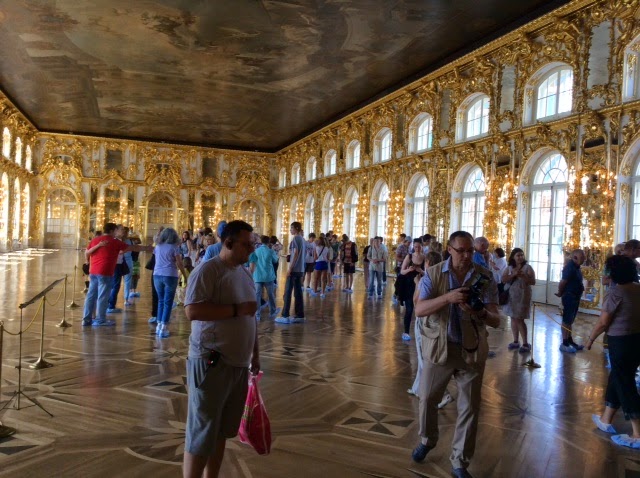
One of the Hermitage's architecturally  magnificent salons

In addition to various cathedrals, parks, palaces, stores, forts and monuments, we stopped at the massive monument to the 900 day siege and bombing of Leningrad, as it was then known, where Hitler lost his way in WWII, as millions, literally, of Russians starved and froze to death if they were not killed by daily bombing and artillery fire. Terrible brutal times. In the US we sometimes forget that while we made huge sacrifices of blood and money to assure victory in the two World Wars, our primary role was to supply war materials while our Allies suffered the bulk of the casualties. Today, in the war against terror, it is unfortunately our own youth who are doing the bleeding and dying.

The first highlight was our stop in Pushkin, as the imperial summer palace complex of Elizabeth and Catherine is called, also known as Tzaroe Selo, perhaps 25 miles south of the city. This Summer Palace was successfully designed to resemble Versailles, outside Paris. The Russians of the 18th century sure did have a love affair with  France and all things French -- including its language and Napoleon  --until he invaded Russia. When we think of these magnificent art filled museums we have to remember that they represent the Russian serfs' "taxpayer dollars at work".
They make you wear these booties to protect the floors


Lunch in a restaurant owned by a friend of Putin consisting of hot borsht, potato pancakes, hot pockets of dough baked with cabbage, mushroom or meat in them and the best tasting cranberry juice I have had.


We visited Peter the Great's summer palace as well, Peterhof, about 25 miles west of town, on the Gulf of Finland branch of the Baltic. You can see the Gulf at the far end of this grand fountain filled canal.


Same fountains, from below.


I had not known of Peter's training, prowess and love of naval architecture and warfare. Note the interesting cross atop the steeple here, sitting on an anchor.

But his palace is best known for its many magnificent fountains, fed by gravity from lakes high above and flowing out into the Gulf.

We did miss the museum of ship models here, due to threatening torrential rains which hit soon after we began to drive home.

After the rain we got out with Natalia and took the St. Petersburg Metro for a few stops before being picked up again by Dennis for the rest of the ride home. Mike loves to ride foreign subways and this one is designed elegantly and unusually deep beneath the city.


The island fortress of Peter and Paul from the river.


The two Rostrum Towers featuring the hulls of ships sticking out of their sides.


The magnificent Church of the Savior of Spilt Blood, built in the late nineteenth century on the site of the assassination of Tzar Alexander II, who freed the serfs and was assassinated for it.

Shrine at the specific assassination site

 Interestingly, part of the reason for his sale of Alaska to the US ("Seward's Folly") was to raise some of the funds by which he compensated the landowners for the loss of their property. No civil war resulted and the only blood shed was the Tzar's.

Sunset here is at 11:30 and sunrise at 4:30; we have been sleeping through both. Again we have been impressed by the heavy volume of shipping in the Baltic.

Saturday, June 21, 2014

Tallinn (Estonia) -- Maritime Museum


We were let off the boat here in Estonia's capital from 10:00 am to 4:00 pm and took a shuttle bus from the cruise ship dock to the edge of the medieval walled city up on the hill. Lene rode back (round trip bus fare $10.00) but because the Maritime Museum was half way back, I walked.

We were without the company of our companions, Mike and Linda. Her broken wrist was causing increasing pain so they went to a Tallinn doctor who replaced her hard cast with a soft one at a ridiculously low price, by US standards.

In town Lene and I took a free two hour walking tour led by students or recent graduates of the local University who majored in "Cultural Theory".
She spoke with flawless English, quite engagingly, with humor about Estonia's tangled history of centuries of occupations by Scandinavian nations, Tzarist and most recently communist Russia and with a briefer time under Hitler. Its current period of freedom, since the early 1990's, is the longest in its history, and while it has a sizable Russian speaking minority, this history makes it highly unlikely that they will seek "protection" from Vlad Putin.

The huge freighter load of logs we saw come in at Warnemunde likely was loaded in Tallinn, lumber being Estonia's chief export. While Lutherans form the largest organized religion, they are a minority in a nation which is overwhelmingly secular or as our guide called them Athiests. As a result, many of the large churches whose spires dot the skyline, are now museums. LOTS of towers:
Small one with Lene


This one is called Look Into the Kitchen


Estonia's independence was won in "The Singing Revolution". The nation has huge mass organized singing festivals, but under Russia only government approved songs were allowed. But in the year in question, at the end of the officially approved program the crowd broke out in uncontrollable spontaneous leaderless disapproved anthems of freedom. The Russian army chose not to mow down the crowd and victory was won. There is a bas-relief sculpture honoring Boris Yeltzin. 

Here is Freeedom Square and next the top of a huge glass cross dedicated to freedom.


Trip Advisor gave our daily tour exceptionally high praise and it covered the same sights that Celebrity sold for $45 per person. We happily gave our guide 10, about $13.50, as a tip. So with $20 as bus fare, it cost us a total of $33.50 instead of the $90 that Celebrity was charging.

I bought a small bottle of Vana Tallinn, the local 90 proof Estonian Liqueur, but our guide warned us that the local specialty, amber, is all imported.

This cathedral was built in the late nineteenth Century.


From the top of the walled city looking to the new modern city and then from the base of the old city looking up to the top.
 

I am a sucker for Maritime Museums, and I have to admit that Tallinn's was not the best I have visited. Built with a modern concrete structure inside the shell of a medieval tower, it sought to cover fishing and caning, military, freight, cruise ships and sailboats from prehistoric times to the present and while part was in Estonian and English, the history of the Estonian-Russian naval war of 1918-20 was in Estonian and Russian, which left me ignorant of this obscure chapter in world history. Here is our ship from the rooftop of the museum, where they have a nice cafe.


After the steam room we took in our first show. It told a new story of a couple overcoming obstacles to their marriage, consisting almost exclusively in 1980s pop songs and set in Wonderland and Oz. Whimsical fun with high production value. Then another great dinner aboard.

Friday, June 20, 2014

A Bigger Boat


ILENE is sitting on her mooring while we are cruising from Amsterdam to St. Petersburg and back on the Celebrity Constellation along with our brother and sister in law, Mike and Linda, and 2030 other folks, the boat being filled to capacity -- plus near 1000 crew. She is 965 feet long; her beam is 105 and her draft is 26. And she outweighs ILENE  9100 to 1.
Our cabin, though on starboard, was third deck, the second row of  large round portholes (just below the life rafts, about three forward of the very large ones portholes under the enclosed exterior black elevators.
Roger, Mike, Lene and Linda with cast on her arm 
This is our sixth cruise -- almost all with my brother and or Lene's, and their wives. The pleasure of behemoth cruising pales compared with cruising ILENE. The big advantage of the big boats is they go to places that we will never otherwise get to and the hotel is moved at night while you sleep with no watches to stand or navigation issues to resolve and there is no packing, unpacking and getting to and from airports or railroad stations. Food is prepared and served, the room is professionally cleaned by our smiling steward who remembers my name and there are countless and varied shipboard entertainments.

We have missed about half of the evening night club-like shows. This is partly because we are day people to which night clubs are less of an attraction and partly due to our proximity to the land of the midnight sun. One night we got to the theater after dinner and saw that the show was wrapping up. "We'll stay for the second show," said I. "This is the second show" was the response. But while it was almost 11 PM,  it was still light outside, creating the illusion of 7:30. The traditional "sailor's midnight", i.e., sundown, gets thrown out the window here.

The food, while good, has never again achieved the dazzling excellence that we recall from our first such cruise of the Eastern Caribbean on a Princess ship about fifteen years ago. The excellence of that first time experience may be a creation in my mind, and back then I ate like a pig while now I am conscious of a desire to limit the number of pounds that this vacation will add to my personal tonnage. (Actually, my first weighing after returning home showed a gain of seven pounds.) Mercifully, the "midnight buffet" is a thing of the past, a victim of both cost cutting and peoples' increasing consciousness of the perils of extreme obesity. But the buffet is open about twenty hours per day.

This boat was built twelve years ago but was recently refurbished and looks pristine. Newer ones have larger gyms to accommodate a greater percentage of health conscious cruisers. We took in a stretch class almost every morning and  worked out in the gym and visited to the sauna or steam room almost every day.

Too many of the "entertainments" are infomercials for the products and services that the ship is forever trying to sell. I have a personal prejudice against being "sold". When I want something, I'll ask for the help of the salesperson's suggestion. But unsolicited sales help makes me less likely to buy the advertised product or service. On the boat they have art lectures to try to sell you art, gaming lessons to try to increase their casino business, tours of the galley to try to get you to dine, for additional fees, in the several specialty dining rooms which used to be free, and lectures on wines and liquors to induce sales of drinking cards. We are very poor customers in the eleven different bars because the two women do not drink at all and Mike and I have only a very occasional beer or glass of wine. And we have not patronized the mall of shops. And the ship's land excursions are very heavily promoted too, and not a good value. I learned from my brother, Allen, years ago, that especially when you have a group (we are four) you can do better with your own locally sourced tour guide or taxi driver than with the expensive tours that the boat pushes. This lesson was driven home in Amsterdam's airport, where we met a Celebrity greeter who told us that their special private direct shuttle to the boat cost only $38.00 per person.  But Mike told us the better way. The local railroad station runs under the airport and for $4.00 you get a ticket to Amsterdam's central station with only a beautiful fifteen minute waterfront walk to the boat.
My three companions love to play cards and are quite good at this; they like to play with me because I am a good loser. Linda's arm was in a sling this whole trip and I became her "card holder".

The best thing about cruising the sailing vessel ILENE is that we can make our own schedule. If we like a place we can stay a while. If storms threaten, we stay put. Before I was retired I did not have the benefit of almost unlimited time. Neither does Constellation. She is on an extremely rigid fixed schedule with one "day" in each port except two in St. Petersburg and this cruise has four "at sea" days among the twelve.  Many people do not like these "at sea" days but as long as I have my book and good companions, they are fine by me. And we will end up having visited seven nations, six of which are new for me.

The exception is Germany, birthplace of my father, in which, during a Danube River cruise a few years ago, we visited Regensburg and Nuremburg, in the southeast. This voyage included a lengthy fifteen hour visit to the seaside resort town of Warnemunde, near the ancient Hanseatic League port of Rostock, in the northeast.  That day our dockside visit extended to midnight to accommodate more than half of the passengers who took a seven hour round trip bus ride costing about $200 per person in order to spend a few hours in Berlin. We took a ferry from our dock in Warnemunde  to the heart of Rostock for $10, and after several hours of wandering among the churches, 
Huge organ above clock
Clock with 135 year calendar
gates to the ancient city,
it's galleries, university etc.
A $3 train ride brought us back to Warnemunde. I was quite conscious that this was my first ride on a train in Germany, but this was not in a cattle car. Germany is indelibly stained in my mind by its Third Reich, and I cannot help but look for references to this abhorrent period. But I found none here in Rostock other than the account for what had been rebuilt after the bombing of 1942.


They reverse our "red, right returning" rule in the placement of the buoys in the Baltic.

This is the former communist East Germany but the spirit of capitalism is thriving with innumerable food, lodging, clothing, novelty, souvenir and every other type of store. The volume of the shipping traffic past our boat including both freight and passenger boats plus many sailboats from marinas in this port was very heavy. This and the next picture are from the top of the old lighthouse


Warnemunde is a beachfront resort.

I just liked the looks of this Dutch style gaff-rigged low-aspect ratio sloop with her brown leeboards up (instead of a keel). 


Sunday, June 1, 2014

Bennett's Beneteau

I had the pleasure of sailing with Bennett, Ed and Ian on Bennett's new Beneteau, 37 feet long built in 2011 and quite beautiful and fast.
Ed and I left our cars at the Harlem and got into the rented car at 7:30 A.M on May 30 for the ride up to North Wickford,  RI.  The boat was almost ready to go. But I noticed that one section of the stainless steel tubing that holds up the bimini had come loose from the socket which holds it in place and was dangling, though fortunately the two allen head set screws which clamp it into the socket were not missing. So during Bennett's drive to drop off the car, he picked up a tool kit and the broker went and got his allen wrenches and this was fixed. This repair was at the bottom of the diagonal from the upper right down to the left, to the built in starboard davit.
We also got a bottle of Spray Nine cleaner and took up a lot of the pollen that coated the boat -- another disadvantage of being on the land.
I was all in favor of not dropping below five knots to make sure that I got home reasonably early so as to not miss the flight that Lene and I are taking to Amsterdam today, the day after our arrival. But it was tough at first using the motor only. Somehow we seemed to have good tide at first and good wind later, after we got south of  Point Judith and headed west to home. 
We departed at 1:20 pm and arrived at City Island at 10:20 am the next day, May 31 -- 21 hours for the 130 nautical mile passage, almost six knots. Two rainstorms before dinner, the first light and the second heavy, showed that the new boat is toasty dry inside. I am calling her "the new boat" because her current name is "Ohana" (I wonder what that was all about) and Bennett has not yet selected her new name.
Dinner was fine despite confusion as to provisioning. We had trouble finding the switch that controls the solenoid that lets propane flow from its tank to the burner. We also found that the yard had not done a good job of flushing all of the propelene glycol (pink antifreeze) from the fresh water tanks. The water had a funky taste and smell, so we used bottled water to boil the pasta. And we had only one pot so after draining the pasta (no strainer or pot holders so I used the lid to keep the pasta in and clothing to hold the pot) I poured the jar of vodka sauce (which had been placed in the refrigerator) into the pot and with low heat and stirring it all got warm. The only utensil was a spatula but with it and fork we got the pasta onto plates.  No salt, pepper or grated cheese but it was warm and filled our bellies. We also had confusion about the accompanying salad. We had four prepared packaged bowls of Ceasar salad that I had not known about. And redundantly, we had lettuce, tomato and cucumber, but no dressing for the salad I had planned to make. So I added some of those fresh vegetables to the prepared salad, used its dressing and again, the crew was happy.
 Ian and I were off duty from eight pm until one am. So we missed the passage through The Race, which I was told was made at 7.5 knots speed over ground, near the slack. 
We have tentatively decided that the boat does not have a speedo to measure speed through the water, and no instrument to display such, or at least we have not founds such yet. The relevant speed, except for racers, is SOG, with water speed useful only to know how much positive or negative effect the current is causing. SOG and depth ( and we do not yet know whether depth is calibrated as actual number of feet of water, like on ILENE, or number of feet below the keel, which some prefer) are shown in data boxes on the Raymarine radar/chartplotter display. It is a larger and newer model than ILENE's. 
Bennett has to learn how to use this tool better, which will come with reading the manual and playing with it. We were shown a control for changing the brightness, which must be turned way down at night, but we forgot how to do it and could not figure out how to do it once it got light in the morning whereupon we could not see the screen. But we also had two Ipads with iNavX, so our position, course to waypoint and speed were always known. Our use of the Raymarine unit as a chart plotter had to end earlier when we ran off of the edge of the chart. The prior owner had the electronic chip containing the charts for New England. This extended only to the waters of extreme eastern Long Island Sound and we sailed off the edge it its "known world".
We had experimented with the sails, including the in-mast roller-furled main, with vertical battens, but the wind was either too light and or too much in front of us from the west to be used consistently and so we had motored the whole way until about 3 am when the wind came up on our starboard side in the teens, and we sailed home on a beamy close reach and made up to seven knots.  The boat is beamy and carries her beam well aft making her stiff (stable against excessive heeling) and roomy. Both sails are drawing well but both could use an inch or two of luff tension next light wind day. Their halyards can both be led aft to the cockpit.
She has an interesting and clever hatch board. It has a built in lock at the bottom, is hinged at the top from which it lifts up and aft and then slides in horizontally, forward, under the coach roof. So there is no need to find places to stow the hatch boards and lock. Her built in cockpit table has wide side extensions and a socket in which to plug a detachable electric lamp for evening enjoyment on the mooring.
The propane tank is rather smaller but there is room in the locker for a second one. The locker is a rather flimsy thing with a strap to hold down its lid, located on the deck in the port aft quarter. (To reach it, you lift up the helmsperson's seat to starboard and then the port quarter of the cockpit bench tilts lifts up and outboard to port revealing a space for a life raft and the propane locker.) The less rugged construction of the propane locker is not unsafe because in the unlikely event that propane leaks, it will leak out into the cockpit sole and thence flow out over the stern, which is quite open save for two lifelines, and not up across the raised threshold at the companionway into the cabin. There is very little backrest for persons seated on the sides at the aft end of the cockpit and at the helmsperson's seat. So at least one of those blue folding seats with back rests will make for more comfortable seating. She has many fewer lines than On Eagles Wings, but most of them are not whipped, so there is still something I can do to be useful during future sails.
Bennett, Ed and Ian on the Harlem launch
All told it was a very easy and pleasant passage and upon returning to the Harlem I drove Bennett and Ian to Bennett's home in NJ. 

Monday, May 26, 2014

Levi and Hugh

Last time these two gentlemen appeared in this blog was in late June 2013 aboard ILENE at the end of a lovely daysail amid the many islands of Boston Harbor.
Levi is Hugh's grandson. Hugh and I, as junior officers, served together on the USS Hammerberg, DE-1015, back in 1967.
     They came to New York, Memorial Day weekend, for sightseeing and largely to explore New York's harbor islands. On Saturday they did the USS Intrepid and The High Line before coming to our house to rest up before dinner. When offered his choice of Vietnamese, Polish, Persian, Chinese, Deli, Italian, Indian or Ukranian, Levi asked for German, also within about half a mile of our house. I enjoyed Schnitzel, Red Cabbage and Spaetzele with them at Rolf's.
Next day I met them at Bowling Green after they had toured Liberty and Ellis Islands, to take the ferry to Governor's Island, recently turned into a park after centuries of military use. As many as 5000 people worked on the island during wartime, and 60 percent of them lived on the island in various structures built during the nineteenth and twentieth centuries, many of which have been re-purposed for tourism.
     I had visited the island only once before, in 1968, when it was a major Coast Guard base. I took my division of men assigned to the Navy Reserve "surface training division" (no boat) at the Brooklyn Navy Yard, where I was assigned to complete my military reserve duty after two years of active duty. The reserve unit was sadly a joke and a waste of taxpayer money: men who were not motivated to train were supposed to be taught by Chief Petty Officers who were getting out and did not want to teach. So I looked for opportunities to avoid the boredom and the Governor's Island visit, along with ones to the nearby South Street Seaport Museum and the Hayden Planetarium (to study navigation, of course), were our escape hatch to sanity. After a year of monthly weekend meetings during my first year of law school, we were all offered the opportunity to resign and I never looked back until my visit to the Governor's Island with Hugh and Levi.
       A stream of visitors is debarking from the ferry. ($2 for the round trip passage, seniors half price, kids free -- a bargain!) and a view north up the mighty Hudson River is to the left.
The ferry is a small one compared to the Staten Island ferry and is seen behind the tree to the left, with its other terminal, on Manhattan, at the extreme left. To the extreme right can be seen the tall ships of the South Street Seaport Museum, to which my friends walked next.
They have done a great job of making the island into a city/national park. Tours are available of the two forts, the pentagonal one in the center of the island and one with a curved outer wall in the extreme northwest corner. The island's size was near doubled with landfill excavated a century ago from the tunnels through which subways now rush. There was lots of activity on the island with a gift shop an arts center, many food kiosks, several performances for kids, pop up galleries for art, clothing, and the Math Museum, and to the west, large fields for soccer with Lady Liberty as a spectator.


They also have a "grove" of hammocks, bicycle rentals (or you can bring your own) and bike paths.
Manhattan's skyline  from above the carefully and diversely planted new trees on the island, with the new Freedom Tower to the left.
Governor's Island is a fun place to visit for city dwellers and tourists alike. Hmm .... all they need here is a group of moorings and a dinghy dock!

But meanwhile progress in getting ILENE ready for her upcoming 17 month "season" (June '14 through October '15) is proceeding, but she is not quite ready to sail yet and other events keep interceding.

Saturday, May 24, 2014

Maintenance

So, I figured that you guys were so thrilled by the earlier post about heads and bottom paint that you crave more. Bottom near the the propeller (lower left) with a black splotch, not yet done, a dirty blueish area that has been scraped but not sanded and almost white areas, mostly sanded.


The sanding rig: At bottom, the ridiculously expensive Fein random orbital sander. Its grey hose leads to the side of the conical top of the "Dust Deputy". The boat's mini shop vac is off to the right with its black suction hose from the top of the dust deputy. It sucks the paint dust through holes in the sanding disc to the top of the cone at which point it swirls down the sides of the cone into the five gallon bottom, thereby saving the vacuum cleaner's life.


A selfie in my uniform: white tyvek overalls, dust mask and goggles over eye glasses, and holding the scraper. I have learned that using half of the width of the blade of this tool is best for scraping paint from the bottom. It is a game of square inches.


A study in black and white of the bottom near the starboard quarter: The black is untouched and the white ready for washing, five coats of grey barrier coat paint and then two coats of new blue bottom paint. The top is the canvas winter cover. The thin yellowish stripe will be gone, sanded and covered with paint.

ILENE is wearing her new blue bottom paint, except for the keel. The grey barrier coat keeps seawater away from the plastic gelcoat that covers the fiberglass and resin. We want this barrier because seawater has this nasty habit of entering tiny holes and eating the boat in the spots where it enters. This is called blistering and can ruin the boat. But as I understand it, seawater does not enter lead and ILENE's keel is lead, covered only in bottom paint. That paint is designed to keep barnacles at bay so the keel, which does not need to be sanded down to bare for barrier coat, is black -- because I have left over black bottom paint, which costs about $250 per gallon. So  ILENE will have a two tone bottom, and hopefully no will will notice once she is in the water --unless we heel VERY far over indeed.

The newly straightened and reattached bow pulpit also shows in the above pic. Actually, Fernando did not straighten the bent pieces but cut them away and welded in new straight pieces and then polished and polished and polished until you can't see the weld, which is stronger than the original. Fernando also replaced the fiberglass and gelcoat at the stern and helped me install a replacement swim platform ladder, restoring the boat to the way she was before getting whacked one night last fall by a hit and run boater.
The freeboard (side of the boat above the waterline) shines, thanks to a day of help from our friend, Nicholas (and our expert personal trainer) -- wipe on; wipe off -- but we use a pair of power buffers.
     One of the big suppliers, Defender Marine, generally a low price vendor, had a big sale up in Connecticut and I went with Dave, of our Club, to buy paint, the ladder and a new VHF radio, among other things. Lets just say "north" of a thousand dollars.
        The existing ICOM radio was top of the line when the boat was built in 1999, but it does not permit a remote microphone in the cockpit and it is neatly embedded in nice looking cherry wood at the navigation station in the cabin. The problem has been that when we want to use it, someone had to run down into the cabin. When underway, Lene was the runner, but our mutual disabilities require both of us: I have mild hearing difficulties and when they say "north" or south",  Lene's brain clicks off. So the new radio is now attached at the helm in the cockpit electrically and to its own the antenna atop the radar arch. We now have two redundant high powered VHF radios.
The one in the cockpit, because its antenna is much lower, has a range of only about eight miles and will be used 99.99% of the time. The old radio's masthead antenna will give it a range of 20 miles and it will be used if we need to call the Coast Guard, which will likely be only when the black paint of the keel is above water. Thanks, Ed, for your three days of help on this project and several others. Yes, installation cost, primarily fitting wires into awkward spots using slippery lube, elbow grease and ingenuity, cost more than the radio and antenna.
Another project has been to replace the internal parts of the plumbing fixtures in the heads, as described in a prior post. While I was at it, I completely detached, removed and sanded the base of the aft head which had become corroded green and repainted it with several coats of Rustoleum primer and then white paint.


 And while in the heads, I have pulled out about 100 feet of the plastic hoses that carry fresh water in the boat. The original owner did not have deck fills: fixtures with a plate in the side decks connecting a hose from there to the water tanks. I installed them a few years ago before we left for Grenada. Now we can add water to the tanks by opening a deck fill fitting, sticking in a hose and turning on the fresh water hose from the dock. The prior owner did not sail the boat much but kept her at the dock and entertained his grandkids on her. So he had fixtures at the bow and stern into which one could screw the same shore side water hose. City water entering through either of these orifices would go through a pressure reduction valve and then run to near the back of the boat to pass through either a one stage or a three stage water filtering system and then to a "Y" valve which directed the incoming water to either the port or starboard water tanks.  All ripped out at last except some pieces that are so buried under other hoses that in those portions of the boat they just lie there harmlessly, open at both ends. Soon to arrive from Headsync and to be installed by me are the parts needed to permit the fresh water from the watermaker to be sent to the starboard water tank (as well as the port one where it goes now).
The former owner also had two Lectrasan sewage treatment units which use very salty water, electricity and a stirring function to allegedly turn sewage into water that is as pure as sea water. But they never really worked  well and several states have outlawed their use. So I took the units and their discharge hoses out a few years ago. I mentioned that they needed very salty water. So fresh water was pumped to five gallon pails filled with rock salt to make water that was salty enough to work the Lectrasans. The pails have been gone for a while (storage space for cat food) and now the hoses carrying the water from the fresh water pump to them are also gone.
Also new shutters (on the left)  were purchased from Zarcor to keep out sun and provide privacy if needed. One of the old horizontal pleated ones is to the right:

The sticky bearing at the bottom of the small jib roller furler was replaced by our rigger, Jeff of Performance Yacht Management, who is also repairing the boom vang's spring, replacing an allen head set screw at the top of the genoa roller furler and installing a new clutch so that the outhaul line, which controls the tension of the foot (bottom) of the mainsail, can be adjusted from the cockpit, avoiding the need to go forward to the base of the mast. Some tears in the mainsail and its stackpack were fixed by Doyle Sailmakers.

As of May 23 this calendar year I have spent 46 days working on the boat. And 15 more last fall after the season makes a total of 61 work days. I must confess that whatever joy such work held for me previously has been getting old.
But the end of the drudgery and high dollar days is nearing, after which the fun days of sailing can resume.

And  it wasn't all work this winter. We had Michelle and Manu of Teepee as house guests for a few days while they were traveling from the Bahamas, where Teepee lay, to Australia, where a grandchild was born. We had met them in the Caribbean several times and at Hop-O-Nose marina. Here they are at an ice skating exhibition.