"There is nothing more pleasant than cruising on a boat with the whole family."
Letter from Empress Catherine the Great

Tuesday, June 24, 2014

A Rudderless Boat?

During sea days my request for a time on the bridge was answered with printed invitations both to the Bridge and to the Engine Control Room. Fifteen years ago, such tours were offered to all passengers and announced like to the shows or bingo. But now, maybe due to terrorism, only those who request same are invited and one must bring one's room key and a photo ID. And only about 25 of the 2300 passengers came.

Most if not all of the officers of both the mechanical and navigation staffs have Greek surnames and were educated in Greek maritime colleges. They are quite fluent in English and pleasant and polite, but they speak with strong Greek accents. My father spoke with a German accent so I am used to such, but with advancing age and consequent hearing loss it becomes more difficult for me to understand accents.

The primary source of power for the ship and it's huge propellers are gas turbines which generate electricity. The heat generated by the gas is trapped and used to make steam used to create even more electricity. Everything is duplicated so that the energy from either of two engine rooms, each containing two engines can be directed via electrical cables (rather than huge propeller shafts) to either of the two propellers or to both. So if either part of the power system fails, it's sister can still power the ship-- to 17 knots but not to the max speed of 25. If an engine fails, the restart procedure takes only two minutes -- a tiny fraction of the time it took to restart Hammerburg's steam boilers!

Constellation also has two huge reverse osmosis water making machines to supply the food, drinking and washing needs of its huge complement of passengers and crew.

All waste water from the engines, from showers, sinks and laundry and from the ship's heads is piped to a central tank and treated by microbes and UV light before being discharged -- as clean enough to drink!  A bit stronger and more successful sewage treatment than ILENE's former Lectrasan machines. The alternative is to keep this water in holding tanks and pump it out in port but this alternative comes with a big sewage fee.

No rudder!!!  Yes, because the huge propellers can be rotated on a vertical shaft -- like the out board motor on a dinghy!  These propellers do not have a reverse gear. To achieve reverse, you turn the propellers around. They spin in the same direction as before, but now instead of pushing the boat forward their pushing power is directed to pull it aft. And no need for stern thrusters, like the three eight foot diameter ones in the bow; just rotate the ships propellers to thrust to the side. The boat also has two large (retractable so that she can pull up to a dock in port) stabilizer fins that stick out about 22 feet on each side to reduce rolling.

The bridge is forward on the ninth deck, below the gym and the cocktail lounge on decks ten and eleven. It is enclosed and extends several feet outboard from both the sides of the ship giving the officer in command visibility of the sides of the ship from stem to stern. 


I asked whether they controlled degree if heel in turns like the sharp ones in the island archipelago on the way to and from Stockholm and the Lieutenant did not really give an answer. Ilene's arms are folded.
On port wing of bridge
Similarly, as to why they went clockwise three quarters of the way around the large island on which Copenhagen is situated, rather than the shorter route one quarter of the way around that island, counterclockwise from the south to the east, and again the answer made no sense, referring to a number of factors that can affect such decisions. But the chart posted near the shore cruise office on deck three shows only our route, the long way.

The Captain also gave a talk in the theater
Part of theater, sorry about fuzzy shot.
about the construction of such boats (modular -- like the huge military vessels we saw being built in Bath ME) and navigation.

He is an extremely witty and charming man and answered all questions. The short answer is that there is a bridge between Denmark and Sweden under which Constellation cannot pass, necessitating the long route. She has a 45 degree righting angle despite only 25 feet of draft and an eleven story freeboard, but he never exceeds five degrees of heeling and despite sharp turns --sharp for a boat this size -- in the archipelago of islands outside Stockholm, we did not exceed three.
Tight turns

One passenger asked if he could bring his family along: "I could but I don't have one." How about a girlfiend? "I could but I don't have one." How about a boyfriend? "I could, but I don't want one."


They told me that Maine looks a lot like Sweden. I took it on faith. Now this picture shows that Sweden looks a lot like Maine.

Our cabin, looking inboard; next is outboard.


Faux teak deck

Part of the gym


Part of the pool

Monday, June 23, 2014

Two Days With Natalia in St. Petersburg

St. Petersburg was the jewel in this cruise's crown. We had two days at sea and change two time zones to get here and the same going back to Amsterdam. So they spend two days and one night here. None of us are permitted through Russian customs and immigration without a document specifying who is our tour guide. Partly as a consequence, the tours are quite expensive, but former model Natalia (with her husband, Dennis, a former ski jumper, as driver) took the four of us around in a late model VW van at a better price than Celebrity's. Mike had found and selected Natalia months ago.
Natalia's English and her knowledge of Art, Russian history and her city were extensive and entertaining. She was the highlight of our stay here. Dennis does not speak English but is an excellent and attentive driver. In contact with Natalia by cell phone, he was always where we needed him. They proved their value added when Natalia left Lene and I with Dennis in a downtown park that was having an international garden show while she drove Linda and Mike to a local hospital staffed by US doctors to look again at Linda's painful healing broken wrist, and then Dennis drove them and Lene back to the ship, about 25 minutes away, while Natalia put her art history training to work on a personalized tour of the Hermitage. I wonder what happens when you are two of forty passengers on a tour bus and your wrist starts to throb?
Hermitage from the Neva, which it fronts,

I helped Natalia with my commentary on these two strategically contrasting paintings by 18th Century Italian painters who were unknown to me. On top Tiepolo's "Dictatorship Offered to Cincinnatus"; he was a Roman general who like our George Washington after two terms, declined to lead the nation but went back to his farm. Below, Guglielmi's "Apotheosis of the reign of Catherine the Great" -- she who loved to wield power.
Exterior from the street side

One of the Hermitage's architecturally  magnificent salons

In addition to various cathedrals, parks, palaces, stores, forts and monuments, we stopped at the massive monument to the 900 day siege and bombing of Leningrad, as it was then known, where Hitler lost his way in WWII, as millions, literally, of Russians starved and froze to death if they were not killed by daily bombing and artillery fire. Terrible brutal times. In the US we sometimes forget that while we made huge sacrifices of blood and money to assure victory in the two World Wars, our primary role was to supply war materials while our Allies suffered the bulk of the casualties. Today, in the war against terror, it is unfortunately our own youth who are doing the bleeding and dying.

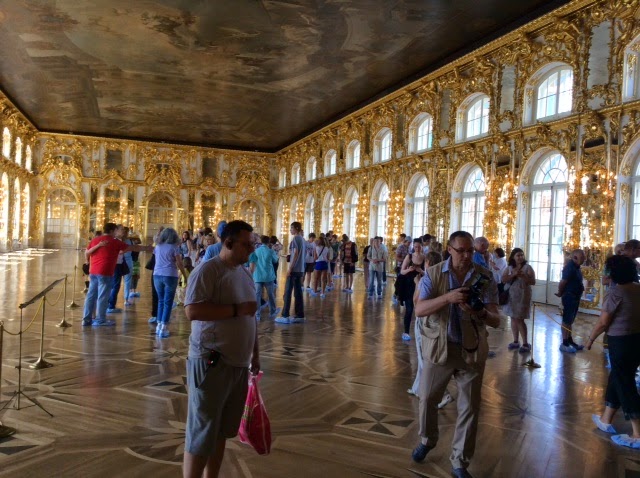
The first highlight was our stop in Pushkin, as the imperial summer palace complex of Elizabeth and Catherine is called, also known as Tzaroe Selo, perhaps 25 miles south of the city. This Summer Palace was successfully designed to resemble Versailles, outside Paris. The Russians of the 18th century sure did have a love affair with  France and all things French -- including its language and Napoleon  --until he invaded Russia. When we think of these magnificent art filled museums we have to remember that they represent the Russian serfs' "taxpayer dollars at work".
They make you wear these booties to protect the floors


Lunch in a restaurant owned by a friend of Putin consisting of hot borsht, potato pancakes, hot pockets of dough baked with cabbage, mushroom or meat in them and the best tasting cranberry juice I have had.


We visited Peter the Great's summer palace as well, Peterhof, about 25 miles west of town, on the Gulf of Finland branch of the Baltic. You can see the Gulf at the far end of this grand fountain filled canal.


Same fountains, from below.


I had not known of Peter's training, prowess and love of naval architecture and warfare. Note the interesting cross atop the steeple here, sitting on an anchor.

But his palace is best known for its many magnificent fountains, fed by gravity from lakes high above and flowing out into the Gulf.

We did miss the museum of ship models here, due to threatening torrential rains which hit soon after we began to drive home.

After the rain we got out with Natalia and took the St. Petersburg Metro for a few stops before being picked up again by Dennis for the rest of the ride home. Mike loves to ride foreign subways and this one is designed elegantly and unusually deep beneath the city.


The island fortress of Peter and Paul from the river.


The two Rostrum Towers featuring the hulls of ships sticking out of their sides.


The magnificent Church of the Savior of Spilt Blood, built in the late nineteenth century on the site of the assassination of Tzar Alexander II, who freed the serfs and was assassinated for it.

Shrine at the specific assassination site

 Interestingly, part of the reason for his sale of Alaska to the US ("Seward's Folly") was to raise some of the funds by which he compensated the landowners for the loss of their property. No civil war resulted and the only blood shed was the Tzar's.

Sunset here is at 11:30 and sunrise at 4:30; we have been sleeping through both. Again we have been impressed by the heavy volume of shipping in the Baltic.

Saturday, June 21, 2014

Tallinn (Estonia) -- Maritime Museum


We were let off the boat here in Estonia's capital from 10:00 am to 4:00 pm and took a shuttle bus from the cruise ship dock to the edge of the medieval walled city up on the hill. Lene rode back (round trip bus fare $10.00) but because the Maritime Museum was half way back, I walked.

We were without the company of our companions, Mike and Linda. Her broken wrist was causing increasing pain so they went to a Tallinn doctor who replaced her hard cast with a soft one at a ridiculously low price, by US standards.

In town Lene and I took a free two hour walking tour led by students or recent graduates of the local University who majored in "Cultural Theory".
She spoke with flawless English, quite engagingly, with humor about Estonia's tangled history of centuries of occupations by Scandinavian nations, Tzarist and most recently communist Russia and with a briefer time under Hitler. Its current period of freedom, since the early 1990's, is the longest in its history, and while it has a sizable Russian speaking minority, this history makes it highly unlikely that they will seek "protection" from Vlad Putin.

The huge freighter load of logs we saw come in at Warnemunde likely was loaded in Tallinn, lumber being Estonia's chief export. While Lutherans form the largest organized religion, they are a minority in a nation which is overwhelmingly secular or as our guide called them Athiests. As a result, many of the large churches whose spires dot the skyline, are now museums. LOTS of towers:
Small one with Lene


This one is called Look Into the Kitchen


Estonia's independence was won in "The Singing Revolution". The nation has huge mass organized singing festivals, but under Russia only government approved songs were allowed. But in the year in question, at the end of the officially approved program the crowd broke out in uncontrollable spontaneous leaderless disapproved anthems of freedom. The Russian army chose not to mow down the crowd and victory was won. There is a bas-relief sculpture honoring Boris Yeltzin. 

Here is Freeedom Square and next the top of a huge glass cross dedicated to freedom.


Trip Advisor gave our daily tour exceptionally high praise and it covered the same sights that Celebrity sold for $45 per person. We happily gave our guide 10, about $13.50, as a tip. So with $20 as bus fare, it cost us a total of $33.50 instead of the $90 that Celebrity was charging.

I bought a small bottle of Vana Tallinn, the local 90 proof Estonian Liqueur, but our guide warned us that the local specialty, amber, is all imported.

This cathedral was built in the late nineteenth Century.


From the top of the walled city looking to the new modern city and then from the base of the old city looking up to the top.
 

I am a sucker for Maritime Museums, and I have to admit that Tallinn's was not the best I have visited. Built with a modern concrete structure inside the shell of a medieval tower, it sought to cover fishing and caning, military, freight, cruise ships and sailboats from prehistoric times to the present and while part was in Estonian and English, the history of the Estonian-Russian naval war of 1918-20 was in Estonian and Russian, which left me ignorant of this obscure chapter in world history. Here is our ship from the rooftop of the museum, where they have a nice cafe.


After the steam room we took in our first show. It told a new story of a couple overcoming obstacles to their marriage, consisting almost exclusively in 1980s pop songs and set in Wonderland and Oz. Whimsical fun with high production value. Then another great dinner aboard.

Friday, June 20, 2014

A Bigger Boat


ILENE is sitting on her mooring while we are cruising from Amsterdam to St. Petersburg and back on the Celebrity Constellation along with our brother and sister in law, Mike and Linda, and 2030 other folks, the boat being filled to capacity -- plus near 1000 crew. She is 965 feet long; her beam is 105 and her draft is 26. And she outweighs ILENE  9100 to 1.
Our cabin, though on starboard, was third deck, the second row of  large round portholes (just below the life rafts, about three forward of the very large ones portholes under the enclosed exterior black elevators.
Roger, Mike, Lene and Linda with cast on her arm 
This is our sixth cruise -- almost all with my brother and or Lene's, and their wives. The pleasure of behemoth cruising pales compared with cruising ILENE. The big advantage of the big boats is they go to places that we will never otherwise get to and the hotel is moved at night while you sleep with no watches to stand or navigation issues to resolve and there is no packing, unpacking and getting to and from airports or railroad stations. Food is prepared and served, the room is professionally cleaned by our smiling steward who remembers my name and there are countless and varied shipboard entertainments.

We have missed about half of the evening night club-like shows. This is partly because we are day people to which night clubs are less of an attraction and partly due to our proximity to the land of the midnight sun. One night we got to the theater after dinner and saw that the show was wrapping up. "We'll stay for the second show," said I. "This is the second show" was the response. But while it was almost 11 PM,  it was still light outside, creating the illusion of 7:30. The traditional "sailor's midnight", i.e., sundown, gets thrown out the window here.

The food, while good, has never again achieved the dazzling excellence that we recall from our first such cruise of the Eastern Caribbean on a Princess ship about fifteen years ago. The excellence of that first time experience may be a creation in my mind, and back then I ate like a pig while now I am conscious of a desire to limit the number of pounds that this vacation will add to my personal tonnage. (Actually, my first weighing after returning home showed a gain of seven pounds.) Mercifully, the "midnight buffet" is a thing of the past, a victim of both cost cutting and peoples' increasing consciousness of the perils of extreme obesity. But the buffet is open about twenty hours per day.

This boat was built twelve years ago but was recently refurbished and looks pristine. Newer ones have larger gyms to accommodate a greater percentage of health conscious cruisers. We took in a stretch class almost every morning and  worked out in the gym and visited to the sauna or steam room almost every day.

Too many of the "entertainments" are infomercials for the products and services that the ship is forever trying to sell. I have a personal prejudice against being "sold". When I want something, I'll ask for the help of the salesperson's suggestion. But unsolicited sales help makes me less likely to buy the advertised product or service. On the boat they have art lectures to try to sell you art, gaming lessons to try to increase their casino business, tours of the galley to try to get you to dine, for additional fees, in the several specialty dining rooms which used to be free, and lectures on wines and liquors to induce sales of drinking cards. We are very poor customers in the eleven different bars because the two women do not drink at all and Mike and I have only a very occasional beer or glass of wine. And we have not patronized the mall of shops. And the ship's land excursions are very heavily promoted too, and not a good value. I learned from my brother, Allen, years ago, that especially when you have a group (we are four) you can do better with your own locally sourced tour guide or taxi driver than with the expensive tours that the boat pushes. This lesson was driven home in Amsterdam's airport, where we met a Celebrity greeter who told us that their special private direct shuttle to the boat cost only $38.00 per person.  But Mike told us the better way. The local railroad station runs under the airport and for $4.00 you get a ticket to Amsterdam's central station with only a beautiful fifteen minute waterfront walk to the boat.
My three companions love to play cards and are quite good at this; they like to play with me because I am a good loser. Linda's arm was in a sling this whole trip and I became her "card holder".

The best thing about cruising the sailing vessel ILENE is that we can make our own schedule. If we like a place we can stay a while. If storms threaten, we stay put. Before I was retired I did not have the benefit of almost unlimited time. Neither does Constellation. She is on an extremely rigid fixed schedule with one "day" in each port except two in St. Petersburg and this cruise has four "at sea" days among the twelve.  Many people do not like these "at sea" days but as long as I have my book and good companions, they are fine by me. And we will end up having visited seven nations, six of which are new for me.

The exception is Germany, birthplace of my father, in which, during a Danube River cruise a few years ago, we visited Regensburg and Nuremburg, in the southeast. This voyage included a lengthy fifteen hour visit to the seaside resort town of Warnemunde, near the ancient Hanseatic League port of Rostock, in the northeast.  That day our dockside visit extended to midnight to accommodate more than half of the passengers who took a seven hour round trip bus ride costing about $200 per person in order to spend a few hours in Berlin. We took a ferry from our dock in Warnemunde  to the heart of Rostock for $10, and after several hours of wandering among the churches, 
Huge organ above clock
Clock with 135 year calendar
gates to the ancient city,
it's galleries, university etc.
A $3 train ride brought us back to Warnemunde. I was quite conscious that this was my first ride on a train in Germany, but this was not in a cattle car. Germany is indelibly stained in my mind by its Third Reich, and I cannot help but look for references to this abhorrent period. But I found none here in Rostock other than the account for what had been rebuilt after the bombing of 1942.


They reverse our "red, right returning" rule in the placement of the buoys in the Baltic.

This is the former communist East Germany but the spirit of capitalism is thriving with innumerable food, lodging, clothing, novelty, souvenir and every other type of store. The volume of the shipping traffic past our boat including both freight and passenger boats plus many sailboats from marinas in this port was very heavy. This and the next picture are from the top of the old lighthouse


Warnemunde is a beachfront resort.

I just liked the looks of this Dutch style gaff-rigged low-aspect ratio sloop with her brown leeboards up (instead of a keel). 


Sunday, June 1, 2014

Bennett's Beneteau

I had the pleasure of sailing with Bennett, Ed and Ian on Bennett's new Beneteau, 37 feet long built in 2011 and quite beautiful and fast.
Ed and I left our cars at the Harlem and got into the rented car at 7:30 A.M on May 30 for the ride up to North Wickford,  RI.  The boat was almost ready to go. But I noticed that one section of the stainless steel tubing that holds up the bimini had come loose from the socket which holds it in place and was dangling, though fortunately the two allen head set screws which clamp it into the socket were not missing. So during Bennett's drive to drop off the car, he picked up a tool kit and the broker went and got his allen wrenches and this was fixed. This repair was at the bottom of the diagonal from the upper right down to the left, to the built in starboard davit.
We also got a bottle of Spray Nine cleaner and took up a lot of the pollen that coated the boat -- another disadvantage of being on the land.
I was all in favor of not dropping below five knots to make sure that I got home reasonably early so as to not miss the flight that Lene and I are taking to Amsterdam today, the day after our arrival. But it was tough at first using the motor only. Somehow we seemed to have good tide at first and good wind later, after we got south of  Point Judith and headed west to home. 
We departed at 1:20 pm and arrived at City Island at 10:20 am the next day, May 31 -- 21 hours for the 130 nautical mile passage, almost six knots. Two rainstorms before dinner, the first light and the second heavy, showed that the new boat is toasty dry inside. I am calling her "the new boat" because her current name is "Ohana" (I wonder what that was all about) and Bennett has not yet selected her new name.
Dinner was fine despite confusion as to provisioning. We had trouble finding the switch that controls the solenoid that lets propane flow from its tank to the burner. We also found that the yard had not done a good job of flushing all of the propelene glycol (pink antifreeze) from the fresh water tanks. The water had a funky taste and smell, so we used bottled water to boil the pasta. And we had only one pot so after draining the pasta (no strainer or pot holders so I used the lid to keep the pasta in and clothing to hold the pot) I poured the jar of vodka sauce (which had been placed in the refrigerator) into the pot and with low heat and stirring it all got warm. The only utensil was a spatula but with it and fork we got the pasta onto plates.  No salt, pepper or grated cheese but it was warm and filled our bellies. We also had confusion about the accompanying salad. We had four prepared packaged bowls of Ceasar salad that I had not known about. And redundantly, we had lettuce, tomato and cucumber, but no dressing for the salad I had planned to make. So I added some of those fresh vegetables to the prepared salad, used its dressing and again, the crew was happy.
 Ian and I were off duty from eight pm until one am. So we missed the passage through The Race, which I was told was made at 7.5 knots speed over ground, near the slack. 
We have tentatively decided that the boat does not have a speedo to measure speed through the water, and no instrument to display such, or at least we have not founds such yet. The relevant speed, except for racers, is SOG, with water speed useful only to know how much positive or negative effect the current is causing. SOG and depth ( and we do not yet know whether depth is calibrated as actual number of feet of water, like on ILENE, or number of feet below the keel, which some prefer) are shown in data boxes on the Raymarine radar/chartplotter display. It is a larger and newer model than ILENE's. 
Bennett has to learn how to use this tool better, which will come with reading the manual and playing with it. We were shown a control for changing the brightness, which must be turned way down at night, but we forgot how to do it and could not figure out how to do it once it got light in the morning whereupon we could not see the screen. But we also had two Ipads with iNavX, so our position, course to waypoint and speed were always known. Our use of the Raymarine unit as a chart plotter had to end earlier when we ran off of the edge of the chart. The prior owner had the electronic chip containing the charts for New England. This extended only to the waters of extreme eastern Long Island Sound and we sailed off the edge it its "known world".
We had experimented with the sails, including the in-mast roller-furled main, with vertical battens, but the wind was either too light and or too much in front of us from the west to be used consistently and so we had motored the whole way until about 3 am when the wind came up on our starboard side in the teens, and we sailed home on a beamy close reach and made up to seven knots.  The boat is beamy and carries her beam well aft making her stiff (stable against excessive heeling) and roomy. Both sails are drawing well but both could use an inch or two of luff tension next light wind day. Their halyards can both be led aft to the cockpit.
She has an interesting and clever hatch board. It has a built in lock at the bottom, is hinged at the top from which it lifts up and aft and then slides in horizontally, forward, under the coach roof. So there is no need to find places to stow the hatch boards and lock. Her built in cockpit table has wide side extensions and a socket in which to plug a detachable electric lamp for evening enjoyment on the mooring.
The propane tank is rather smaller but there is room in the locker for a second one. The locker is a rather flimsy thing with a strap to hold down its lid, located on the deck in the port aft quarter. (To reach it, you lift up the helmsperson's seat to starboard and then the port quarter of the cockpit bench tilts lifts up and outboard to port revealing a space for a life raft and the propane locker.) The less rugged construction of the propane locker is not unsafe because in the unlikely event that propane leaks, it will leak out into the cockpit sole and thence flow out over the stern, which is quite open save for two lifelines, and not up across the raised threshold at the companionway into the cabin. There is very little backrest for persons seated on the sides at the aft end of the cockpit and at the helmsperson's seat. So at least one of those blue folding seats with back rests will make for more comfortable seating. She has many fewer lines than On Eagles Wings, but most of them are not whipped, so there is still something I can do to be useful during future sails.
Bennett, Ed and Ian on the Harlem launch
All told it was a very easy and pleasant passage and upon returning to the Harlem I drove Bennett and Ian to Bennett's home in NJ.