"There is nothing more pleasant than cruising on a boat with the whole family."
Letter from Empress Catherine the Great

Friday, May 5, 2017

January 22 to May 5 -- Twenty Nine More Work Days

I've written several posts since January 21, but they were all about "Other" days with boat related: art, friends, travel, and club activities -- but not about work on the boat. Yet such work has been going on and knowing how much some of you guys like this stuff (OK, not many of you) this post, on a rainy Friday after ILENE was supposed to have been launched yesterday (but the launch crew ran out of daylight) will catch you up.
Yes, 29 more work days,  have occurred with more than 120 hours, averaging four hours and nine minutes per day. These included five more work at  home days, refinishing the cabin sole, which was the biggest project of the winter. These 29 days, together with the 23 earlier ones between haul out on October 14 and January 22, makes for a total of 52 work days this winter season, with a few more to go to clean the interior, continue to compound and wax topsides, launch, mount head sails and bring ILENE from New Rochelle to the Harlem.
What was accomplished during these 29 days? I mean other than the regular attention to:
+the bilge, 
+snow on the cover, 
+scrubbing the bottom in parts with maroon Scotchbrite and applying paint left over from last year to the waterline, bow, keel and rudder (the spots where it washes off more quickly), 
+sanding and four coats of Velox paint to the prop, 
+replacing all of the zincs, 
+uncovering and transporting the winter cover from New Rochelle to City Island (half of it to Doyle Sails for replacement of a broken zipper),  
+bringing the sails in the opposite direction, and 
+compounding and waxing everything above the water line.
The newly repaired cabin sole boards, except for two large ones that are reserved for next winter's work, are completed and reinstalled. You see the old finish, top, and the new.
They shine, but teak is a strange wood and some of the teak bungs, as you can see,  do not match the color of the rest of the sole making for an interesting abstract pattern.
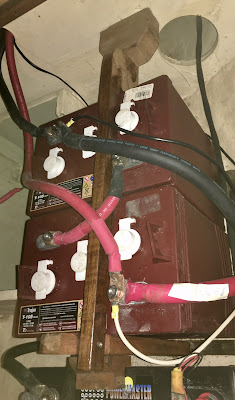
Don came through with new wooden sticks to hold the batteries in place that match and replace the old ones. Repeated little drips of battery acid had so rotted them after 18 years of use, that they were no longer strong enough to do their job.
The darkly stained pieces show the effect of the acid.
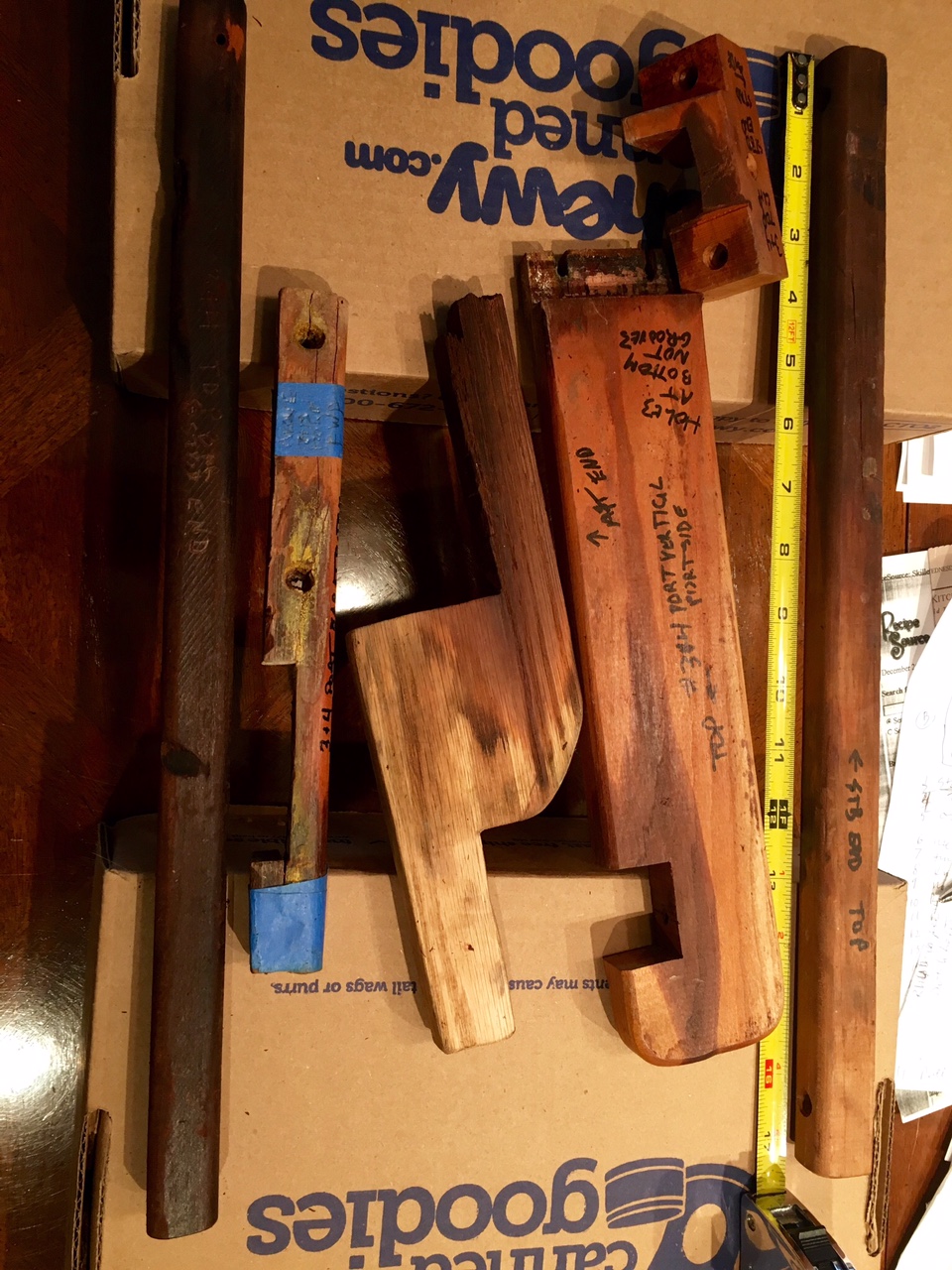


I coated the new wood rods over the batteries and their "holder" pieces with resin so they should last longer than the next 18 years. Thanks, Don.


I spent a lot of time and money on lines this winter, the strings that run everywhere on sailboats. I had fead the bright idea to put the four halyards, one for each of the four sails (main, jib, genoa and spinnaker), through the washing machine and a fabric softener rinse after 18 years aloft. And I ran messenger lines to be able to pull the halyards back up to the top of the mast and back down through the interior of  the mast in the spring. But the line I used for the messengers was to thin and two of them broke. I bought a stronger 125 foot line, used the remaining cheapo messengers to get the sturdy messenger in place and then the sturdy messenger to get the headsail halyards into place. The two that broke required me to engage Jeff Lazar, the terrific local rigger. He has a climbing apparatus that connects to any stout halyard by which he climbs to the top without the need for me to haul him up in a bosn's chair. But how to get lines from the top of the mast to the narrow slots near its base where the halyards exit? Jeff uses a clevis pin attached to a length of thin but strong chain. Gravity pulls the pin to the point inside the mast where I was able to use Jeff's grabbing tool to extract it from the slot. After that he attaches the end of the halyard he had brought aloft to the end of his messenger permitting me to pull the halyard down through the mast. 

But I needed two additional expensive visits from Jeff to get ready to sail. While aloft to insert the halyards, he noticed that a bearing at the top end of the foil of the Genoa roller furler was missing so he ordered the part and returned a few days later and installed it. 

Jeff's third visit to ILENE was to re-rivet a "D" ring to the starboard side of the mast (above the second spreader) to which a small block is attached, The Lazy Jacks of the stack pack are tied to a line through that block so the stack pack can be adjusted to the correct height. I had apparently broken the D ring off while raising the main. I prepared for Jeff's visit by removing the half rivets contained in the D ring's attachment holes with hack saw, Dremel tool and hammer, and cleaned off the rust. Jeff drilled out the other parts of the rivets, remaining in the mast, and used his rivet gun to reattach the D ring.

I actually managed to fix another screw up myself: In the fall, I had put a big knot in the aft end of the first reefing line. The purpose was so its end would not pull forward into the interior of the boom when I snugged it up. But unfortunately I put this knot at the lower rather than the upper half of the opening at the aft end of the boom, thus achieving the worst of all possible outcomes: the knot was at the forward end of the boom, too big to be pulled out at that end, and it was fourteen feet from the aft end of the boom!  My first plan was to use my 25 foot electricians tape, to snake it out, by fastening a pick to the steel tape's end with tape, and feeding it forward till it grabbed the knot. No luck, the first pick is still in the boom. I tried again, this time lashing the pick to the snake so it could not pull off, but it did not grab. Plan B did work. I taped and tied the end of the snake to the portion of the errant reefing line just forward of the knot and used the tape to push the knot aft through the boom. I got to 18 " of the aft end, when this method failed to make further forward progress. With another pick, attached to a stick, I was able to reach in, grab the knot and pull the line out the last 18 inches. As to the pick that is still in the boom, I tested the second one and learned that they are magnetic, while the boom is aluminum. So I attached a pretty strong magnet to the end of the snake and approaching from the aft end, tried to grab the pick with the magnet. No luck yet. It's being magnetic means that it is not stainless steel and will likely rust. Any ideas for me on how to get it out?

 My final string play this winter involved a sturdier set of blocks and line to hoist the aft end of the dinghy (the heavy end that has the outboard and fuel tank) up from the sea to the port end of the davit bar. This had been very heavy and required me to use the power winch at the coach roof to get it up. The reason was that the equipment was too flimsy for the load, with 1/4" diameter line over sheaves with 7/8" diameter. In fact the center sheave of the block had been scraped away by the line under pressure, exacerbating the problem. One aspect of the solution is the use of new 5/8" diameter line over much larger blocks. But the other part of the problem was that the old rig had three sheaves at the top and only two at the bottom. The newer equipment that I ordered and have now installed adds an extra sheave to the system which should halve the force required to lift the dinghy. 1) the Good small tackle, to starboard; 2) the worn away center sheave of the bad block that was to port; 3) the new heftier rig.

Finally I ordered a sheet of faux teak for the swim platform. They sent me a sheet of clear plastic on which to create the template. But to make the template the swim ladder had to be removed. The four nuts securing the bolts that hold the swim ladder in place are at the very far aft end of the boat, under the cockpit sole requiring a crawl through a very small place to place a wrench on the nuts. Three nuts came off easily enough, but after wrenching the last one for a while, I realized that when I turned the nut, the bolt turned with it. What to do? Get a second person to hold a Phillips screwdriver on the outside, on the top of the bolt while I turn the wrench  from inside to loosen the nut.  But there was no second person so I grabbed the head of the bolt with a vise grip wrench and lashed a stick of wood to the closed wrench which was long enough to wedge into the forward corner of the swim platform to stop rotation. It worked! All is put back together again except the nuts, which will be installed when Lene comes to help me clean the interior tomorrow. First picture is with the ladder removed.
The platform looks better than before, I think.

Tuesday, April 25, 2017

April 15 to 22 -- Three "Other" Days: Days Off From Boat Work

Don't worry friends. I have been working on ILENE and she will be ready to launch soon. When she does I will report on the winter season's work. But this post is about non-boat-work days. 

A three day weekend in the Berkshires with good food and conversation, a string quartet concert and rest -- but no boat work except a visit to the local hardware store for stainless bolts and brass screws (which I count as inadequate to call it a working day) -- came first.

Monday was the memorial service for Estelle, a lady of my Congregation, who served as head of the nursery school and on the board as social action chair in addition to being a physicist, an IT worker, a liberal humanist, a Yiddishist, a conservationist , an all around good person and -- wait for it --  a passenger on my boat. She was 89 and will be missed.

Friday was an all-day (10:30 - 6:00) conference at the CUNY Graduate Center titled:
 
I wondered what that could have been about. In fact ten curators and professors of American Art History gave papers, illustrated with slides, on aspects of American Landscape (and Seascape) Art. In fact it was great fun and quite interesting. Eight of the ten talks involved the watery side of things. Two of the talks were about Winslow Homer's "The Gulf Stream", which we viewed during
the Harlem's winter excursion to the Met in February. One of these talks contrasted Homer's  painting with one that was given the same name by a modern Black artist, Marshall, showing a group of black people out for a fun sail in the tropics instead of one on an out of control boat in extreme peril. Both show the boat's port quarter aspect, heeled to port, but in Homer's this is caused by the tumultuous waves of the Stream, and in Marshall's by the graceful effects of the breeze.
Another talk dealt with nautical charts and another with the riverine area of St. Augustine, which we have come to love after ILENE's three stops there during our southern cruises. Only about fifty people, good refreshments, and I was able to contribute to these Ph.D's educations by filling them in on aspects of sailing, of which they were unaware.


Saturday, after setting up for brunch for eight folks from Lene's HS class, I went to the Harlem for a meeting to discuss plans for the summer cruise. Both a nine day and a five day option had been prepared, which would required either a full five consecutive days off from work, or only three. I expected a debate about the relative merits of these two alternatives, and had called about twenty of our newer members with boats 25 feet or longer, for whom these shorter duration cruises, with shorter passages, had been designed. I like planning cruises, even ones that I'm not available to attend.

But the meeting was quite frustrating. Three families of experienced cruisers, PCs of the Club, attended, along with a new member, Mike, who has a 33 foot Scandinavian boat. They designed a cruise of about two weeks duration with five lay days in Block Island; that's what they wanted to do. Others may join them. Mike plans to detach from the others and return to the Harlem via Montauk Point and the south shore of Long Island.
None of the five day protagonists attended. I will flesh out details for the five day itinerary and serve as the contact point for connecting those folks, if any, who wish to attend. Hopefully someone will agree to provide a bit of leadership or coordination during the five days, if anyone at all takes part in this second of two Club cruises.
Back to work; my mistress, ILENE, beckons.

Wednesday, March 22, 2017

March 18-19 -- An Organizational Weekend

Readers know that I belong to both the Harlem YC and the Corinthians YC. Saturday, the 18th was Harlem day for me, with three back-to-back events.

1. The first Annual Club Cruise Planning Meeting -- I'm the Fleet Captain (Job description: organizer of  Club cruises). I have this job literally only because no one else wants it and only until someone does. For 2017, Lene and I can't even go on the Club Cruise because we will be cruising ILENE up in Canada, but I'm pleased to try to keep the spirit of cruising alive in the Harlem. Cruising with the Club has been in decline the last few years. Maybe it's because of me, but I don't think so. I think that fuel prices have deterred the power boaters, that membership has been in decline due to the economy, that many of the twelve to fifteen boats that used to cruise together in the late 80's have been sold due to retirement, illness or death, and that the remainder of us just don't have the strength and stamina that we used to have.
A lot of good ideas came out during the meeting. Let's not even try to have a sixteen day cruise, our historical norm, or even a nine day one. Let's instead plan a five day cruise, including a non-holiday weekend, with relatively short and easy mileage each day, at least one lay day, and at least one each of a dock, a mooring and an anchorage. I will call all of the newer members with boats large enough to cruise, let's say 25 feet, and personally invite them to participate and try to answer their fears. This could give them the confidence to try, with the hope that they will enjoy the experience. First step: P.C, Bruce will create the first draft of the five day itinerary. I am more optimistic than I was before the meeting.

2. Immediately following was the membership meeting with reports from all the officers on the good work they are doing, not just keeping our old house upright but improving it, and without a dues increase. We owe so much to the tireless expert efforts of our Board Members and Officers.

3. Next a segue to our St. Paddy's Day Irish dinner party. Lots of excellent food, family style at each table and a guest appearance by this elegant guy.

Sunday, the 19th was Corinthians' Day. This is a Club without a clubhouse. We all keep our boats elsewhere and the club runs social programs.

1. A delicious end extensive lox-and-bagels-and-a-lot-more brunch in the elegant apartment of Past Master Bob Ebin in The Beresford on Central Park West at 81st Street. In addition to the food the apartment was full of art and many sailors who always love to talk with each other.

2. Bob's daughter, Lauren, is a professional art historian on the staff of the Metropolitan Museum of Art. That museum took over the old Whitney, on Madison Avenue at 76th St. when the Whitney moved downtown to a newer bigger structure neat the Highline. We walked through Central Park for a tour of the exhibit of Marsden Hartley's Maine work. Though Hartley was not a great painter, in my humble opinion, his work had special interest to those of us who have cruised Maine waters. I realized how much better Lauren was at leading this event as compared to my feeble efforts last moth. Here is Hartley's tipsy view of Portland Light;
This is the Kennebec River:


Camden Hills (from the East side of Pennobscot Bay)


Finally this is by one of Hartley's mentors, Ryder. We saw his "Under a Cloud" at the Fifth Avenue Met last month. See two posts back.


No, all is not fun and games: work continues on restoring ILENE for the 2017 season. But that is relatively boring so I will save it up for a while.

Thursday, March 16, 2017

South American Trip February 25 -- March 10 -- Watery Aspects

I had been to Ecuador and Peru in 1966, thanks to Uncle Sam, but this trip with Lene was much better.  All I said was, "Whatever happens will be nice; so relax and enjoy." Lene chose the destination and the tour operator, carried the passports and the money, negotiated better seats and tipped the many people who helped us.  I enjoyed everything especially her company. In the past she tended to isolate with me, but on this trip she was an equal partner in starting and maintaining conversations and friendships with fellow tourists. When we sail I take the planning, worrying and laboring oar, but not on this vacation. Monogram Tours runs a very classy operation. We were met at and dropped off at each airport and hotel, by local people with cell phones back to the office. Almost every time it was the local host and his or her driver. With two people, a car, and airlines that change plans, it was amazing to me that there were no dropped balls. One driver was about twenty minutes late so he called a co-worker for another firm in the industry who found us and chatted with us at Starbucks until he arrived, and apologized. Yet so many flights and hotels make for a less fun experience that aboard the ILENE, where side benefits are that we get to eat a lot more of our own, healthier, home cooked meals, our planning is a lot more flexible, our cats can come along, and we do not have to pack and get to airports about every day and a half. 

Between Quito, Ecuador and the Galapagos our flight stopped in Guayaquil, where the Hammerberg put in back in 1966. It was a very sleepy small and impoverished town back then but now has 3.5 million residents!
The first of our four Galapagos days was lost due to airline delays. The islands, look bleak from the air, set in the sea.
Nearing the airport we flew close to an island that I thought seemed like the island which was the setting for "The Beak of The Finch" and later Google confirmed that indeed it was Daphne Major.  Clearing into Baltra airport from Ecuador should be a snap, like flying from New York to Chicago, but it is not. For one thing there is the systematic collection of the $100 per person entry fee, which in our case had been prepaid with receipt by the tour. They inspected the interior of our hand luggage and had a dog sniff all the checked luggage, apparently sniffing for drugs. They are very concerned with the importation of alien species, intentional or not.
Once on the airport's island we had a five minute bus ride, a five minute boat ride to Anta Cruz, the central island, a 45 minute bus ride across the center of that island to Puerto Ayoro, its town, on its southern side, a five minute boat ride to the hotel's side of the port and an eight minute walk to the the Finch Bay Eco Hotel with its pool between the building and the small beach. There is a bunch of sea bums who climb our of the water and like to use up the shaded benches on the docks. Witty and Alfie, you now have competition for Lene's heart.
It is warm here; we're about 40 miles south of the equator. We were each being given a free glass of wine at the bar with the excellent four course dinner. This is an excellent hotel, though the alternative accommodations, on a boat, would have been even better.

Next day was a land day, exploring the highlands, the crater pits and the land tortoises.

Then a jaunt in to town for a postcard and stamps and a lipstick for Lene who left her collection of them in Quito. On the way I saw a flag of the ARC, a rally for cruising sailers. ILENE's romp on the Caribbean 1500, from Hampton VA to Tortola BVIs in 2010 was an ARC event. In the launch, they call them pangas, from town to our hotel, I saw a group of folks who had the fit lean look of cruising sailors. Yes, they are on the ARC and set to depart next day for the Marquesas, about 3000 miles west of here. That made my day.
Next morning, an earlier breakfast than usual to join a group of 15 on the hotel's 60 foot yacht, m/v Sea Lion, bound for Santa Fe Island, about 18 miles to the ESE. Not much wind.
We came to a cove and one crew got into and detached the big dink and affixed the mooring line from the boat's bow to the cleat on the mooring. The matting at the bow of the dink and pangas
is because embarkation and debarkation is over the bow to the dock or seawall. Our first excursion was by dink to the beach (only our feet got wet) to look at the colony of about 40 sea lions, lounging and playing on and off the beach.
We learned to distinguish between the genders by the shapes of their foreheads. There were a couple of babies only two weeks old, maybe 18 inches long.
They have no fear of humans but our guide told us to stay maybe four feet away and not use flash, though it was full sunlight. We learned about their feeding and mating habits and their enemies -- sharks, which sometimes catch them when they go out to catch fish. Mamas turn this fish to milk and nurse their young -- they are sea mammals.
Then a walk on a rocky path, after we put on our shoes, to a hill covered with many cactus trees. These flower all year long and each male of the species of land iguana who live only on Santa Fe, yellow orange in color, sits in the shade of the trunk of his own cactus tree and eats the fruit bulbs when they fall off. All female iguanas are welcome.
Back to the boat for a good full lunch on China with cloth tablecloths and napkins. Then back to the dinghy with snorkel gear. They provided "Snorklepro" brand gear which fit me better than any other I have tried. The fish were plentiful and varied in their multicolored show. I especially liked the yellow orange mullet which swam at surface level, above my eye level and are said to be tasty, and the King Angelfish, black except for a white vertical stripe down the middle of its side, a long white protrusion underneath, a thin violet thin stripe of piping along its top edge and a shockingly brilliant small yellow tail.  After this it was time to cavort with nature's cavorters: the sea lions, who were swimming very near shore. Our naturalist guide, Soto, advised us to swim in close to the rocks and then move away, drawing the seals out to play with us. Through our masks, under the water surface, we saw a fabulous display of their dexterity.  Next it was off to try to find sea turtles, also in this same unnamed bay, but we had done this in the Tobago Cays and I was tired so I went back to the boat. I hauled in the mooring line when the man in the dinghy cast it off the mooring.
During the ride home, I asked a lot of questions about the boat and then offered to take the helm. "You want to?"  "Yes!" And so he let me have it.
The boat does not have autopilot not a chart plotter. I just love a driving boats.
The first half of our last full day in the Galapagos paradise we visited the Charles Darwin Nature Center, which is at the far eastern end of Charles Darwin Avenue along the waterfront of Puerto Ayoro. The place was reopened last week after extensive renovations, but was rather underwhelming, with its focus on the raising of the Giant Tortoises. Then, after lunch we went by a much smaller boat to Devine Bay, to the west of Puerto Ayoro, where we  saw some blue footed boobies,
a unique Galapago breed, hiked across the peninsula to the colony of black marine iguanas which swim down using their long powerful tails to propel them, grab onto rocks with their large claws and bite off the algae.
Back to the boat for a round of cooling but unspectacular snorkeling except that Lene followed a sea tortoise around. Lene had no great expectations for the Galapagos but now she wants to return.

An 11.5 hour travel day brought us to Lima Peru. Its airport and seaport are in Callow, where again, I had been with the USS Hammerberg


in 1966. Our hotel was in the fashionable Miraflores section, set on a high bluff above a narrow beach with Pacific rollers coming in from Asia. A lot like Miami Beach with high rises and wealth

 The Sacred Valley, a richly fertile narrow flat area through with the Rio Urubamba, brown with erosion flows, ultimately to the Amazon, surrounded by steep jungle mountains. We stopped at two ancient Inca settlements on terraced hillsides, where we climbed, a lot, to the stone structures.
The first was near Pisac and the last is at Ollantaytambo.
If you are a "if you have seen one church (or in this case Inca place you have seen them all"  type person, this trip is not for you.  Between the two we stopped for shopping in Pisac.
Next morning we were dropped at the railroad station of  Ollantaytambo for the 90 minute ride to the tiny town that is the base camp for Machu Picchu: Aguas Caliente. The train was crowded but with tables and we had tea and a sort of large hot flat pastry filled with raisins and quinoa, analogous to snack and beverage service on an airplane, but served on china with metal cutlery. 
But the scenery was the main attraction. The river narrowed as did the valley. The river was continuous rapids as the valley descended in altitude. The water, appearing like chocolate milk, swirled around boulders, moving, by my estimate at eight knots. And the mountains rose very sharply and steeply close aboard. We descended into a rain forest with its different ecology. The "Inca Trail" to Machu Picchu, joined the tracks and then rose far above us into the mountains. This part of the trail is a four day trek for the fit. Our guides told us that day one is exhilarating "and then, on day two, you die", from the strain. We also learned that the Inca sites we climbed the day before were good for conditioning our legs for Machu Picchu. Our bus passes were scanned and we were off on a half hour bus ride from the village to the main attraction that crossed the river and then climbed about 2000 feet via about 20 switchbacks to the site, arriving at about 10:30. There,  separate site tickets and passports were examined and we were in. And it is a breathtaking site. The town of stone houses, factories, warehouses and temples was built by the Incas between 1450 and the arrival of Pisarro in 1532. It was not finished but was abandoned from then until it was put on the map by Yale's Prof. Hiram Bingham in 1911 (the same year that the NYPL and Grand Central Station opened). So for 380 years it lay dormant. The city or citadel is on a steep hillside plateau in the saddle of a ridge among even higher hills, east and west, with that raging milk chocolate river winding around the site about 2000 feet below. The hillsides are terraced for agriculture with some llama grazing contentedly. Water flowed through it from springs higher in the mountains and it gets lots of sun.
The granite rocks did not have to be carried up to the site because the whole mountain is granite. Speculation about how the Incas split and polished the rocks was discussed. Speculation because while they were obviously well educated no evidence of Incan writing has yet been found. It is not a very flat plateau, with elevations  within varying by perhaps 400 feet. During a delicious buffet lunch at the cafeteria just outside the site my body fought with my mind. The later wanted to continue touring the site -- by then the rain had stopped -- but my body said no way! During o
ur second day in Machu Picchu Lene elected to shop the tiny town and enjoy a message.  I went back up and was at the site, alone, for four hours, of hiking and climbing the steep trails. The first two hours involved a steady but light rain, and the sun did not break through the clouds until the fourth hour. 
The most famous views of the site are essentially looking westward over the stone city with a mountain at its west end in the background. One can climb a trail to the summit of that mountain but the number of people allowed per day is limited and we had not obtained a permit, a month in advance. 
If one does an about face after climbing a bit, one sees the entrances to trails. To the right, around the south side of the bigger Machu Picchu ("old mountain") itself, which towers over the east end of town, is the trail to the Inca Bridge. The path averages about three feet wide, along the face of a near vertical mountainside and gives a view of the part of the river, and the thundering sound of the crashing waters rising 2000 feet. At the end of this trail a strong wooden gate bars further access. A retaining wall was built up against the cliffs with a twenty foot wide section naked except for several old wooden rails. The trail continues past this bridge but only for Incas -- who are extinct. 
The other two trails to your left, lead to the peak of Machu Picchu itself (for me "the trail not taken") or to the Sun Gate. A stony path with stone stairs in parts, along the north side of the mountain to that site, higher than the climbable peak at the other end of town. There are stone structures at the Sun Gate. The path consists of one very long path alongside the mountain, with views back to the ancient stone city, the switch back road that the buses take, and the river, below.
On the train back to Ollantaytambo the pastry given out with the tea was savory, like some sort of pizza. And the crew of three stewards/conductors put on a fashion show and offered to sell us the sweaters and jackets. At the terminal, Emir and his driver for a two hour drive back to Cusco. 

Our trip was toward the end of the low season, the rainy season, which meant that rain and clouds were a problem at Machu Picchu. The positive side is that five times as many people are there in the high season, making it hard to pose for pictures and to traverse the narrow stone staircases.
One thought that passed my legally trained mind was that the experience would not be permitted in the US due to liability fears. Our building codes have standards for the width of steps, the grade, and for hand rails. The only boundaries I saw were to temporary, to keep people away from small areas so the grass could grow.

I very nice winter vacation, thank you, with just enough water to keep me happy.


Tuesday, February 7, 2017

The Boat Show and The Harlem's "Winter Cruise" to the Met Museum of Art

Here is the snappy new professional looking display for our booth at the show. Nice, with lots of literature on the table explaining our programs. But the big advantage of the new display is that it rolls up into a small cylinder that, when empty, serves as a base for a table, and which, when full, we can bring through the front door instead of having to deal with ornery and expensive employees of the Javits Center who we had to use to bring the old display in from the loading dock.

Also a nice larger display screen, lower left. on which lots of photos form a slide show.
The best part of this year's show, for me, was that Lene came along, staffing the booth with me and others on Thursday from 4:30 to 9 pm. Fact is that everything is more fun with Lene, and whenever I drag her out to do things with me, she ends up having a good time too. I had signed up to do a double shift that day -- noon to 9, and it is a sign of the strength of our Club that I wasn't needed that much.
It being a weekday, traffic was light and so I wandered among the other exhibits. Regrettably, except for a sailing kayak by Hobie Cats, this was exclusively a power boat show, so there was nothing of interest among the many boats.  I did contract with PlasTeak, a purveyor of faux teak decking material, for  a piece of their plastic to cover ILENE's swim platform, the only ratty looking part of the boat. They will supply material for me to make a pattern, the piece itself, the glue to affix it and technical advice. Last year I dealt with their competitor, but they never returned my calls or did the job. I think poorly of that competitor. all told, the show was rather boring, but it serves our Club's recruitment efforts. More members spreads our fixed costs among more folks, lowering dues.

Much more fun was our visit to the New York Metropolitan Museum of Art, to see a group of art works related to boats. The maximum number of folk they allow in a tour is 25 and we had that number signed up but late defections reduced our group to 18.
Planning this year's expedition was the most difficult yet, and I hope not to exceed the record. Four prior plans as to where to go had to be scrapped, as did two prior plans for lunch.
A, viewing of maritime Act auction as Bonhams; B, The Russell Jinishian Gallery of Contemporary Marine Art;
C, India House, a lunch club near the Battery which has maritime art; and D, The former Customs House and the Cunard ticket office, which have murals.
As for lunch, we started at the Petrie Cafe in the Museum, and reserved at one outside restaurant before we found our home in another.
We started our tour in Egypt, almost 4000 years ago, with these models of papyrus funeral sailing barges for the Nile, found in a Pharaoh's tomb during the 19th century. This one is being rowed on its way home, against the prevailing wind. The large white vertical appears to be a boom and mast gallows. another model showed the mast and boom set up for a square rigged sail. Some of our better sailors figured our how they steered this barge, which had eluded me.

The Met has a terrific collection of late 19th century oil paintings in a semi storage area of the North American wing, which was focused on New York harbor."The Emporer" was painted for the captain of a Tugboat, extolling the power of his boat. That's me reading its title, printed all the way across the bottom. Incidentally, most of the photos in this posting (all the good ones) are by Chris Wentz of ZSails, who is not a Harlemite but has attended our last two excursions.

"The Cloud", evokes the mood of an impending storm on a dark night, being interpreted by my friend, Greg. He is an artist and professor and really knows about art, though he modestly chides me for telling people this. He agreed to come along to plan our trip and pointed out a lot of the things we otherwise would have missed and enhanced our visit.


We saw old Dutch Masters who painted at the other Haarlem, the one in Holland, painted during the period that New York was New Amsterdam.

France was represented by Courbet. After a lively discussion, we agreed this was after a shipwreck.
And England was represented by by Turner"s "Whalers", painted for a wealthy whaleship owning patron who refused the painting after it was done -- too violent! The black blob, the whale's head has just stove some boats, lower right.
And we went to Papua-New Guinea to check out this fifty foot dugout canoe, built in 1960 by named native craftsmen, used as a riverine cargo barge, and purchased by a Rockefeller for the Museum. It looks primitive but is the newest of the works we viewed.


 And most of us stayed to enjoy lunch together at nearby Via Quadronno.
Next I'm offering a potential follow up visit for those who expressed an interest but were unavailable on Feb. 4. Maybe there will be a response.
If not, there are summer and winter cruises to help plan and if my sprained wrist ever heals there is plenty of work to do on ILENE.

Monday, January 23, 2017

Jan 1 - 21 -- Winter Calm

Eight work days but only 30 hours. I've been slowed, a lot, by a sprained left wrist that I'm supposed to rest. Most of the time was spent on the cabin sole refinish job. Doyle Sails gave me the  "Common Sense" brand hardware for the new attachment of cockpit cushions (and lent me the tool for attaching the grommets) and I removed the old button type fasteners with my dykes. Also, I finished the cleaning out of the aluminum fresh water tanks. Unfortunately, I see that corrosion has caused pitting of the inside surface of the tanks and they will need to be replaced in a few years, hopefully before the pits become holes all the way through.
Add caption
How do you like the new removable orange rubber gaskets, peeking out from under the edge of one of the four viewing (and cleaning) port covers, cut from a sheet of rubber from Canal Rubber?

I've also had three pleasurable "Other" days so far this young year. First a dinner with other Corinthians at a restaurant in Greenwich Village. Lots of good sailing talk with my stuffed artichoke and only a ten minute walk.

Next, a second day at the Met, with Greg, of my book group, who knows a lot about art. We refined our tour of selected boating art, and decided we had to omit several lovely pieces including those of the impressionists. So much great art and so little time! Our tour will cover almost 4000 years of history and every continent except Africa and Australia.

Finally a "Two Act"  evening at the Harlem. First a membership meeting, at which I agreed to serve as our Fleet Captain until a replacement can be found, with a charge to try to organize a meeting to get the summer cruise planned (even though if plans for Nova Scotia reach fruition ILENE will not be able to participate). I was also charged to try to organize a winter cruise with a charter boat in a warm place next winter. Speaking of warm places in the winter, Pandora has reached the BVIs after a rough passage. Google Sail Pandora for Bob's blog.  I reported to the members that 20 of our 25 slots for the "land cruise" to the museum are filled so far.

Act Two was International Night which costs $15.00 (as a fund raiser) with a cash bar. You also bring a dish. As usual, each couple brought enough food in their dish to serve 20 but only two mouths to eat it; gluttony ensued. I made my first carrot cake, with cream cheese icing, and it was good. It is one of my favorita annual events at the club.